Risk Of Tightening Cycle ‘Very Much Alive’ With Kharif MSP Hike, Economists Say
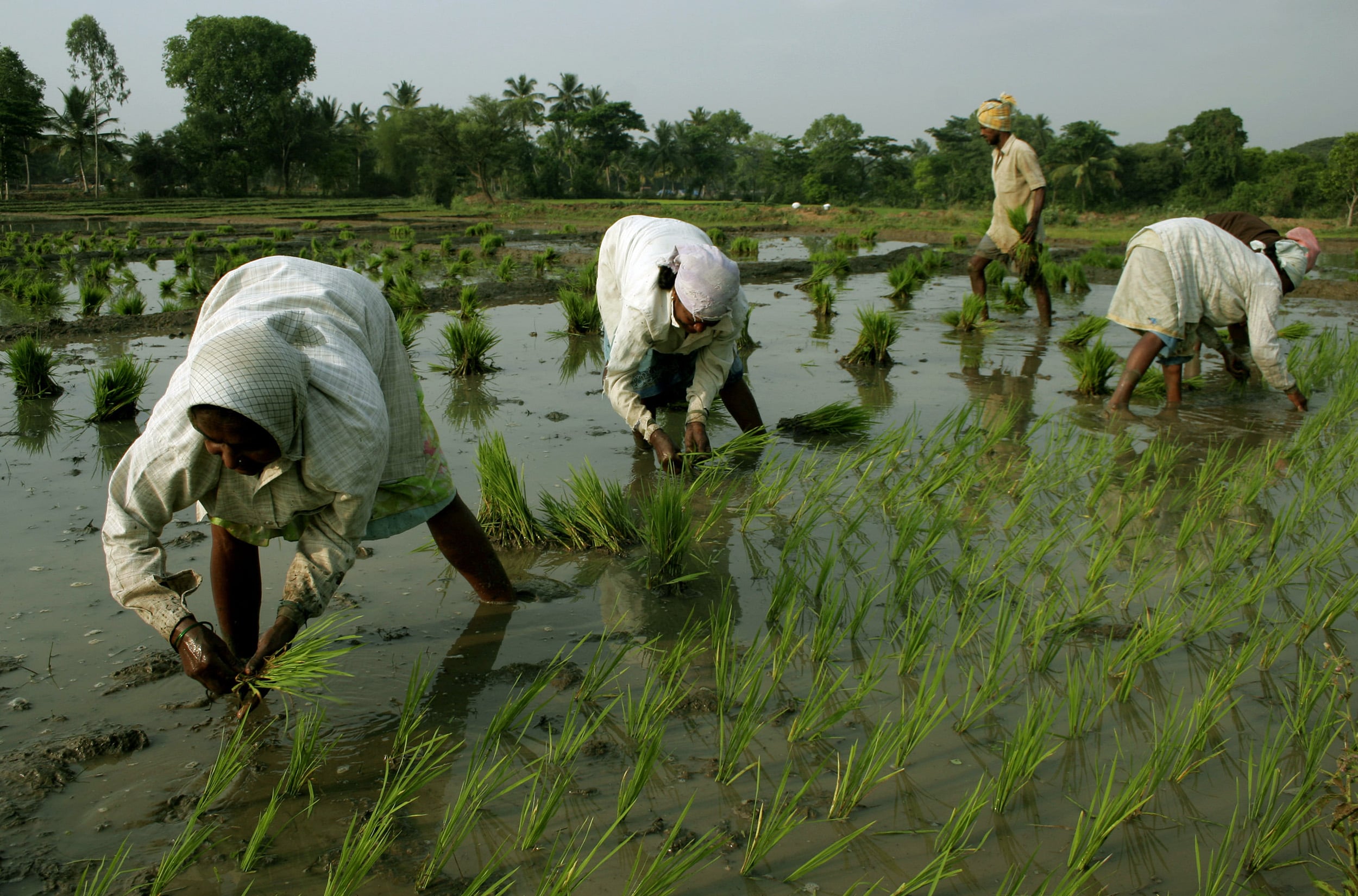
Prime Minister Narendra Modi's administration today increased the minimum support price for Kharif crops, delivering on its campaign promise, as it looked to respond to concerns of distressed farmers.
Economists had warned about the inflationary impact of such a hike but were able to quantify the impact today once the exact prices were announced.
“While the statistical impact on inflation would be 90-95 basis points, realistically, it would be around 40-60 basis points assuming full pass-through on the procured crops,” Suvodeep Rakshit and Upasna Bhardwaj, economists at Kotak Economic Research, said in a note. “The fiscal impact would be minimal, for now, but await details on the modality that will provide clarity on the fiscal cost and extent of rural demand boost.”
Citi economists Samiran Chakraborty and Anurag Jha too expect inflation to rise in a similar range if the complete price hike is passed on to the consumers. “Combining these effects we raise our average FY19 inflation forecast to 4.8 percent from 4.7 percent earlier, though March-end 2019 inflation could be about 5 percent,” they wrote in a research note.
And while India's monetary policy committee raised benchmark rates in its June policy for the first time in more than four years, the hike in MSP increases the risk of a tightening bias, according to UBS Global Research. “The risk of a 100 basis point tightening cycle (including the 25 basis point hike already announced) is now very much alive to ensure financial stability,” it said in a report.
Here are the highlights of what economists made of the MSP hikes:
Kotak Economic Research
- The production weighted increase in MSP is around 17.4 percent over the previous year. That's lower than earlier pre-election years.
- Higher MSP would provide a likely floor to other crops, although much would still depend on the supply.
- Expect RBI to sound caution regarding MSP hikes and see it as a likely boost for rural demand.
- Another rate hike is likely in August.
- Fiscal impact will be limited for now at with an additional cost of about Rs 7,500-8,000 crore.
UBS Global Research
- On an average weighted basis the MSP hike is highest in six years.
- Impact on CPI inflation expected to be between 35-70 basis points.
- Fiscal impact will remain limited to 0.1 percent of the GDP in fiscal 2019.
- There could be an increase in populist spending on schemes which could support farmer incomes in the run up to the elections next year.
Citi Research
- While MSP increases appear very large, they are not uncommon and lower than that of the previous pre-election years.
- Rural demand will be supported.
- Baseline assumption that it will increase additional expenditure by 0.2-0.3 percent of the GDP.
- Expect CPI to breach the 5 percent mark again in September-October.
- If MSP increase translates into a more pervasive increase in food and wage inflation, then there is a possibility of two more rate hikes of 25 basis points starting in August.

-
The Curious Case of Equitas Small Finance Bank And A CEO Who Quit For Stock

PN Vasudevan believes persistent investor concerns over a perceived conflict of interest had become a governance overhang on Equitas Small Finance Bank's stock, even as the lender improved profitability and asset quality.
-
Talking Points This Week: AI Cash Burn, A Tiger Comeback And An India That Still Finds Its Own Path
India is not immune to higher oil or tighter global liquidity, yet its earnings base is broader, its domestic policy levers are still available.
-
Foreign Investors Own Half Of HDFC Bank and ICICI Bank. An LTCG Cut Could Matter Most Here
Foreign portfolio investors have US$115 billion parked in HDFC Bank, ICICI Bank. If the government cuts long-term capital gains tax, Jefferies says returning foreign money could land here first.
-
'Never Seen This Level Of Negativity': Sandeep Tandon Says The Next Rally May Be Closer Than You Think
Veteran investor Sandeep Tandon says foreign selling is easing, large-caps are due a comeback and mid-caps are crowded, while he turns positive on gold, power and pharma this Diwali.
-
Indians Stay With Family, Not In Hotels | The Reason Why
India still lacks enough clean, reliable and affordable hotels for budget-conscious travellers.
-
The Economic Imperative: Analysing The Material Driving Force Behind India-Canada Strategic Reset
This economic complementarity is further reinforced by deep institutional investment ties and talent mobility, which form the bedrock of the bilateral framework.
-
Medicine Pricing: Where Must Profit Stop?
India must confront excessive margins, hidden incentives and regulatory gaps that threaten the integrity of medicine.
-
Why Amazon And Flipkart Are Struggling To Beat Meesho In India's Smaller Cities
With 274 million users and lowest-cost logistics, Meesho is defending its value commerce crown against giants like Amazon and Flipkart.
-
High US Salaries, No Green Card Certainty: The Financial Calculation Facing Indian H-1B Families
The suspension of PERM processing at eight technology employers does not cancel existing H-1B visas. What it does is force a question many Indian families have been avoiding: is the US salary worth tying your career and family plans to one employer?
-
Swiggy vs Eternal: Food Delivery's Two Rivals Are No Longer In The Same Race
Eternal is building a private AI assistant, dark.ai. Swiggy is still working out how to make Instamart pay, with an operating loss of Rs 895 crore in the July-September quarter while Blinkit stayed profitable.










