Courts Alone Won’t Be Able To Knock Out Imran Khan
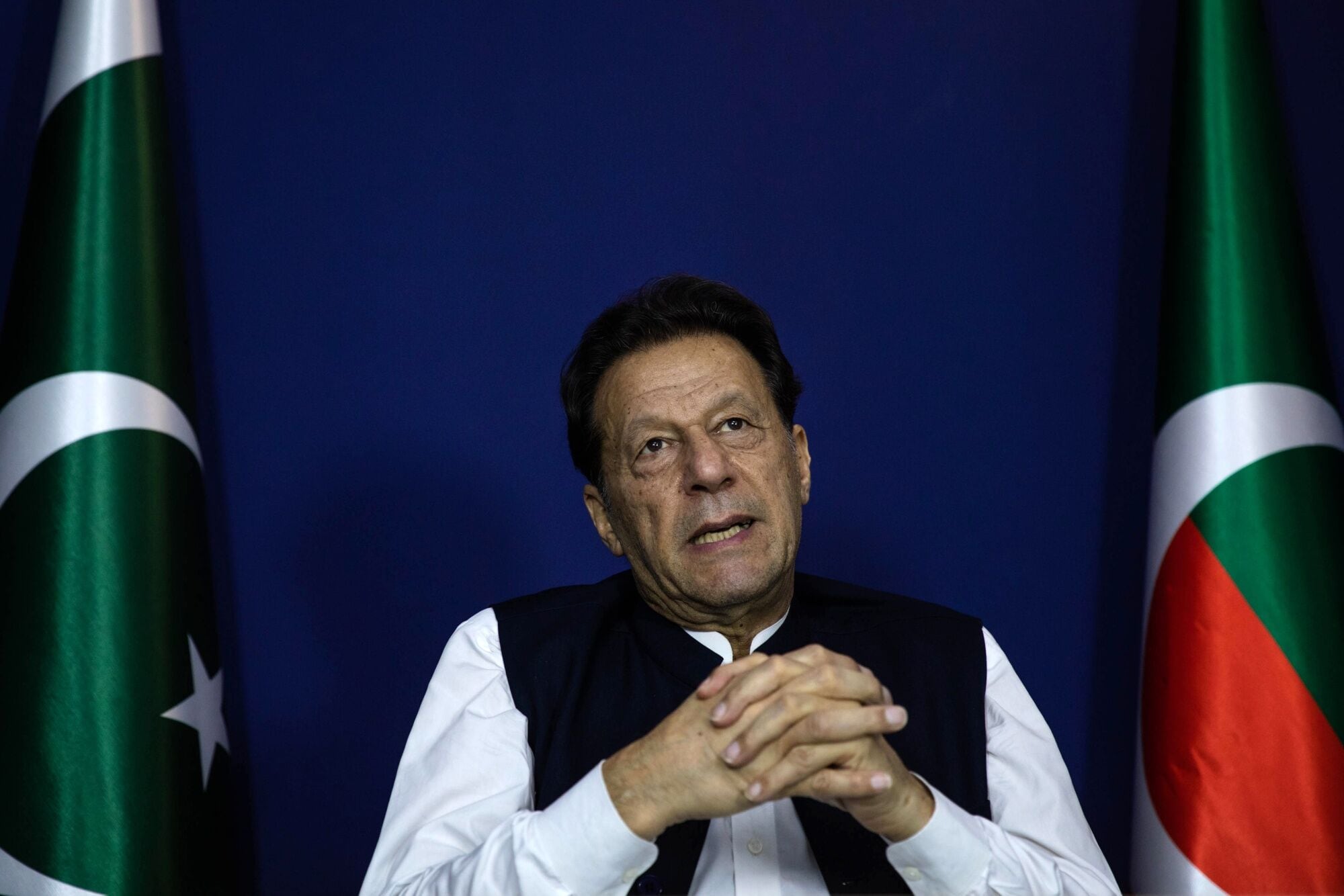
(Bloomberg Opinion) -- Not for the first time in its modern history, Pakistan's judiciary — tacitly backed by the rest of its “establishment” — appears to be seeking to snuff out the career of a leading politician. Late last week, former Prime Minister Imran Khan was convicted of misappropriating official gifts. He has been sentenced to three years in prison and cannot stand for election for five years.
Khan claims, not without reason, that the slew of legal proceedings against him are intended to keep him from contesting the next general elections, expected this fall. Khan's party, the Pakistan Tehreek-e-Insaf or PTI, has won a streak of by-elections since being forced out of power last year and had a good chance of returning to power.
That prospect is anathema to Pakistan's establishment, in which the military plays a dominant role. After first embracing Khan's insurgent, Islamist, anti-US rhetoric, the generals have more recently recoiled against his increasingly direct, populist attacks.
Past Pakistani leaders, including Khan's predecessor Nawaz Sharif, have been disqualified on equally flimsy grounds. In many ways, though, Khan's hold over his followers is unique — closer to that wielded by a figure such as former US President Donald Trump, himself caught up in an expanding legal morass. Neither man's opponents should celebrate too soon.
On the one hand, it is true that the populist movements led by figures such as Khan and Trump are highly dependent on their personalities. Khan's decades in the public eye as the charismatic captain of the national cricket team mean that his followers see him not as a “regular” politician but as a successful celebrity outsider capable of transforming the country.
Both men are also in their 70s, with no obvious successors. Entangling them in court proceedings and appeals should theoretically distract them long enough to break the hold they have over their followers. It's hard to look like a winner if you're losing case after case in the courts.
It's equally true that neither Khan nor Trump can credibly complain about their treatment. Khan, who originally rose to power thanks to the military's backing and who campaigned for Sharif's disqualification as a candidate, cannot act surprised if the establishment has now withdrawn its protection. Similarly, Trump has plenty of nerve criticizing the US Justice Department after cheering on the FBI's (far less damning) inquiry into Hillary Clinton's email server in 2016.
Nevertheless, both men are likely to get away with such cynical attacks. Like all populist leaders, their appeal is based around the belief that they share their followers' experience of victimization and persecution. Those acolytes don't particularly care about the open hypocrisy of their champions. Liberals believe that those who break norms should pay a price for this error; populist leaders can convince voters that norms are just another establishment conspiracy.
On purely rational grounds, too, Khan has reason for confidence. Pakistan faces an economic emergency, which helps him make the usual populist case that the country has been betrayed by mainstream politicians.
Perhaps he will miss one election; that need not mean that his career is at an end. Pakistanis point out that even after Sharif was disqualified, his party clawed its way back into power. His brother is now prime minister. Knowing that may help explain why Khan's followers have been relatively muted in their response to his conviction so far.
In Pakistan no less than the US, the fact is that no judicial verdict, however justified or overdue, can substitute for a political one. Khan's sentencing, just like Trump's many indictments, will only feed his followers' paranoia and paradoxically increase his political power.
Liberals in the US should have learned by now they cannot rely on judges to fight their battles for them. Similarly, Pakistan's establishment, accustomed to pulling strings behind the scenes, needs to step back and let Pakistan's civilian politicians — who love neither Khan nor the military — learn how to win back voters' trust on their own.
Populism is a disease of democracy and needs to be defeated democratically. The US, with its centuries-old institutions, may be able to see off Trump in 2024; Pakistan, with a much shallower democratic tradition, may find moving beyond Khan much harder. But the defense of democracy permits no shortcuts.
More From Bloomberg Opinion:
- Trump Will Struggle to Lie His Way Out of This: Timothy O'Brien
- Democracy Can Survive Inequality, Wokeism, China: Tobin Harshaw
- Pakistan Is Caught Between the Army and Imran Khan: Mihir Sharma
This column does not necessarily reflect the opinion of the editorial board or Bloomberg LP and its owners.
Mihir Sharma is a Bloomberg Opinion columnist. A senior fellow at the Observer Research Foundation in New Delhi, he is author of “Restart: The Last Chance for the Indian Economy.”
More stories like this are available on bloomberg.com/opinion
©2023 Bloomberg L.P.

-
Signature Play: The Classic Cocktail Is Dead. Or Is It?

Classic cocktails are disappearing from India's cocktail menus. But they're still being ordered, taught to bartenders and borrowed from. So, who's really having the last drink?
-
A New Samvat Wishlist: Inclusive Prosperity And Human Development
India has strengthened its economic foundations through infrastructure, digital access and enterprise. Its next growth chapter must deepen productivity, create better livelihoods and widen participation in prosperity.
-
Love, Sex Aur Dhokha: The Audacious Plot To Spy On Jensen Huang
A Taipei dinner, a Singapore chip buyer and a suspected Chinese asset: inside the alleged spy operation that got close to NVIDIA's Jensen Huang.
-
Ten Things I Learnt This Samvat
Patience can be a trap. Cheap stocks can stay cheap. Leverage can wipe you out. What did Samvat 2082 teach us? Niraj Shah writes on 10 lessons from the year gone by.
-
Talking Points This Week: Tech Nerves, FII Buying, And A Faraway Banking Shock
The global markets are not shining this Diwali. The exception in the large markets is, India.
-
Midterm Rally Lasted A Day. The Hard Reality Of A Divided US May Last Two Years | Opinion
Between a contested AI boom, a debt ceiling that arrives in 2027 and a president with every incentive to act alone, the next two years may prove more volatile than the first day's rally suggests.
-
Blue Wave Will Derail the AI Trade but Won't Dismantle the AI Era | Unhedged Position
The Democrats' sweep of the US Congress will see politics collide with economic forces both over the long and short term.
-
It's Time To Take The GST Council's Bet On Trust Global
Payment records can prove India's services exports, and clear, proportionate rules can bring foreign digital sellers into the tax net.
-
Opinion | India at 38: From Innovation Overperformer to Innovation Powerhouse
India now has 453 VC-backed deep science startups, 18 of them late-stage, after 117 percent growth since 2020. Laurus Labs, at USD 9.3 billion, is the most valuable deep science company in any middle-income economy outside China.









