NDTV World Summit 2024: Silk Road Premise A Myth, India Was At Heart Of Main Trade Says William Dalrymple
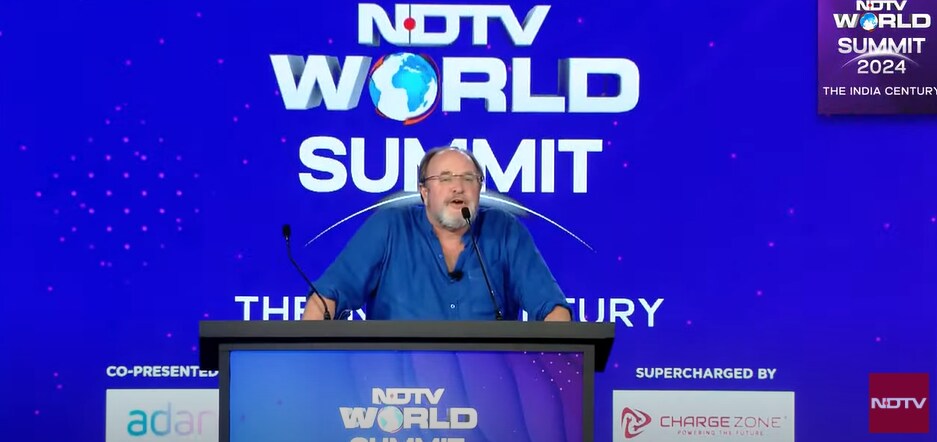
Scottish historian William Dalrymple argued on Monday that the classical concept of the 'Silk Road' ignored India's influence and impact on the trade route network.
The writer demonstrated the economic, cultural and academic influence of India, using examples that were comparatively lesser known by the general public at the NDTV World Summit 2024.
He stated that in his new book, 'The Golden Road', he had covered the overarching global influence on Europe and Asia, which had often been forgotten by time and buried by colonialism.
Dalrymple also covered the detailed time line of India's waxing soft power influence on the culture, education, religion and civilisations of the rest of the world from 250 BC—1200 AD.
"The story is about colonialism, about the way that Macauly and others like him who said that a single shelf of good English books is worth more than the entire native literature of India and Arabia," he said.
The art curator also spoke of a bust of Buddha that was discovered in Egypt and which was made of marble sourced from Turkey. It was found in a temple dedicated to the goddess Isis, at a port where generations of Indian merchants would bring their goods to the Roman empire.
He also drew attention to the galleries of Angkor Wat in Cambodia, which he called one of the biggest Hindu temples outside India.
Dalrymple noted that the temple had murals depicting Hindu iconography such as the battle of Kurukshetra and of Lanka and images of Krishna and Gopis, inspired by stories first told in Delhi.
The writer and presenter of the documentary 'Shiva's Matted Locks' noted that Oxford University had discovered a new map of the 'Silk Road', which mapped out roman coin hordes discovered by archaeologists.
"India is dotted with Roman coin hordes. It is now clear that India and Rome were the principal trading partners of each other in the early millennia B.C.," he said.
He stated that the nation's most successful export was the spread of Buddhism, while drawing attention to the Anuradhapura stupas that was constructed by Prince Mahinda, son of King Ashoka.
The presenter of many BBC shows also detailed how Buddhism spread from India to Myanmar, Thailand, Malaysia, and Indonesia.
"By 100 AD, India is locked with Rome in a very regular trading relationship. Pliny (ancient Roman historain) talks about the astonishing drain of gold from Roman pockets into those of India," the art historian said.
He said that the Romans knew every port on the west coast of India and they particularly focussed on Kerala and Gujarat, which were then known as Muziris and Barigaza, respectively.
To prove the point, he showed the Muziris Papyrus artefact, which was a shipping invoice signed by a merchant and a financier from Alexandria in Egypt, and a description of the cargo on a ship called Hermapollon that had sailed back from Muziris.
Referring to the invoice, he said that the Indian trader was going to send 10 tonnes of ivory, pepper, spices and a thing called naad, which is used for making perfumes.
According to the historian, ivory was the most lucrative export from India to Rome, as was malabathrum (used in cooking and medicine).
He said that scholars now believe that "one-third of the Roman Imperial budget" was spent on customs when the goods from India entered Berenice shipping port in those times.
Dalrymple said that the Romans considered these to be expensive luxury items and "the Romans couldn't get enough of these Indian products.".
Conversely, he also spoke about Egyptian glass beakers found in Kabul, brought by a Roman Egyptian ship to the mouth of the Indus River, "punted up the Indus and the Kabul river.".
He asserted that India was not in any way peripheral to the main trade networks in ancient Asia but was at the heart of all trade networks.
The author also said that Nalanda University was akin to Oxbridge and other Ivy League universities during that time period and was a hub for scientific and mathematical advancements.
Its architectural influence spread to the madrasas in Afghanistan and made their way to the Romans, influencing the architecture in Oxbridge.
The flow of students to India highlighted its status as a centre of trade, economy, religion, and philosophy, according to the historian.
Sanskrit emerged as the language of diplomacy and culture, spanning from Kandahar to Bali. The Palava script formed the base for various Southeast Asian scripts such as Khmer and Thai, according to Darlymple.
"What they admire about Indian culture is the attraction of soft power, not conquest by the sword. Indian soft power is so powerful, everyone wanted a bit of it, that everyone wants a bit of it," he stated.

-
Getting To Work Costs Women More | The Reason Why

It is not just about women paying more than men. It is about women paying much more in cities than in villages.
-
AI Bias In Investing Cannot Be Eliminated, But It Can Be Governed
Framing is a particularly important example as identical financial information presented in terms of gains rather than losses can lead an LLM to reach a different assessment.
-
Joining The Dots | Dark Skies, Steady Diya: Why Hope Holds This Diwali
With war, a weak rupee and foreign outflows weighing on sentiment, policymakers at the NDTV World Summit and market veterans at NDTV Profit Ignite: Diwali Edition offered the same advice: stay invested and filter out the noise.
-
The Curious Case of Equitas Small Finance Bank And A CEO Who Quit For Stock
PN Vasudevan believes persistent investor concerns over a perceived conflict of interest had become a governance overhang on Equitas Small Finance Bank's stock, even as the lender improved profitability and asset quality.
-
Talking Points This Week: AI Cash Burn, A Tiger Comeback And An India That Still Finds Its Own Path
India is not immune to higher oil or tighter global liquidity, yet its earnings base is broader, its domestic policy levers are still available.
-
Foreign Investors Own Half Of HDFC Bank and ICICI Bank. An LTCG Cut Could Matter Most Here
Foreign portfolio investors have US$115 billion parked in HDFC Bank, ICICI Bank. If the government cuts long-term capital gains tax, Jefferies says returning foreign money could land here first.
-
'Never Seen This Level Of Negativity': Sandeep Tandon Says The Next Rally May Be Closer Than You Think
Veteran investor Sandeep Tandon says foreign selling is easing, large-caps are due a comeback and mid-caps are crowded, while he turns positive on gold, power and pharma this Diwali.
-
Indians Stay With Family, Not In Hotels | The Reason Why
India still lacks enough clean, reliable and affordable hotels for budget-conscious travellers.
-
The Economic Imperative: Analysing The Material Driving Force Behind India-Canada Strategic Reset
This economic complementarity is further reinforced by deep institutional investment ties and talent mobility, which form the bedrock of the bilateral framework.
-
Medicine Pricing: Where Must Profit Stop?
India must confront excessive margins, hidden incentives and regulatory gaps that threaten the integrity of medicine.










