Morgan Stanley Drops Contrarian Bet For Dollar To Rally In 2024

(Bloomberg) -- Morgan Stanley, one of the few remaining dollar bulls, downgraded its outlook for the US currency citing declining Treasury yields following the Federal Reserve's dovish pivot.
The bank changed its outlook for the greenback to neutral from bullish, noting that seasonality and short positioning could potentially still drive further upside. The bank had been betting on a stronger dollar since at least mid-November, previously forecasting that the Dollar Spot Index would strengthen about 8% from current levels in the second quarter.
Hedge funds and banks including Goldman Sachs Group turned bearish on the greenback in December after Federal Reserve Chair Jerome Powell signaled a shift to cutting rates this year. The dollar index subsequently plunged to a five-month low before rallying in the first four days of January. It was down 0.2% on Thursday.
“Our conviction about dollar strength has waned meaningfully,” strategists including David Adams wrote in a note published Jan. 4. “US data deceleration has compressed growth differentials, US rates have fallen further compared with peers, and investors appear far from defensive based on equity returns.”
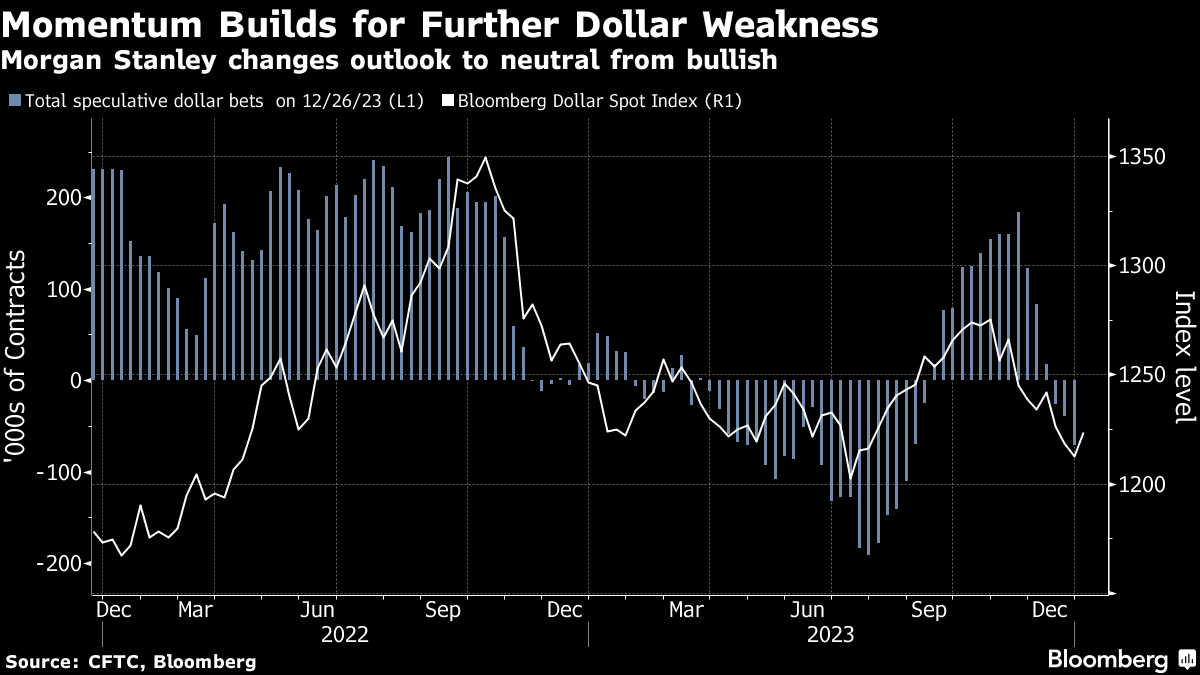
Fidelity International, JPMorgan Chase & Co., and HSBC Holdings Plc were among a minority of money managers that went against consensus in December, warning that the dollar will surprise by getting stronger in 2024 as the US economy outperforms. A weaker dollar is the majority view among analysts surveyed by Bloomberg.
Morgan Stanley also closed its short euro-dollar trade recommendation, suggesting investors play a short euro-yen position instead. The bank forecasts that the yen will gain as US rates fall and the euro will drop as the euro-area economy continues to weaken.
“The cloudier outlook for the dollar doesn't change the fundamentals for the other G3 currencies,” Adams said.
More stories like this are available on bloomberg.com
©2024 Bloomberg L.P.

-
Getting To Work Costs Women More | The Reason Why

It is not just about women paying more than men. It is about women paying much more in cities than in villages.
-
AI Bias In Investing Cannot Be Eliminated, But It Can Be Governed
Framing is a particularly important example as identical financial information presented in terms of gains rather than losses can lead an LLM to reach a different assessment.
-
Joining The Dots | Dark Skies, Steady Diya: Why Hope Holds This Diwali
With war, a weak rupee and foreign outflows weighing on sentiment, policymakers at the NDTV World Summit and market veterans at NDTV Profit Ignite: Diwali Edition offered the same advice: stay invested and filter out the noise.
-
The Curious Case of Equitas Small Finance Bank And A CEO Who Quit For Stock
PN Vasudevan believes persistent investor concerns over a perceived conflict of interest had become a governance overhang on Equitas Small Finance Bank's stock, even as the lender improved profitability and asset quality.
-
Talking Points This Week: AI Cash Burn, A Tiger Comeback And An India That Still Finds Its Own Path
India is not immune to higher oil or tighter global liquidity, yet its earnings base is broader, its domestic policy levers are still available.
-
Foreign Investors Own Half Of HDFC Bank and ICICI Bank. An LTCG Cut Could Matter Most Here
Foreign portfolio investors have US$115 billion parked in HDFC Bank, ICICI Bank. If the government cuts long-term capital gains tax, Jefferies says returning foreign money could land here first.
-
'Never Seen This Level Of Negativity': Sandeep Tandon Says The Next Rally May Be Closer Than You Think
Veteran investor Sandeep Tandon says foreign selling is easing, large-caps are due a comeback and mid-caps are crowded, while he turns positive on gold, power and pharma this Diwali.
-
Indians Stay With Family, Not In Hotels | The Reason Why
India still lacks enough clean, reliable and affordable hotels for budget-conscious travellers.
-
The Economic Imperative: Analysing The Material Driving Force Behind India-Canada Strategic Reset
This economic complementarity is further reinforced by deep institutional investment ties and talent mobility, which form the bedrock of the bilateral framework.
-
Medicine Pricing: Where Must Profit Stop?
India must confront excessive margins, hidden incentives and regulatory gaps that threaten the integrity of medicine.










