Modi To Encapsulate Making Of New, Innovative India In Davos
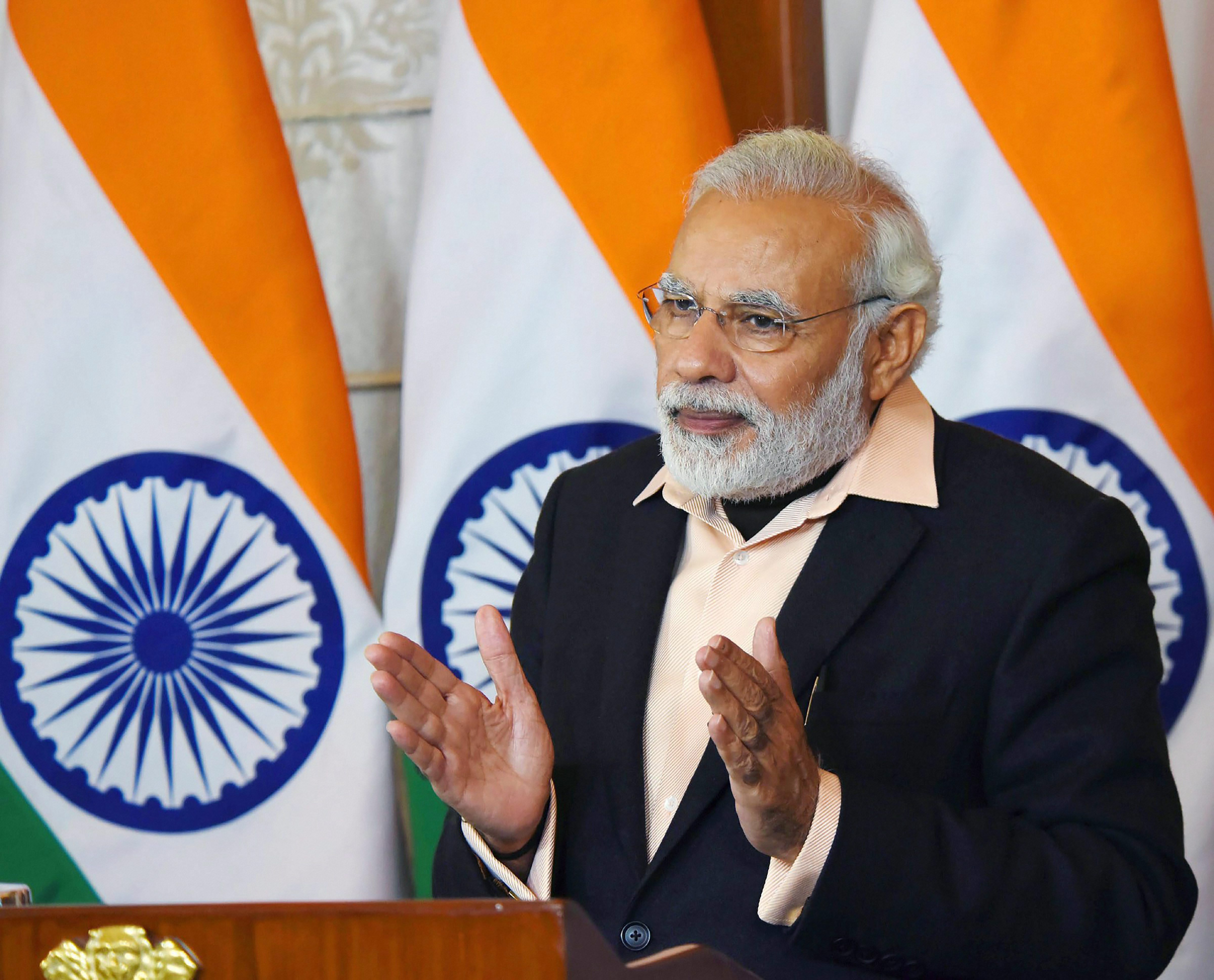
Prime Minister Narendra Modi, accompanied by several ministers and business leaders, will encapsulate making of ‘a new, young and innovative India' when he addresses the rich and powerful from across the world at the Swiss town Davos later this month.
In his first appearance at the World Economic Forum Annual Meeting—being held this year with a theme of 'Creating a shared future in a fractured world'—Modi is also expected to talk about his experience with 'cooperative federalism' in India, while urging the world for a collective crackdown on terrorism, economic imbalances, cyber threats and various societal ills.
Sources familiar with the draft programme of various sessions of the 48th Annual Meeting of the WEF said the Indian leaders, including Modi, will also talk about numerous steps they have taken to make it easier to do business in India, check corruption, clamp down on black money, streamline taxation and boost sustainable growth.
Adding further star power, Bollywood king Shahrukh Khan, for a change, would not be seen serenading heroines with his signature ‘open-arm' charm on Swiss Alps, but will rather talk about creating a change in India through women empowerment.
Another star speaker will be ex-Reserve Bank of India Governor Raghuram Rajan, who has been praised as well as criticised often for his vocal views on everything from politics to economics and is credited for predicting the global economic crisis of 2008.
He will speak on the power of economic narratives and how policymakers can address the challenges of the 21st century.
The final programme of the five-day event, starting January 22, will be unveiled on Tuesday by Geneva-based WEF, which describes itself as an international public-private organisation working to improve state of the world and has been hosting the confab every year in Davos.
Also Read: What Will Donald Trump Find in Davos?
Modi is being seen as one of the biggest stars this year, with U.S. President Donald Trump being the other. Those scheduled to attend the powwow also include U.K.'s Theresa May, Canada's Justin Trudeau, France's Emmanuel Macron, Pakistan's Shahid Khaqan Abbasi, Jordan's King Abdullah and Queen Rania, Brazil's Michel Temer and Switzerland's Alain Berset.
Also Read: Prime Minister Modi To Hard Sell India As Investment Destination At Davos
This will be Modi's first Davos visit and also the first by an Indian Prime Minister since the one by H D Deve Gowda in 1997. In case of Trump, he will be the first U.S. President to attend since Bill Clinton in 2000.
As many as six union ministers, two chief ministers, over 100 chief executive officers and several other high-profile attendees from India will be hobnobbing with their counterparts from across the world, while over 3,000 global elite at their annual jamboree would be served Indian cuisine including desi 'chai-samosa' and several Gujarati dishes, among those from various other states, at the opening night welcome reception.
As per the draft programme, Modi will deliver the opening plenary on January 23. A day before, he will have a bilateral meeting with Swiss President Berset. Modi is expected to have other bilaterals as well and will also meet global CEOs.
To read more stories on the Davos World Economic Forum 2018, click here!
Among other Indian leaders, Finance Minister Arun Jaitley will have several engagements and will also speak at a session on 'India's role in the world', talking about how the political changes, structural reforms and technology innovations are changing the country's socio-economic context.
Union Minister Jitendra Singh will speak at a session on 'From fragile cities to renewal', while Piyush Goyal will talk on 'post-establishment politics' and how a new generation of political leaders has swept into governments and parliaments around the world. Goyal will also speak on disaster resilience in infrastructure and on 'designing for smart mobility'.
Industry Minister Suresh Prabhu is expected to meet his counterparts from other countries and discuss the WTO-related issues, among other engagements, while Dharmendra Pradhan will talk about value-chain innovations that can help the industries and governments unlock economic and societal value.
M J Akbar, minister of state for external affairs, will speak on nuclear threats to international security, as also on securing peace and stability in the Asian century.
Among other Indian participants, Department of Industrial Policy and Promotion Secretary Ramesh Abhishek will talk about the Asian innovation ecosystem, while NITI Aayog CEO Amitabh Kant will talk about the use of big data in policy making and on implementing strategies for inclusive growth.
Also Read: Trump Will Bring Eight Cabinet Members to Davos Forum This Month
Chief Ministers Devendra Fadnavis (Maharasthra) and N Chandrababu Naidu (Andhra Pradesh), as also Telangana minister K T Rama Rao will talk about investment attractiveness of their respective states, while the Indian CEOs, led by industry body CII, would be also pitching the India growth story in addition to exploring potential business deals.
This will be the first time that India will host the welcome reception, where yoga will also be showcased along with cuisines from across the country.
Also Read: Desi Cuisine, Yoga To Open WEF Davos Meet; Indian Presence To Be Largest-Ever
The prominent Indian businessmen would include Gautam Adani, Mukesh Ambani with wife Nita, Rahul Bajaj with son Sanjiv, N Chandrasekaran with a host of Tata group executives, Chanda Kochhar, Uday Kotak, Naresh Goyal, Anand Mahindra, Sajjan Jindal, Sunil Mittal with son Kavin, Salil Parekh, Azim Premji, Ravi Ruia and Prashant Ruia.
Besides, several Indian-origin global leaders will be present, including Lakshmi Mittal and son Aditya, Indra Nooyi and Sundar Pichai, who will talk about the age of artificial intelligence, future of the open web and the technology's impact on society. PepsiCo's Nooyi will pitch for urgent steps needed to be taken towards better capitalism.

-
Getting To Work Costs Women More | The Reason Why

It is not just about women paying more than men. It is about women paying much more in cities than in villages.
-
AI Bias In Investing Cannot Be Eliminated, But It Can Be Governed
Framing is a particularly important example as identical financial information presented in terms of gains rather than losses can lead an LLM to reach a different assessment.
-
Joining The Dots | Dark Skies, Steady Diya: Why Hope Holds This Diwali
With war, a weak rupee and foreign outflows weighing on sentiment, policymakers at the NDTV World Summit and market veterans at NDTV Profit Ignite: Diwali Edition offered the same advice: stay invested and filter out the noise.
-
The Curious Case of Equitas Small Finance Bank And A CEO Who Quit For Stock
PN Vasudevan believes persistent investor concerns over a perceived conflict of interest had become a governance overhang on Equitas Small Finance Bank's stock, even as the lender improved profitability and asset quality.
-
Talking Points This Week: AI Cash Burn, A Tiger Comeback And An India That Still Finds Its Own Path
India is not immune to higher oil or tighter global liquidity, yet its earnings base is broader, its domestic policy levers are still available.
-
Foreign Investors Own Half Of HDFC Bank and ICICI Bank. An LTCG Cut Could Matter Most Here
Foreign portfolio investors have US$115 billion parked in HDFC Bank, ICICI Bank. If the government cuts long-term capital gains tax, Jefferies says returning foreign money could land here first.
-
'Never Seen This Level Of Negativity': Sandeep Tandon Says The Next Rally May Be Closer Than You Think
Veteran investor Sandeep Tandon says foreign selling is easing, large-caps are due a comeback and mid-caps are crowded, while he turns positive on gold, power and pharma this Diwali.
-
Indians Stay With Family, Not In Hotels | The Reason Why
India still lacks enough clean, reliable and affordable hotels for budget-conscious travellers.
-
The Economic Imperative: Analysing The Material Driving Force Behind India-Canada Strategic Reset
This economic complementarity is further reinforced by deep institutional investment ties and talent mobility, which form the bedrock of the bilateral framework.
-
Medicine Pricing: Where Must Profit Stop?
India must confront excessive margins, hidden incentives and regulatory gaps that threaten the integrity of medicine.










