Logan Says Fed Should Slow Asset Runoff As Reverse Repo Dwindles
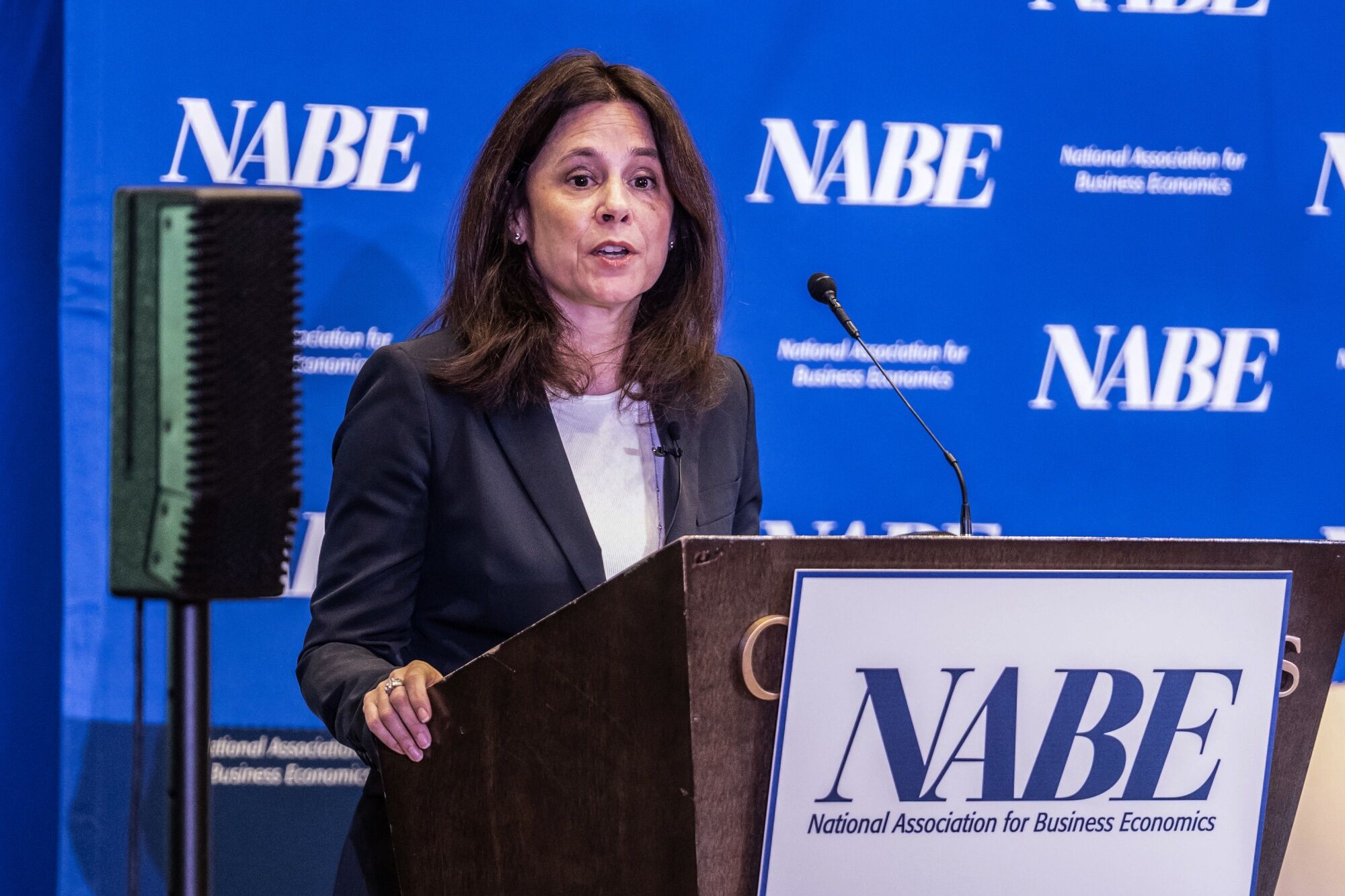
(Bloomberg) -- Federal Reserve Bank of Dallas President Lorie Logan said the US central bank may need to slow down the pace at which it shrinks its portfolio of assets amid scarcer liquidity in financial markets.
While there's still more than enough liquidity in the financial system, she said, individual banks could start to see constraints. Speaking at an event in San Antonio on Saturday, Logan said it's now “appropriate” to begin discussing the parameters around a Fed decision to slow the pace of its balance-sheet runoff.

“In my view, we should slow the pace of runoff as ON RRP balances approach a low level,” Logan said, referencing the Fed's overnight reverse repurchase facility, a place where counterparties such as money-market mutual funds can park excess cash.
“Normalizing the balance sheet more slowly can actually help get to a more efficient balance sheet in the long run by smoothing redistribution and reducing the likelihood that we'd have to stop prematurely,” she added.
Logan's early call to consider slowing the balance-sheet reduction — in other words, to pull back on another form of policy tightening — carries authority because of her previous role as a top official on the New York Fed's markets desk.
Policymakers discussed a potential slowdown in the balance sheet reduction at the Fed's Dec. 12-13 meeting, according to minutes from that gathering released Wednesday. Several policymakers noted that they should begin discussing the technical factors that would drive the decision, and Logan's remarks Saturday about the rapid decline in overnight repo facility balances provide a starting point.
The Fed has been letting some maturing assets roll off its balance sheet, rather than reinvesting in more securities, as it normalizes policy away from pandemic-era stimulus programs. Its portfolio of assets has shrunk to $7.68 trillion from nearly $9 trillion in 2022.
The Dallas Fed chief, who doesn't vote on monetary policy decisions this year, also said policymakers may need to raise interest rates further if a turnaround in consumer demand causes inflation to re-accelerate.
“If we don't maintain sufficiently tight financial conditions, there is a risk that inflation will pick back up and reverse the progress we've made,” Logan said. “In light of the easing in financial conditions in recent months, we shouldn't take the possibility of another rate increase off the table just yet.”
Despite her warnings on rates, Logan's comments about the balance sheet are in line with a broader shift by the central bank to normalizing monetary policy in 2024, after raising rates since early 2022 to fight elevated and stubborn inflation.
Logan, who spoke on a panel about monetary policy implementation and markets at the American Economic Association's annual meeting, said much of the impact of the Fed's interest-rate hikes so far has already worked through the economy.
Tighter financial conditions played a key role in bringing demand and supply back into balance and keeping inflation expectations anchored, Logan said. A reversal in that in recent months — the 10-year Treasury yield is at 4.05%, from close to 5% in October, and stocks have rallied since then — could push up aggregate demand, she said.
“Over the past few months, long-term yields have given back most of the tightening that we saw over the summer,” Logan said. “We can't count on sustaining price stability if we don't maintain sufficiently restrictive financial conditions.”
Fed officials raised rates to a range of 5.25% to 5.5%, a 22-year high, in the 17 months through July but have left policy unchanged since then amid progress on cooling inflation. None of the 19 policymakers see rates moving higher in economic forecasts released following their December meeting, which markets took as a pivot in policy and rallied on.
(Updates with background starting in sixth paragraph.)
More stories like this are available on bloomberg.com
©2024 Bloomberg L.P.

-
Getting To Work Costs Women More | The Reason Why

It is not just about women paying more than men. It is about women paying much more in cities than in villages.
-
AI Bias In Investing Cannot Be Eliminated, But It Can Be Governed
Framing is a particularly important example as identical financial information presented in terms of gains rather than losses can lead an LLM to reach a different assessment.
-
Joining The Dots | Dark Skies, Steady Diya: Why Hope Holds This Diwali
With war, a weak rupee and foreign outflows weighing on sentiment, policymakers at the NDTV World Summit and market veterans at NDTV Profit Ignite: Diwali Edition offered the same advice: stay invested and filter out the noise.
-
The Curious Case of Equitas Small Finance Bank And A CEO Who Quit For Stock
PN Vasudevan believes persistent investor concerns over a perceived conflict of interest had become a governance overhang on Equitas Small Finance Bank's stock, even as the lender improved profitability and asset quality.
-
Talking Points This Week: AI Cash Burn, A Tiger Comeback And An India That Still Finds Its Own Path
India is not immune to higher oil or tighter global liquidity, yet its earnings base is broader, its domestic policy levers are still available.
-
Foreign Investors Own Half Of HDFC Bank and ICICI Bank. An LTCG Cut Could Matter Most Here
Foreign portfolio investors have US$115 billion parked in HDFC Bank, ICICI Bank. If the government cuts long-term capital gains tax, Jefferies says returning foreign money could land here first.
-
'Never Seen This Level Of Negativity': Sandeep Tandon Says The Next Rally May Be Closer Than You Think
Veteran investor Sandeep Tandon says foreign selling is easing, large-caps are due a comeback and mid-caps are crowded, while he turns positive on gold, power and pharma this Diwali.
-
Indians Stay With Family, Not In Hotels | The Reason Why
India still lacks enough clean, reliable and affordable hotels for budget-conscious travellers.
-
The Economic Imperative: Analysing The Material Driving Force Behind India-Canada Strategic Reset
This economic complementarity is further reinforced by deep institutional investment ties and talent mobility, which form the bedrock of the bilateral framework.
-
Medicine Pricing: Where Must Profit Stop?
India must confront excessive margins, hidden incentives and regulatory gaps that threaten the integrity of medicine.










