Judge Blocks Trump On Oregon Troops As Guard Ordered To Illinois
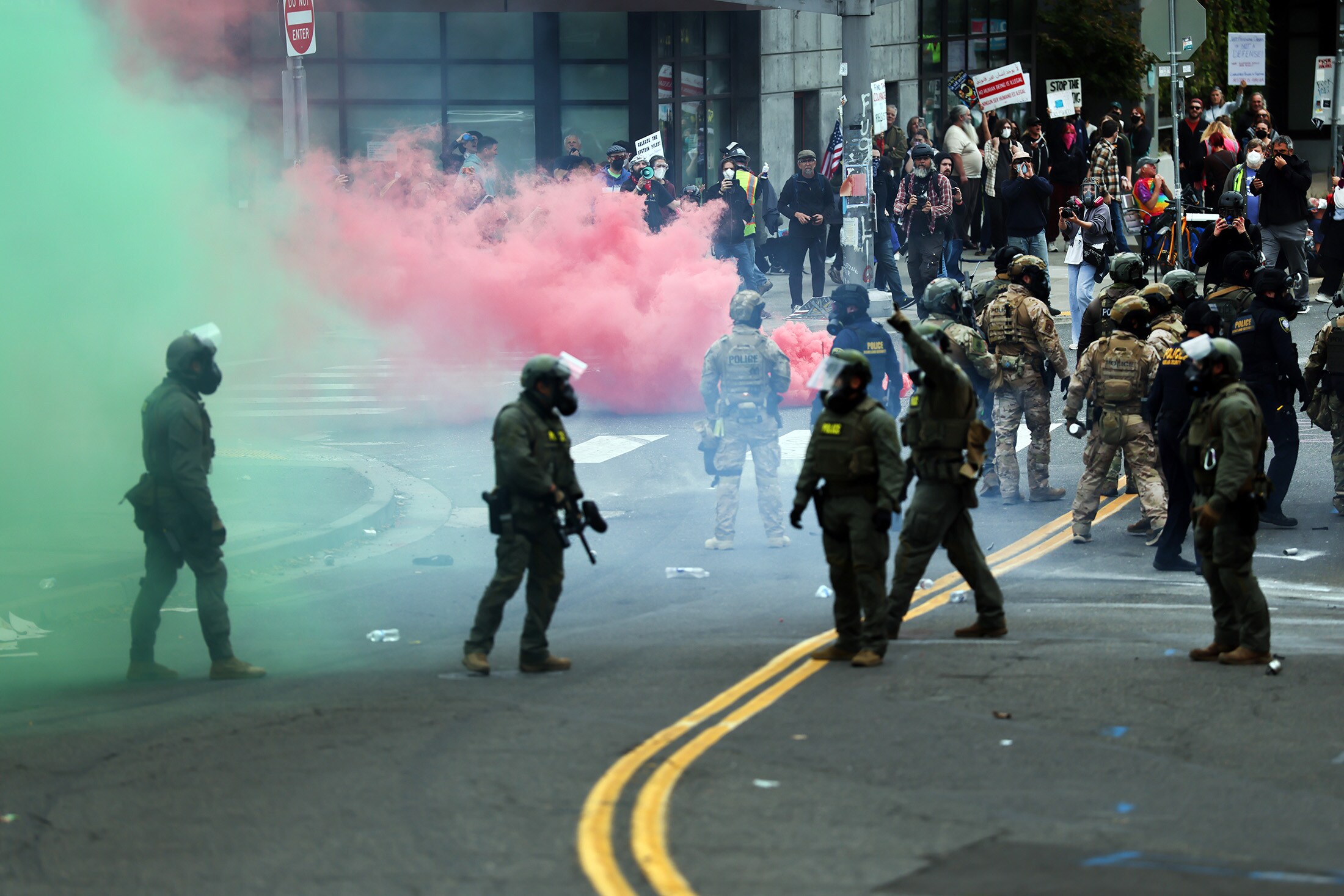
A federal judge temporarily blocked President Donald Trump from sending military forces to Portland, Oregon, to quell protests against his immigration crackdown, even as 300 National Guard troops were ordered to Illinois over the objection of state officials.
US District Judge Karin Immergut, a Trump appointee, said in an order Saturday that the National Guard deployment to Portland did not appear to be justified due to the limited nature of the protests and the ability of local law enforcement to handle the situation.
“The president's determination was simply untethered to the facts,” the judge wrote. She said the temporary restraining order will apply for 14 days, blocking the federalization of 200 Oregon National Guard members to Portland.
Separately on Saturday, Trump authorised the Illinois deployment over the objections of Governor JB Pritzker, a Democrat, who called the move “un-American.”
The cases are the latest in a series of fights over Trump's use of National Guard troops to quell protests against his administration's policies, and to fight crime and help federal officials enforce immigration laws in Democratic-run cities.
State National Guard troops are under the control of individual governors, but the administration has argued that the president has the authority to federalize the troops in the event of a “rebellion” or “invasion.”
In the Oregon case, the judge said there were no facts to support Trump's claims on social media that Portland was ravaged by war and that anarchists and professional agitators were trying to burn down federal property and other buildings.
The White House indicated it would likely pursue appeals.
“President Trump exercised his lawful authority to protect federal assets and personnel in Portland following violent riots and attacks on law enforcement,” White House spokeswoman Abigail Jackson said. “We expect to be vindicated by a higher court.”
The judge agreed the legal precedent requires the courts to give great deference to the president in making such decisions, but she disagreed that Trump had made his determination about Portland in good faith and ruled that deference “is not equivalent to ignoring the facts on the ground.”
An immediate temporary restraining order was justified, she added, because Oregon “will suffer an injury to its sovereignty” as soon as federal troops are deployed, while local law enforcement can continue to protect the ICE facility as they have been even with a TRO in place.
“This country has a longstanding and foundational tradition of resistance to government overreach, especially in the form of military intrusion into civil affairs,” Immergut wrote. “This historical tradition boils down to a simple proposition: this is a nation of constitutional law, not martial law. Defendants have made a range of arguments that, if accepted, risk blurring the line between civil and military federal power — to the detriment of this nation.”
Chicago Tension
The Illinois fight heated up on Saturday as well. Immigration and Customs Enforcement officers have stepped up activity and tensions have flared between federal agents and protesters outside an immigration processing center in suburban Broadview, Illinois.
A Department of Homeland Security spokeswoman said federal officers on Saturday fired defensive shots at a woman who then drove herself to the hospital. Chicago police said they responded to the scene but weren't involved in the incident or the investigation.
Federal prosecutors in Chicago charged three people related to the incident, saying they used their vehicles to impede the work of federal officers. Two of the three people allegedly used their cars to strike those being driven by federal agents, while the third person allegedly rear-ended a federal law enforcement vehicle, according to a statement by the US Attorney's office.
“This morning, the Trump administration's Department of War gave me an ultimatum: call up your troops, or we will,” Pritzker said earlier Saturday. “It is absolutely outrageous and un-American to demand a governor send military troops within our own borders and against our will.”
Broader Plan
Trump has deployed guard troops in Washington, DC, Memphis and Los Angeles. A federal judge in California said the deployment in Los Angeles violated federal laws limiting the authority of the US military to enforce civilian law, but the White House is appealing the ruling.
Oregon officials sued after the Trump administration ordered National Guard troops to respond to protests in Portland and protect immigration officials and federal property in the area.
When he mobilized the troops, Trump wrote that he was directing the Department of Defense to “provide all necessary Troops to protect War ravaged Portland.” The president said US Immigration and Customs Enforcement facilities are “under siege from attack by Antifa, and other domestic terrorists.”
At a hearing Friday, Oregon lawyer Scott Kennedy blasted Trump's public statements about Portland on Truth Social, saying they are not based in reality. In a post earlier this week, the president called the city “a NEVER-ENDING DISASTER.”
Kennedy described the protests at the ICE facility Portland in the days leading up to Trump's post as “dwindling, relatively sedate.” The biggest protest was in June and was handled without federal troops, he said.
“The defense has not identified any inability to enforce the laws,” Kennedy said.
Eric Hamilton, a Justice Department lawyer, said the 200 proposed troops were appropriate for the level of violence in Portland, which was less than that seen in Los Angeles earlier this year.
In court filings, law enforcement leaders in Oregon argued that federal forces would probably create more problems than they would solve.
In response, the Trump argued the state's request for court intervention was premature “before any Guardsmen have begun the mission.” But Justice Department lawyers also claimed that federal immigration agents have faced physical violence and death threats from “cruel activists,” including by erecting a guillotine outside of the Portland ICE office.
On Thursday, the judge initially assigned to the case recused himself from handling it after government lawyers alleged he may have a conflict of interest because of comments made by his wife, Democratic Congresswoman Suzanne Bonamici, that were critical of the deployment.
US District Judge Michael Simon said in a written order he didn't believe he was required under the circumstances to have the case re-assigned, but agreed to it because “it is necessary that the focus of this lawsuit remain on the critically important constitutional and statutory issues presented by the parties.”

-
The Economic Imperative: Analysing The Material Driving Force Behind India-Canada Strategic Reset

This economic complementarity is further reinforced by deep institutional investment ties and talent mobility, which form the bedrock of the bilateral framework.
-
Medicine Pricing: Where Must Profit Stop?
India must confront excessive margins, hidden incentives and regulatory gaps that threaten the integrity of medicine.
-
Why Amazon And Flipkart Are Struggling To Beat Meesho In India's Smaller Cities
With 274 million users and lowest-cost logistics, Meesho is defending its value commerce crown against giants like Amazon and Flipkart.
-
High US Salaries, No Green Card Certainty: The Financial Calculation Facing Indian H-1B Families
The suspension of PERM processing at eight technology employers does not cancel existing H-1B visas. What it does is force a question many Indian families have been avoiding: is the US salary worth tying your career and family plans to one employer?
-
Swiggy vs Eternal: Food Delivery's Two Rivals Are No Longer In The Same Race
Eternal is building a private AI assistant, dark.ai. Swiggy is still working out how to make Instamart pay, with an operating loss of Rs 895 crore in the July-September quarter while Blinkit stayed profitable.
-
Where You Live Shapes How You Get To Work | The Reason Why
Two-wheelers are the most popular way to get to work in India, accounting for nearly 43% of workplace commutes.
-
Unhedged Position: Can India See An Indonesia-Style Time Correction?
The Nifty is trading below levels it first clocked in 2024. Is there, then, as I have suggested in the headline, potential that the current time correction drags on painfully for the next three-five, even ten years?
-
Navigating Friction And Energy Realities: An Analysis Of Marco Rubio's October Visit To India
Occurring at a critical juncture marked by stalled trade negotiations and escalating geopolitical pressures over global energy supplies, the visit offers a profound window into modern US-India relations.
-
India Exports Capital. Why Not Export Trusteeship?
The big question, then, is whether India can build an institution that global borrowers, investors, banks, and lawyers can trust, even without an Indian connection.
-
France's Economy & Politics Are In Crisis | The Reason Why
Let's look at how the French economy and politics evolved under Nicolas Sarkozy, Franois Hollande and Emmanuel Macron.










