Israel At War Transmits Market Risk Across Middle East

(Bloomberg) -- The fallout from the deadly Hamas attack ripped through Israeli assets this week, catapulting the region into what could be a new era of risk and casting a pall over markets from Saudi Arabia to Egypt.
As traders brace for more turmoil in Israel, they are also ramping up protection against the threat that the nation's war against Hamas could lead to a wider conflict in the Middle East. Long seen as less prone to volatility, Israeli markets were hardly immune this time.
Click here for more on the Israel-Hamas War
The cost to insure Israeli bonds against potential default has spiked by 66 basis points since Saturday's assault by Hamas, the biggest surge ever in a week. A jump in the shekel's one-month implied volatility has surpassed every other currency in the world since Monday.
The superlatives are also piling up across the region.
Credit-default swaps on Saudi Arabia and Qatar are headed for their biggest weekly gains since 2020. And as a hedge against rising geopolitical risk, 12-month forward contracts on Saudi Arabia's riyal — which is pegged to the dollar — are on course for their biggest weekly gain since December 2022.
“Clearly a geopolitical risk premium is being built back into the region,” said Abdul Kadir Hussain, head of fixed-income asset management at Arqaam Capital. “The situation is fluid, difficult to predict.”
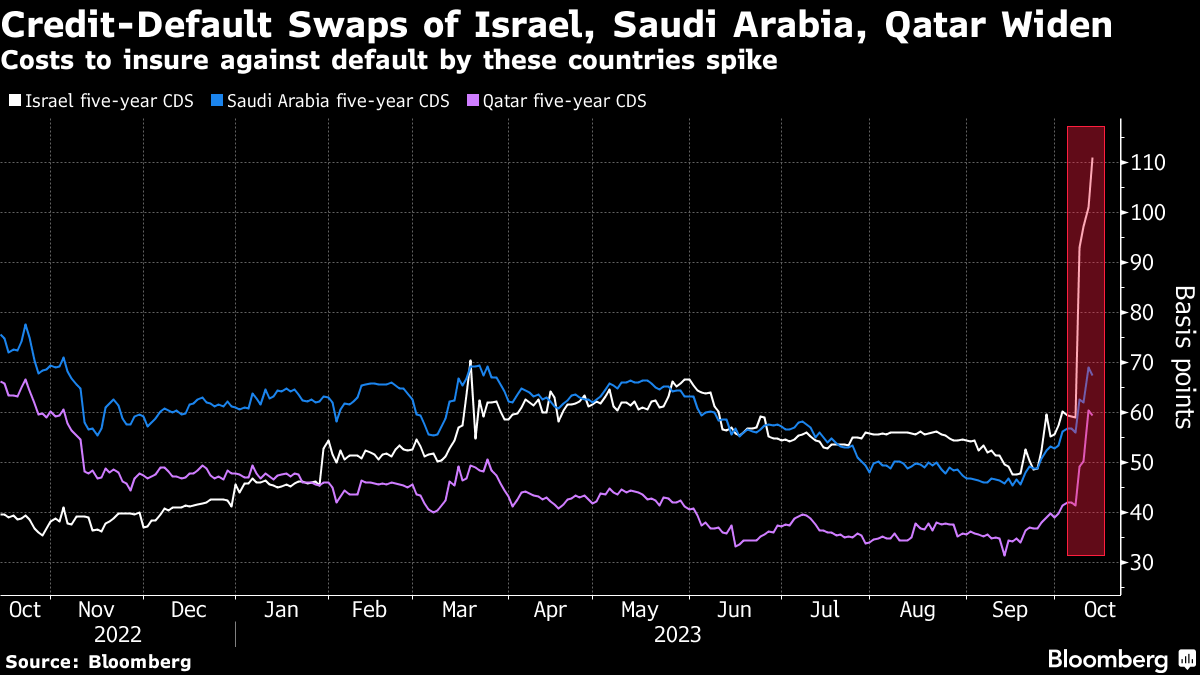
Investors are weighing the danger that the conflict could draw in other countries or militant groups.
Lebanon's Hezbollah, one of the Middle East's most powerful militias, has exchanged fire with Israeli troops on the border over the past few days.
Iran, which supplies arms and money to Hamas, warned that Tehran-backed militants could open a new front in Israel's war against Hamas if the blockade of Gaza continued. Hamas is designated a terrorist organization by the US and the European Union.
A sharper escalation that engulfs the region “is not priced in today,” said Morgan Stanley strategists including Simon Waever. “Yet, such a scenario is also several steps away.”
Policy Response
Soon after the shock assault, policymakers in Israel rushed in with emergency measures that included up to $30 billion of currency interventions to limit the shekel's volatility.
The crisis also focused attention on Egypt, which shares the border with Gaza and is one of the region's most indebted countries. Struggling to unlock financing from its existing $3 billion rescue package from the International Monetary Fund, it's now in talks for an increase in assistance, according to people familiar with the discussions.
While Israel's dollar debt has been among the biggest losers across emerging markets, bonds issued by Lebanon, Jordan and Egypt have also been among the hardest hit this week, according to Bloomberg indexes.
The war will leave Egypt's bonds, already under pressure after last week's downgrade by Moody's Investors Service, more vulnerable given its dependence on tourism and fuel imports, according to Goldman Sachs Group Inc. Jordan is also highly reliant on tourism, strategists at the US bank said.
‘High Correlation'
“There is a relatively high correlation between heightened geopolitical risk in Israel and in the Middle East,” Goldman strategists including Kamakshya Trivedi and Caesar Maasry said in a report.
Israel's benchmark stock index has slumped 6.4% this week, the biggest loser worldwide. The shekel has weakened more than 3% against the dollar even as interventions by Bank of Israel rein in volatility.
Moody's, which is scheduled to review Israel's rating later Friday, said earlier this week that the nation's sovereign credit profile could be tested by a protracted period of war, even though it's has held up in the face of terrorist attacks and military action in the past.
As the Israeli military urged an evacuation of the northern part of Gaza with a ground operation expected soon, losses are set to deepen if the conflict develops into a broader war.
“Markets are reflecting an assumption that the Israel-Gaza war remains contained,” said Hasnain Malik, a Dubai-based strategist at Tellimer. “The prospects of a direct war with Iran, which would prompt a complete reset of risk assessment, seems very unlikely — but one with Hezbollah in Lebanon, which would be much more incremental, is possible.”
More stories like this are available on bloomberg.com
©2023 Bloomberg L.P.

-
Why Swapping Your Old Gold Can Trigger A Rs 5 Lakh Tax Bill, And How You Can Avoid It Legally

Swapping old gold for new is taxed as a sale and a fresh purchase. Getting your own gold remade can cut most of that bill, though it has its own costs.
-
The AI Trade is Done. The Real Opportunity for Investors Starts in 2027 | Unhedged Position
As pureplay AI stocks plunge and circular, capex-led financing unwinds, 2027 is set to be a year of reckoning for AI companies. Yet the bust clears the way for a better opportunity for investors in 2027 -- shifting the spotlight from AI builders to the companies using AI.
-
Leadership As Mission: Why The Age Of AI Demands More Human Leadership
Debjani Ghosh examines how AI is changing leadership, arguing that its success must be measured by its impact on people and the accountability of those guiding its use.
-
We May Need Another Tukaram Mundhe To Fight Air Pollution | The Reason Why
Developers may install basic measures such as sprinklers and green nets, resume work, and continue violating rules when this equipment stops working.
-
Extracting Value From Battery Scrap Could Be Challenging For India | The Reason Why
A discarded lithium-ion battery still contains valuable materials such as lithium, nickel and cobalt. These can be recovered and reused. When such batteries are crushed and shredded, they produce a dark powder called black mass.
-
One El Nino, India Can Handle. Two Could Break The Granary
India's grain stocks can absorb one bad year, but a second El Nino could drain the buffer in two to three years, economists say.
-
India's Troika Of Good Luck | Joining The Dots
As Jensen Huang's exit drags Nvidia down, a cooling AI trade and resilient earnings have revived investor interest in India. A likely RBI rate hike looms.
-
Talking Points This Week: Leadership Shock At Nvidia, Earnings Strength, And The Fog Over Hormuz
The Anthropic IPO pricing and first trading day, Nvidia's upcoming earnings, and any fresh signals from Iran will set the tone for the following week.
-
Signature Play: The Classic Cocktail Is Dead. Or Is It?
Classic cocktails are disappearing from India's cocktail menus. But they're still being ordered, taught to bartenders and borrowed from. So, who's really having the last drink?
-
A New Samvat Wishlist: Inclusive Prosperity And Human Development
India has strengthened its economic foundations through infrastructure, digital access and enterprise. Its next growth chapter must deepen productivity, create better livelihoods and widen participation in prosperity.









