Asian Banks Are Luring Investors Who Think They’re a Safer Bet
(Bloomberg) -- The US-led banking turmoil is driving money into Asian assets, with investors betting that China and the region's emerging economies are in a better position to weather the fallout.
A Citibank analysis of global financial conditions shows Asian financial markets have tightened less than in the US and most Asian currencies have gained ground against the US dollar. An index of financial stocks in the region, excluding Japan, has risen since March 10 — the day Silicon Valley Bank collapsed — compared with an almost 10% drop in the American banking index over the same period.
“We think Asia still remains relatively well-insulated,” said Johanna Chua, managing director and head of Asia-Pacific economic and market analysis at Citi. “A US-centric slowdown means the US dollar will track lower, which is more supportive of capital flows in Asia.”
Economists say one factor working in favor of Asia-Pacific is a generally softer pivot in monetary policy, with central banks in Australia, South Korea, Indonesia and India among those pausing their tightening cycles. China, with its easing monetary policy and a belated re-opening from Covid, is the top attraction for investors.

That's reflected in the $5.5 billion of funds that flowed into emerging-market equity funds over the four weeks up to the end of March, led by Asia, according to figures from TD Securities, citing EPFR Global data. More than 70% of that money went to China. At the same time, developed-market equities suffered net outflows of $8.6 billion, with the US hardest hit.
“Investors are still looking at EM Asia as perhaps the most-favored region, followed by Europe and then perhaps by the US,” David Chao, global markets strategist for the Asia-Pacific at Invesco Asset Management told Bloomberg Radio on April 4. “If you think that the Fed is going to hit a pause button on interest-rate hikes, that would certainly drive capital flows back to EM Asia.”
An end to the cycle of Fed hikes, amid the financial stability risks and signs of cooling demand, could aid Asia by easing pressures from a strong dollar on external finances and reducing the appeal of the greenback as a safe haven.
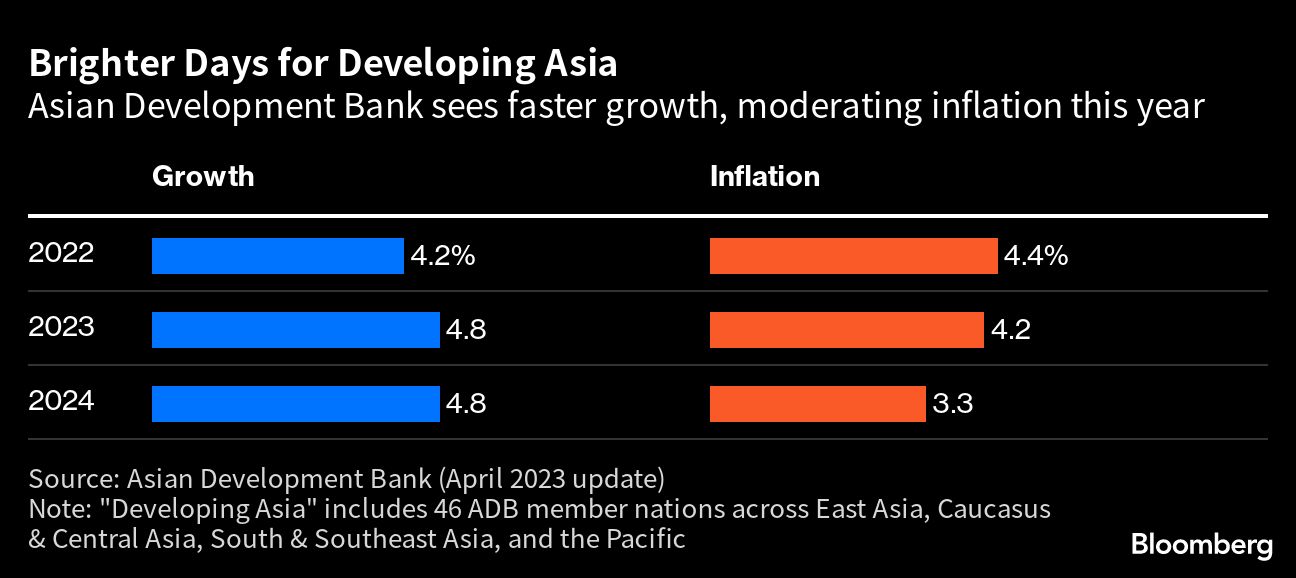
The Asian Development Bank this week said that Asia's developing economies, led by China, are on course for faster growth and slower inflation this year and next, while advanced economies are contributing to a darker global outlook.

China's rebound is expected to percolate throughout the region, which also benefits from supply-chain diversification, booming commodities and a lack of excessive debt growth, said Frederic Neumann, chief Asia economist at HSBC Holdings Plc in Hong Kong.
Citi's Chua reckons that Hong Kong and Thailand, which benefit from China's re-opening, and domestic services-led economies like India and the Philippines “look relatively more resilient” to a global growth shock. “Small, open economies” like Singapore, Vietnam, South Korea, Malaysia and Taiwan would likely be more vulnerable to those spillovers.
The banking turmoil may also mean that Asian tech money invested in the US could now begin to make its way back.
“Within Asia, I think Singapore will be the major beneficiary,” said Prashant Newnaha, macro strategist at TD Securities. “Singapore has strong legal and banking frameworks and is looking to establish itself as the leader in tech and crypto within the region.”
Still, there are risks. Recent gloomy factory data from China damped confidence about the speed of the nation's rebound. And China's worsening relationship with the US increases the potential risks of investing in places such as Hong Kong and Taiwan, Invesco's Chao said.
Moreover, Asia isn't totally immune to the financial instability that spread from the US.
“The outlook really depends on whether things stabilize in Europe and North America,” said Jonathan Kearns, chief economist at Sydney-based investment management firm Challenger Ltd and a former Reserve Bank of Australia official. “If there is some degree of ongoing turmoil, it will spill to Asia as well.”
--With assistance from Garfield Reynolds and Bonnie Au.
More stories like this are available on bloomberg.com
©2023 Bloomberg L.P.

-
The Economic Imperative: Analysing The Material Driving Force Behind India-Canada Strategic Reset

This economic complementarity is further reinforced by deep institutional investment ties and talent mobility, which form the bedrock of the bilateral framework.
-
Medicine Pricing: Where Must Profit Stop?
India must confront excessive margins, hidden incentives and regulatory gaps that threaten the integrity of medicine.
-
Why Amazon And Flipkart Are Struggling To Beat Meesho In India's Smaller Cities
With 274 million users and lowest-cost logistics, Meesho is defending its value commerce crown against giants like Amazon and Flipkart.
-
High US Salaries, No Green Card Certainty: The Financial Calculation Facing Indian H-1B Families
The suspension of PERM processing at eight technology employers does not cancel existing H-1B visas. What it does is force a question many Indian families have been avoiding: is the US salary worth tying your career and family plans to one employer?
-
Swiggy vs Eternal: Food Delivery's Two Rivals Are No Longer In The Same Race
Eternal is building a private AI assistant, dark.ai. Swiggy is still working out how to make Instamart pay, with an operating loss of Rs 895 crore in the July-September quarter while Blinkit stayed profitable.
-
Where You Live Shapes How You Get To Work | The Reason Why
Two-wheelers are the most popular way to get to work in India, accounting for nearly 43% of workplace commutes.
-
Unhedged Position: Can India See An Indonesia-Style Time Correction?
The Nifty is trading below levels it first clocked in 2024. Is there, then, as I have suggested in the headline, potential that the current time correction drags on painfully for the next three-five, even ten years?
-
Navigating Friction And Energy Realities: An Analysis Of Marco Rubio's October Visit To India
Occurring at a critical juncture marked by stalled trade negotiations and escalating geopolitical pressures over global energy supplies, the visit offers a profound window into modern US-India relations.
-
India Exports Capital. Why Not Export Trusteeship?
The big question, then, is whether India can build an institution that global borrowers, investors, banks, and lawyers can trust, even without an Indian connection.
-
France's Economy & Politics Are In Crisis | The Reason Why
Let's look at how the French economy and politics evolved under Nicolas Sarkozy, Franois Hollande and Emmanuel Macron.










