IMF Warns Five-Year Global Growth Outlook Is Weakest Since 1990
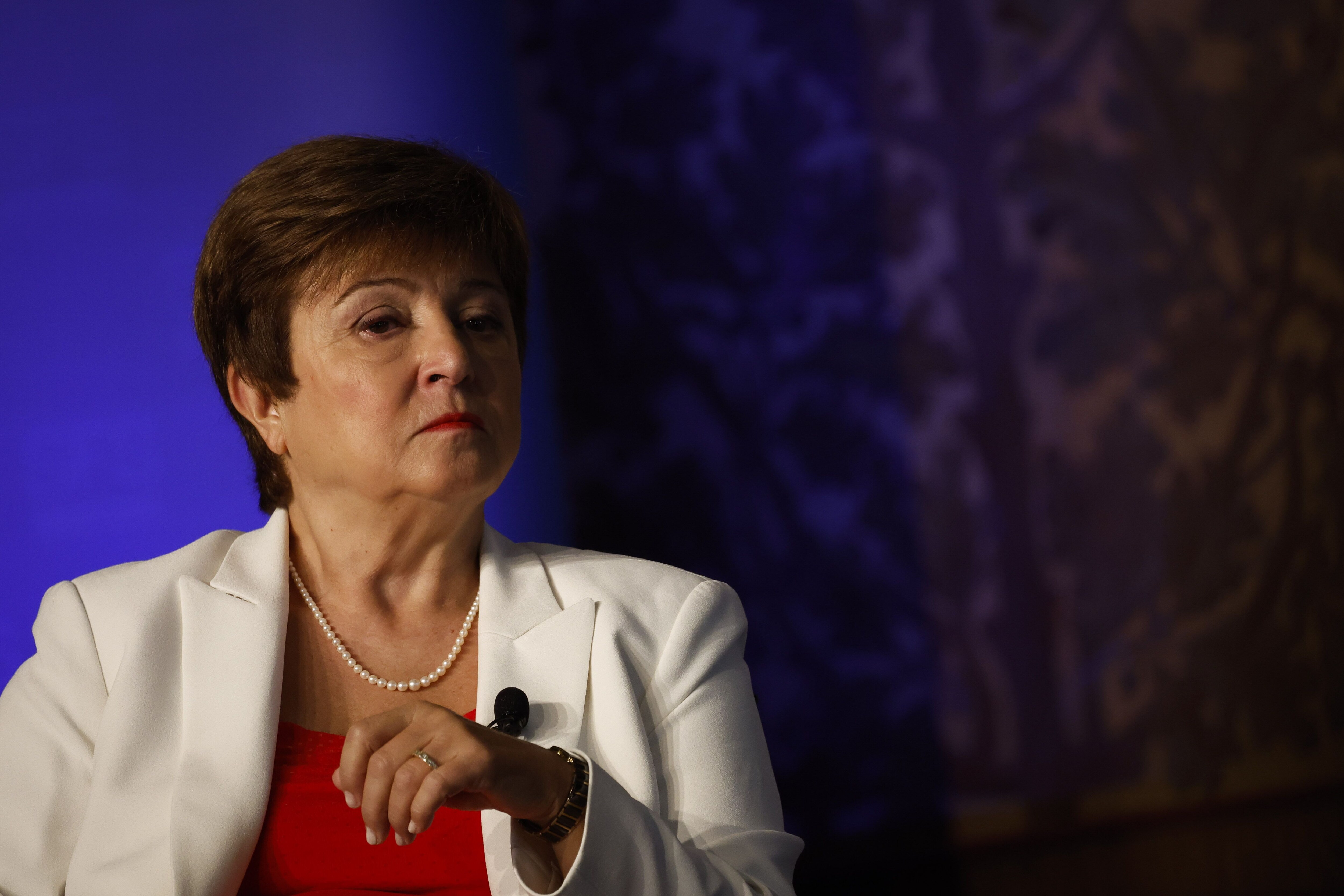
(Bloomberg) -- The International Monetary Fund warned that its outlook for global economic growth over the next five years is the weakest in more than three decades, urging nations to avoid economic fragmentation caused by geopolitical tension and take steps to bolster productivity.
The emergency lender sees the world economy expanding about 3% over the next half decade as higher interest rates bite, Managing Director Kristalina Georgieva said in a speech prepared for delivery in Washington Thursday. That's the lowest medium-term growth forecast since 1990 and less than the five-year average of 3.8% from the past two decades.

For 2023, global gross domestic product will likely expand by less than 3%, she said. That's in line with the fund's January forecast of 2.9%.
About 90% of advanced economies will see growth slow this year as tighter monetary policy weighs on demand and slows economic activity in the US and euro area, the IMF said. It plans to release a more detailed World Economic Outlook report on April 11 as part of its Spring Meetings held together with the World Bank.
Russia's invasion of Ukraine has worsened already tense relations between the US and China, exacerbated a global inflation crisis and is spurring hunger around the world.
“With rising geopolitical tensions and still-high inflation, a robust recovery remains elusive,” Georgieva said in her prepared remarks. “This harms the prospects of everyone, especially for the most vulnerable people and countries.”
Some emerging markets are showing strength, particularly in Asia, with India and China expected to account for half of global expansion. But low-income nations are hamstrung by weakening demand for their exports, with their per-capita income growth remaining below that of the emerging economies. Poverty and hunger that increased during the coronavirus pandemic could climb.
Despite the bleak growth outlook, high inflation means that central banks must continue to raise interest rates, as long as financial stability pressures remain limited after recent banking industry upheaval in the US and Switzerland, Georgieva said.
If the banking system becomes unstable, policymakers will face more complicated trade-offs between inflation and the safeguarding the financial system, Georgieva added. “They need to be more vigilant and more agile than ever.”
Policymakers are set to converge on Washington for sessions focused on numerous global challenges, from unsustainable debt in developing nations to inflation to climate change.
Georgieva's stark message comes a day after the IMF warned that geopolitical fragmentation, driven by tensions between the US and China, risks damaging the global economy, with foreign direct investment and other capital increasingly being channeled toward aligned blocs of countries.
She repeated a warning from January that longer-term trade fragmentation — including restrictions on migration, capital flows and in international cooperation — could cut global gross domestic product by as much as 7% —- equivalent to the combined annual output of Germany and Japan. Interruptions to technology trade could see losses as large as 12% of GDP for some countries, Georgieva said.
Russia's invasion last year sent already strong inflation in many nations spiraling to its highest level in decades. Chinese President Xi Jinping's support for the Russian leader, Vladimir Putin, including a high-profile trip to Moscow last month, drew criticism from the Biden administration and worsened the relationship between the US and China.
Relations between the world's two largest economies have worsened in recent years. They deteriorated under former President Donald Trump, who kicked off a trade war that resulted in hundreds of billions of dollars in tit-for-tat tariffs. President Joe Biden's administration has sustained a hard line, focused mainly on economic and national-security concerns.
Washington last year unleashed strict export controls on semiconductor technologies to China and has spent years targeting Huawei Technologies Co., a leader in telecommunications infrastructure that the US has deemed a national security threat with ties to the Chinese government.
Just last week, Beijing opened a new front in the escalating chip battle, launching a cybersecurity review of imports from America's largest memory-chip maker, Micron Technology Inc. And on Wednesday, US House Speaker Kevin McCarthy and a bipartisan group of lawmakers met with Taiwan's President Tsai Ing-wen in California. a visit to the US that China has protested.
Amid that conflict and after the supply-chain disruptions of Covid-19, the US has encouraged nearshoring and “friend-shoring,” urging companies to move suppliers into aligned countries closer to home and particularly away from Asia and China.
Georgieva urged countries to be pragmatic about strengthening supply chains. She also repeated a call for IMF members to provide debt relief to distressed nations, and to contribute to a trust for the poorest countries that is short billions of dollars.
More stories like this are available on bloomberg.com
©2023 Bloomberg L.P.

-
The Economic Imperative: Analysing The Material Driving Force Behind India-Canada Strategic Reset

This economic complementarity is further reinforced by deep institutional investment ties and talent mobility, which form the bedrock of the bilateral framework.
-
Medicine Pricing: Where Must Profit Stop?
India must confront excessive margins, hidden incentives and regulatory gaps that threaten the integrity of medicine.
-
Why Amazon And Flipkart Are Struggling To Beat Meesho In India's Smaller Cities
With 274 million users and lowest-cost logistics, Meesho is defending its value commerce crown against giants like Amazon and Flipkart.
-
High US Salaries, No Green Card Certainty: The Financial Calculation Facing Indian H-1B Families
The suspension of PERM processing at eight technology employers does not cancel existing H-1B visas. What it does is force a question many Indian families have been avoiding: is the US salary worth tying your career and family plans to one employer?
-
Swiggy vs Eternal: Food Delivery's Two Rivals Are No Longer In The Same Race
Eternal is building a private AI assistant, dark.ai. Swiggy is still working out how to make Instamart pay, with an operating loss of Rs 895 crore in the July-September quarter while Blinkit stayed profitable.
-
Where You Live Shapes How You Get To Work | The Reason Why
Two-wheelers are the most popular way to get to work in India, accounting for nearly 43% of workplace commutes.
-
Unhedged Position: Can India See An Indonesia-Style Time Correction?
The Nifty is trading below levels it first clocked in 2024. Is there, then, as I have suggested in the headline, potential that the current time correction drags on painfully for the next three-five, even ten years?
-
Navigating Friction And Energy Realities: An Analysis Of Marco Rubio's October Visit To India
Occurring at a critical juncture marked by stalled trade negotiations and escalating geopolitical pressures over global energy supplies, the visit offers a profound window into modern US-India relations.
-
India Exports Capital. Why Not Export Trusteeship?
The big question, then, is whether India can build an institution that global borrowers, investors, banks, and lawyers can trust, even without an Indian connection.
-
France's Economy & Politics Are In Crisis | The Reason Why
Let's look at how the French economy and politics evolved under Nicolas Sarkozy, Franois Hollande and Emmanuel Macron.










