Harvard’s President Claudine Gay To Resign After Controversy
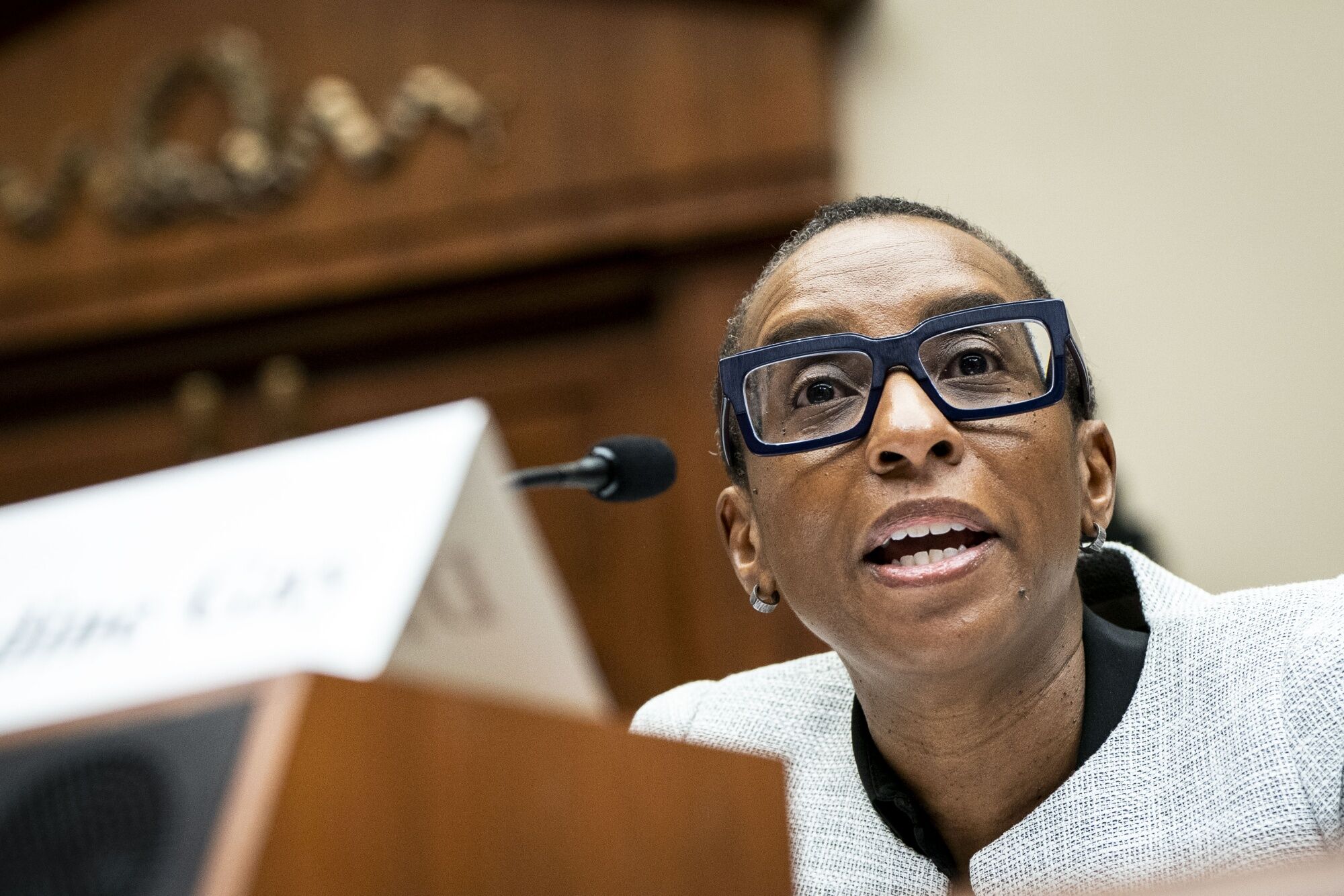
(Bloomberg) -- Claudine Gay is stepping down as president of Harvard University, ending a brief and tumultuous tenure marred by allegations of plagiarism and a campus controversy over antisemitism.
“After consultation with members of the Corporation, it has become clear that it is in the best interests of Harvard for me to resign so that our community can navigate this moment of extraordinary challenge with a focus on the institution rather than any individual,” Gay wrote in a statement.
Her exit is a dramatic about-face from her acclaimed start in July as Harvard's first Black president. Even as recently as Dec. 12, she enjoyed the unanimous backing of Harvard Corp., the university's governing council. Since then, however, new questions have surfaced about her academic work, and a donor revolt over the school's handling of antisemitism has only worsened.
Read more: Harvard's Financial Strain Grows as Blavatnik Joins Donor Revolt
The Harvard Corp., led by Penny Pritzker, said in its own statement that provost and chief academic officer Alan Garber will become interim president and it will undertake a search for a new leader. The letter made reference to Gay's acknowledgment of “missteps,” but also said that she faced “repugnant and in some cases racist vitriol” through phone calls and emails.
“It has been distressing to have doubt cast on my commitments to confronting hate and to upholding scholarly rigor—two bedrock values that are fundamental to who I am—and frightening to be subjected to personal attacks and threats fueled by racial animus,” Gay said in the letter written to members of the Harvard community. She will remain a member of the faculty.

The Harvard Crimson first reported that Gay would resign on Tuesday, after fresh allegations of plagiarism were reported in the Washington Free Beacon.
Gay's abrupt downfall, the second departure in recent weeks of an Ivy League president, underscores the furor on campus following the Oct. 7 attack by Hamas on Israel.
Opposition to Gay had been building in the wake of the attack by Hamas, which is designated a terrorist group by the US and European Union. One of her predecessors as Harvard president, Larry Summers, criticized the university for not speaking out after more than 30 student groups blamed Israel solely for the violence. Gay subsequently condemned the “terrorist atrocities” and spent weeks reaching out to Jewish groups on campus amid concern over antisemitic incidents.
At the same time, however, another controversy had started to swirl around Gay fueled by articles first reported in conservative-leaning media questioning whether she had committed plagiarism.
Allegations of wrongdoing in research are among the most serious in academia. Stanford University President Marc Tessier-Lavigne announced his resignation in July after months of scrutiny of his scientific work that began with reports in the school's student newspaper.
In August, he retracted two papers — flawed brain studies from 2001 that had been cited hundreds of times by other scientists, a sign of their acceptance as important scholarship. Tessier-Lavigne remains a faculty member at Stanford. A special committee of Stanford's board – which included Harvard Corp. member and former Princeton President Shirley Tilghman— began the review of allegations of research misconduct in December 2022.
In backing Gay on Dec. 12, Harvard Corp. said it had examined her work as a political scientist and found “a few instances of inadequate citation” but no violation of Harvard's research standards.
Gay's standing worsened Dec. 20 when Harvard found two more examples of “duplicative language without appropriate attribution.”

In addition, a US House of Representatives committee, which had already announced an investigation of antisemitism at Harvard, widened its focus to include the school's handling of the plagiarism allegations against Gay. Committee Chair Virginia Foxx, a North Carolina Republican, sent a letter to Pritzker and asked Harvard for a response by Dec. 29. The school later received more time to reply.
Gay's position took a major blow at a hearing that the House committee had held on Dec. 5 about antisemitism on US campuses. Gay, along with the presidents of the University of Pennsylvania and the Massachusetts Institute of Technology, gave much excoriated testimony in which they failed to condemn calls for genocide against Jews as a violation of university policy.
The presidents' evasive and legalistic responses to questions from lawmakers, particularly Representative Elise Stefanik, a New York Republican and Harvard alumna, drew widespread outrage. Video clips of the exchanges went viral on social media. Harvard Law School Professor Laurence Tribe, a Gay supporter, described Gay's testimony as “bizarrely evasive.”
Gay later apologized in an interview with the Crimson, saying calls for violence or genocide against the Jewish community, or any religious or ethnic group, are “vile” and “have no place at Harvard.”
Penn President Liz Magill resigned four days after the hearing and board Chair Scott Bok also stepped down. MIT's Sally Kornbluth received strong support from her board.
Stefanik said Gay's decision today was “long overdue.”
“Claudine Gay's morally bankrupt answers to my questions made history as the most viewed congressional testimony in the history of the US Congress,” Stefanik, a Harvard alum, said on Tuesday. “Her answers were absolutely pathetic and devoid of the moral leadership and academic integrity required of the president of Harvard.”
Read more: Why Israel-Hamas War Puts Heat on College Leaders: QuickTake
Even before the hearing, many big donors were rethinking their commitments to Harvard, the oldest and richest US university. Billionaires such as Idan Ofer and Leslie Wexner pulled their support, while many less wealthy alumni also curtailed donations.
While the university has an endowment exceeding $50 billion, the university spends billions of dollars on salaries, wages and benefits for staff and a prolonged downturn in donations could start to threaten financial aid for students, one of its key goals.
Hedge fund manager Seth Klarman and US Senator Mitt Romney, who are both alumni, accused the university of ignoring the safety of Jewish students as pro-Palestinian protests on campus intensified amid Israel's invasion of Gaza. Investor Bill Ackman repeatedly demanded Gay's resignation and almost daily posted or reposted criticisms. On Tuesday, he wrote a cryptic reference to MIT's Kornbluth.
Gay is the daughter of Haitian immigrants and earned her Ph.D. at Harvard in 1998, winning the Toppan Prize for best dissertation in political science. After teaching at Stanford, she returned to Harvard in 2006 as a professor of government.
She held a number of administrative positions, including dean of Harvard's Faculty of Arts and Sciences, before being named president. Gay is a scholar of political behavior, considering issues of race and politics in America.
She took the reins at the Cambridge, Massachusetts-based school on July 1, two days after the Supreme Court ruled against the university in a case that effectively banned race in undergraduate admissions. She was the 30th president of the university, but the first black leader and only the second woman.
“When my brief presidency is remembered, I hope it will be seen as a moment of reawakening to the importance of striving to find our common humanity—and of not allowing rancor and vituperation to undermine the vital process of education,” Gay said in the statement.
(Updates with Harvard endowment and budget in 23rd paragraph.)
More stories like this are available on bloomberg.com
©2024 Bloomberg L.P.

-
Getting To Work Costs Women More | The Reason Why

It is not just about women paying more than men. It is about women paying much more in cities than in villages.
-
AI Bias In Investing Cannot Be Eliminated, But It Can Be Governed
Framing is a particularly important example as identical financial information presented in terms of gains rather than losses can lead an LLM to reach a different assessment.
-
Joining The Dots | Dark Skies, Steady Diya: Why Hope Holds This Diwali
With war, a weak rupee and foreign outflows weighing on sentiment, policymakers at the NDTV World Summit and market veterans at NDTV Profit Ignite: Diwali Edition offered the same advice: stay invested and filter out the noise.
-
The Curious Case of Equitas Small Finance Bank And A CEO Who Quit For Stock
PN Vasudevan believes persistent investor concerns over a perceived conflict of interest had become a governance overhang on Equitas Small Finance Bank's stock, even as the lender improved profitability and asset quality.
-
Talking Points This Week: AI Cash Burn, A Tiger Comeback And An India That Still Finds Its Own Path
India is not immune to higher oil or tighter global liquidity, yet its earnings base is broader, its domestic policy levers are still available.
-
Foreign Investors Own Half Of HDFC Bank and ICICI Bank. An LTCG Cut Could Matter Most Here
Foreign portfolio investors have US$115 billion parked in HDFC Bank, ICICI Bank. If the government cuts long-term capital gains tax, Jefferies says returning foreign money could land here first.
-
'Never Seen This Level Of Negativity': Sandeep Tandon Says The Next Rally May Be Closer Than You Think
Veteran investor Sandeep Tandon says foreign selling is easing, large-caps are due a comeback and mid-caps are crowded, while he turns positive on gold, power and pharma this Diwali.
-
Indians Stay With Family, Not In Hotels | The Reason Why
India still lacks enough clean, reliable and affordable hotels for budget-conscious travellers.
-
The Economic Imperative: Analysing The Material Driving Force Behind India-Canada Strategic Reset
This economic complementarity is further reinforced by deep institutional investment ties and talent mobility, which form the bedrock of the bilateral framework.
-
Medicine Pricing: Where Must Profit Stop?
India must confront excessive margins, hidden incentives and regulatory gaps that threaten the integrity of medicine.










