Global Tech Stocks Drop As ASML Warning Adds To Nvidia Curbs
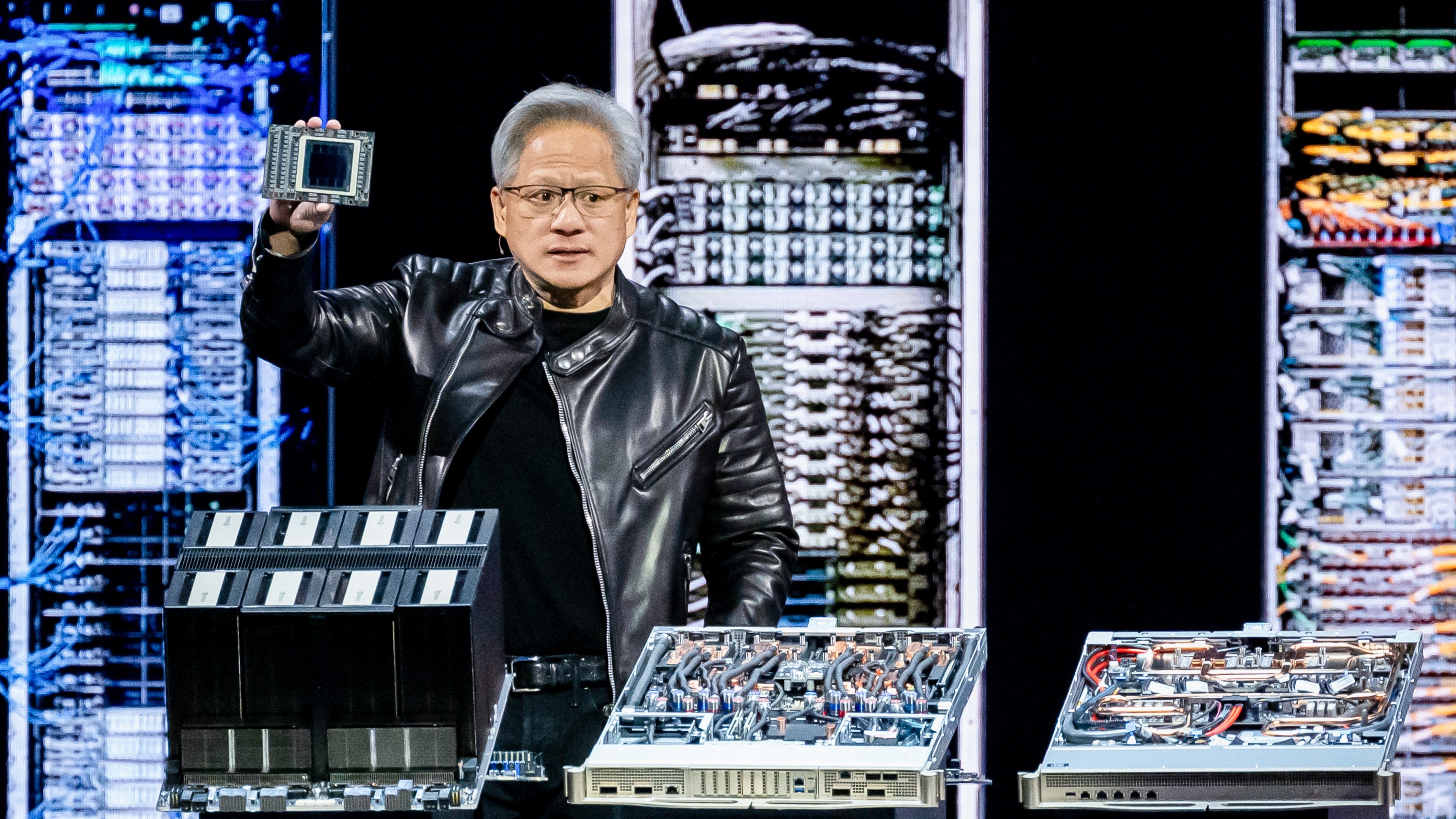
Technology stocks sank as new US government restrictions on the export of Nvidia Corp. chips to China and a disappointing report from ASML Holding NV dimmed the outlook for the semiconductor sector, wiping out $155 billion in market value for the two companies alone.
Nvidia fell as much as 7.1% in US premarket trading after the chipmaker warned it will report around $5.5 billion in related charges during the fiscal first quarter, contributing to a 1.3% decline in Nasdaq 100 futures. Dutch chip-equipment maker ASML slid as much as 7.6%. The selloff in semiconductor stocks over the past three months has already wiped out about $2 trillion in market capitalization.

Nvidia headquarters in Santa Clara, California.
President Donald Trump's administration has barred Nvidia from selling its H20 chip in China, an escalation of Washington's tech battle with Beijing. ASML later added to investor anxiety by posting orders that missed expectations and saying that it doesn't know how to quantify the impact of recent tariff announcements.
“While ASML delivered on the revenue front, it has left investors disappointed at a time when uncertainty will punish such results,” said Ben Barringer, a technology analyst at Quilter Cheviot. Coupled with the latest export restrictions on Nvidia chips, “all of this just adds to the multitude of headaches facing tech CEOs right now, with no sign of the difficulty ending soon.”
The latest developments show how tariffs are already wreaking havoc on global companies. ASML's drop weighed on Europe's semiconductor industry peers, sending the Stoxx 600 Technology Index down by 2.2%.
Trump's trade war is prompting economists to scale back their forecasts for GDP growth worldwide, casting doubt over the outlook for everything from smartphone demand to computing.
Even before Washington slapped additional tariffs on much of the world — only to roll them back shortly after — analysts had questioned whether big tech firms from Microsoft Corp. to Meta Platforms Inc. will continue to buy Nvidia chips at the same pace in 2025.
A bigger-than-expected drop in ASML's bookings failed to alleviate concerns over a potential slowdown in AI demand. Investor focus will now turn to results from key customer Taiwan Semiconductor Manufacturing Co. on Thursday.
While ASML's management affirmed long-term optimism, “the bookings miss sparked fresh debates about whether the AI-driven spending spree from giants like Google, Nvidia, and Microsoft might be cooling down,” said Jacob Falkencrone, global head of investment strategy at Saxo.

Semiconductor firms, which are highly sensitive to economic cycles, have borne the brunt of the market selloff this year. The Philadelphia Semiconductor Index has declined nearly 20% in 2025, trailing a 8% drop in the S&P 500.
The latest curbs on Nvidia's exports to China marked another setback to an industry already battered by geopolitical tensions and a disrupted supply chain.
The H20 restrictions are “driven by concerns over China's rise in the electronics sector, and in that sense, it is likely to become a permanent policy,” said Tomo Kinoshita, global market strategist at Invesco Asset Management. “It is expected to have a significant negative impact on the semiconductor supply chain.”
Among Nvidia's key Asia suppliers, Korean memory maker SK Hynix Inc. slumped 3.7% Wednesday, while Taiwan's TSMC declined 2.5%. Japanese chip-equipment maker Advantest Corp. dropped 6.6%.
Read more: Asia Nvidia Supplier Stocks Drop on H20 Chip Export Restrictions
For China, the broader restrictions raise concerns that access to global tech hardware will be further choked off. Exports of the most-advanced chips and equipment to the Asian nation are already banned, and the H20 is a scaled-down product specifically designed not to be too powerful.
“It is a reminder of the potential susceptibility of tech stocks to the ongoing prickly relationship between the US and China regarding semiconductors,” said Tim Waterer, chief market analyst at KCM Trade in Sydney. “There is a reliance on the H20 chip from big name players in the Asian tech space, so any moves which could impact supply will be a drag on the broader sector.”
US-listed Chinese tech stocks were broadly lower in premarket trading, with Alibaba Group Holding Ltd. down 2.2% and Baidu Inc. falling 1.5%.
On the other side of the equation, China continues to work toward self-reliance in technology, though its companies are still seen lagging far behind advanced global leaders like Nvidia.
Among Chinese hardware stocks bucking the regional sector declines Wednesday, Hua Hong Semiconductor Ltd. closed up 0.6% in Hong Kong while Advanced Micro-Fabrication Equipment Inc. rose 2.5% in Shanghai.
“AI innovation in China is booming and the H20 ban would not dampen it — it may accelerate the use of China domestic chips,” said Vey-Sern Ling, a managing director at Union Bancaire Privee. “Domestic AI chips may not perform as well as Nvidia's H20, but that is missing the point. China has been able to develop innovative AI models despite US restrictions.”

-
Indians Are Travelling, But Not Every Journey Is A Holiday | The Week In Whys

Pilgrims, patients and working women are the real travellers, and the system hasn't quite caught up with them.
-
Getting To Work Costs Women More | The Reason Why
It is not just about women paying more than men. It is about women paying much more in cities than in villages.
-
AI Bias In Investing Cannot Be Eliminated, But It Can Be Governed
Framing is a particularly important example as identical financial information presented in terms of gains rather than losses can lead an LLM to reach a different assessment.
-
Joining The Dots | Dark Skies, Steady Diya: Why Hope Holds This Diwali
With war, a weak rupee and foreign outflows weighing on sentiment, policymakers at the NDTV World Summit and market veterans at NDTV Profit Ignite: Diwali Edition offered the same advice: stay invested and filter out the noise.
-
The Curious Case of Equitas Small Finance Bank And A CEO Who Quit For Stock
PN Vasudevan believes persistent investor concerns over a perceived conflict of interest had become a governance overhang on Equitas Small Finance Bank's stock, even as the lender improved profitability and asset quality.
-
Talking Points This Week: AI Cash Burn, A Tiger Comeback And An India That Still Finds Its Own Path
India is not immune to higher oil or tighter global liquidity, yet its earnings base is broader, its domestic policy levers are still available.
-
Foreign Investors Own Half Of HDFC Bank and ICICI Bank. An LTCG Cut Could Matter Most Here
Foreign portfolio investors have US$115 billion parked in HDFC Bank, ICICI Bank. If the government cuts long-term capital gains tax, Jefferies says returning foreign money could land here first.
-
'Never Seen This Level Of Negativity': Sandeep Tandon Says The Next Rally May Be Closer Than You Think
Veteran investor Sandeep Tandon says foreign selling is easing, large-caps are due a comeback and mid-caps are crowded, while he turns positive on gold, power and pharma this Diwali.
-
Indians Stay With Family, Not In Hotels | The Reason Why
India still lacks enough clean, reliable and affordable hotels for budget-conscious travellers.
-
The Economic Imperative: Analysing The Material Driving Force Behind India-Canada Strategic Reset
This economic complementarity is further reinforced by deep institutional investment ties and talent mobility, which form the bedrock of the bilateral framework.










