GDP Is Stronger With A Blue White House And Red States

(Bloomberg Opinion) --The last US gross domestic product numbers to be released before the election, out last week, put inflation-adjusted growth since Joe Biden took office at annual rate of just more than 3%, which if it holds up for his full term would make his presidency by far the best for economic growth since Bill Clinton's. It's well ahead of the 2.1% annualized GDP growth during the term of his predecessor and possible successor, Donald Trump.
Trump was, of course, dealt the awful hand of a global pandemic during the final year of his term, so there's a reasonable argument for also looking at GDP growth during his administration pre-Covid-19, which was an annualized 2.9%, just slightly less than under Biden. There's also an argument for ignoring Biden's first year in office because the economy was still bouncing back from Covid — although real GDP had already recovered all its pandemic losses and then some by the first quarter of 2021 — which puts his growth rate at 2.7%.
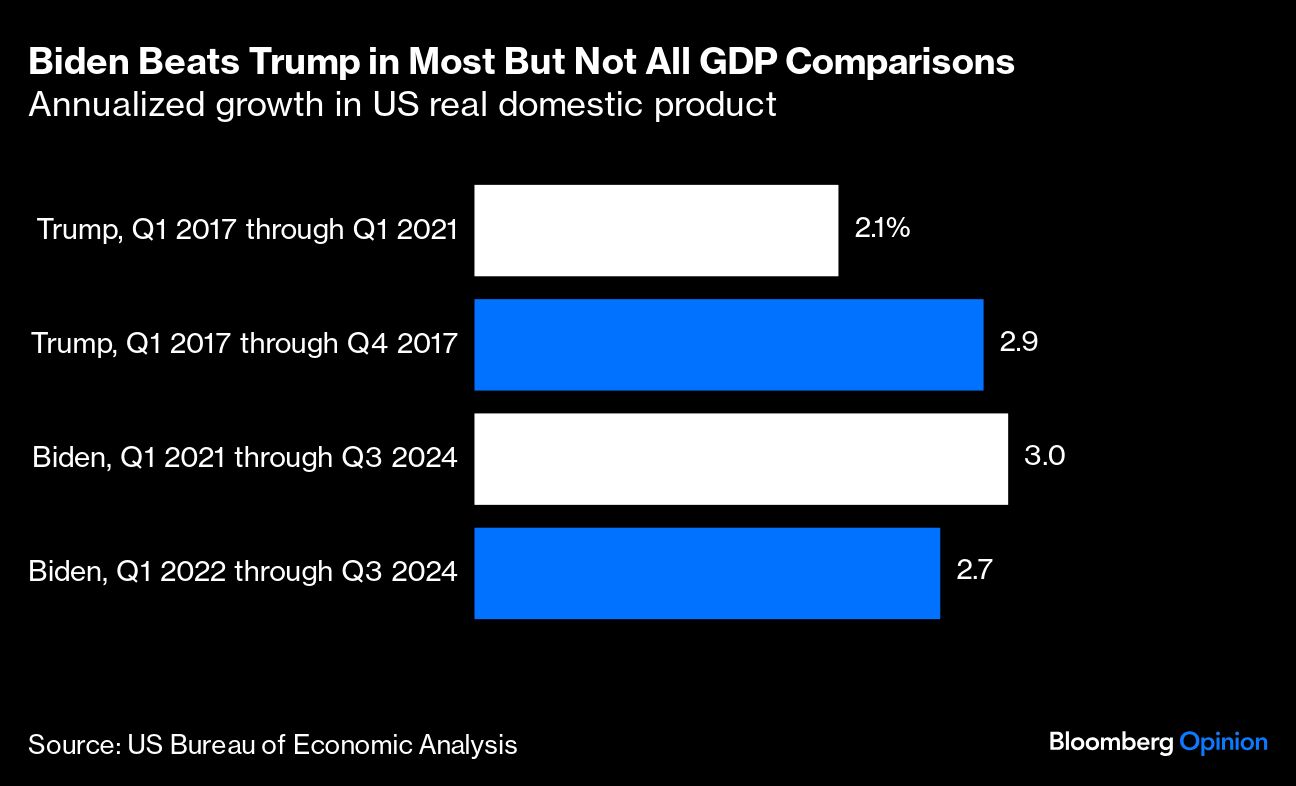
In any case, it is looking as if GDP growth during the Biden years will fit the long-running pattern (with Ronald Reagan's presidency the only real exception) of the US economy growing faster under Democratic presidents than Republican ones.
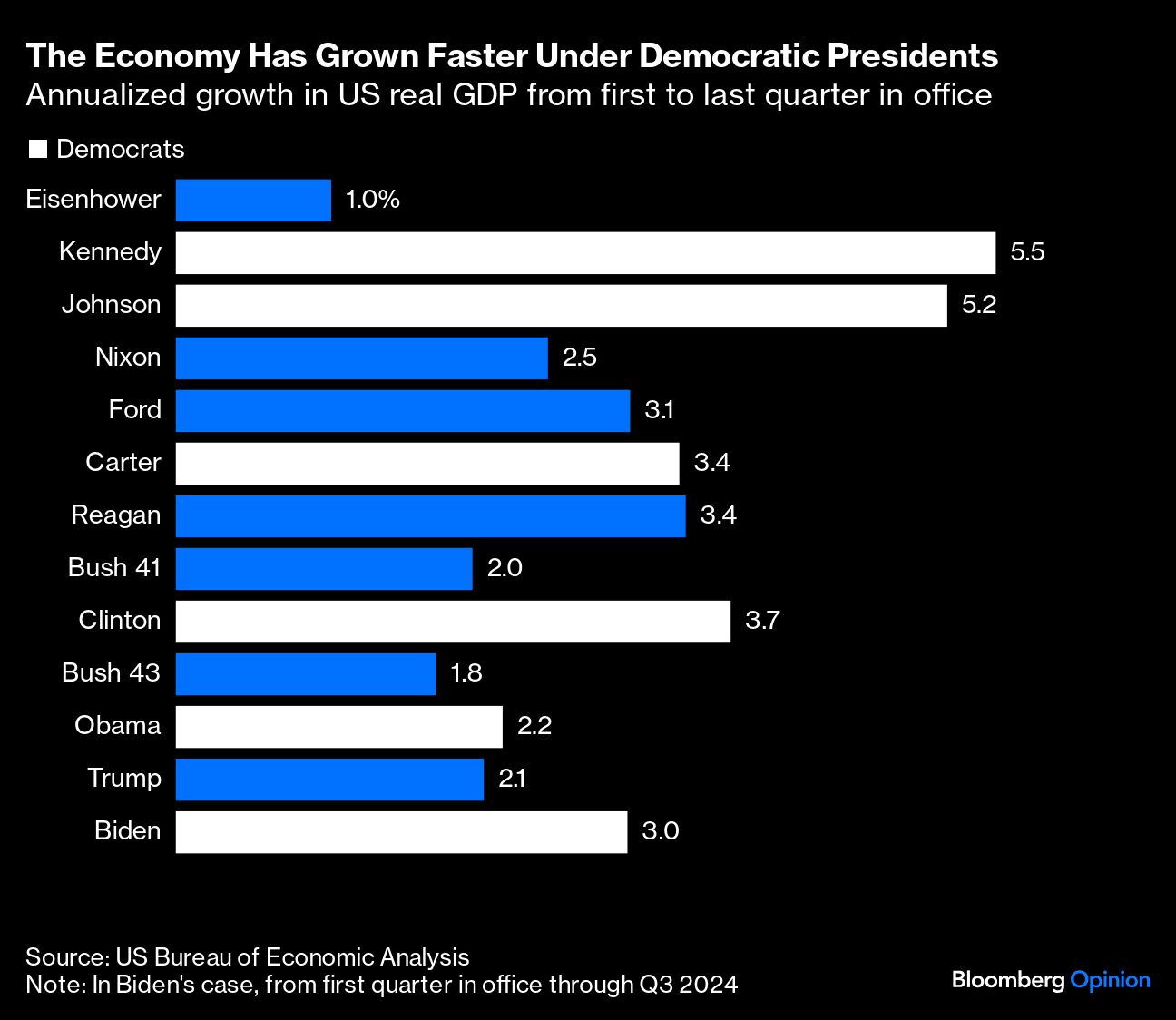
This chart starts with Eisenhower because he's the first president for whom quarterly GDP numbers, which are available from 1947 onward, cover his entire time in office. Calculating growth rates by four-year presidential terms allows one to include Harry Truman's second term as well and turns up average annual GDP growth of 3.9% under Democrats (assuming Biden's growth rate so far holds up for his full term) and 2.4% under Republicans. Annual data available back to 1929 makes the comparison look even worse for the Republicans — 4.5% to 1.7% calculating from the first year of each term to the last — because it includes the economically disastrous presidency of Herbert Hoover.
This Democratic advantage in national economic performance shows up in more than just GDP numbers and has been widely remarked upon over the years. It was even subjected to an econometric analysis published in the prestigious American Economic Review in 2016 that came to the unhelpful conclusion that it was due mainly to “more benign oil shocks, superior total factor productivity (TFP) performance, a more favorable international environment, and perhaps more optimistic consumer expectations about the near-term future” — that is, not obvious differences in economic policy. In an updated review of the evidence this March, Harvard economist and former Clinton administration official Jeffrey Frankel concluded that the pattern seemed too strong to be pure chance but “remains a puzzle.”
Another seeming puzzle is why, despite this evidence, so many Americans (including many otherwise-data-driven financial professionals with Bloomberg terminals who send me cranky messages whenever I do one of these presidential GDP comparisons) believe that the opposite is true — that Republicans are much better for the economy.
Or maybe that's not such a puzzle. People may believe Republicans are better at managing the economy because, below the national level, Republican-run places really have had the edge in recent years.
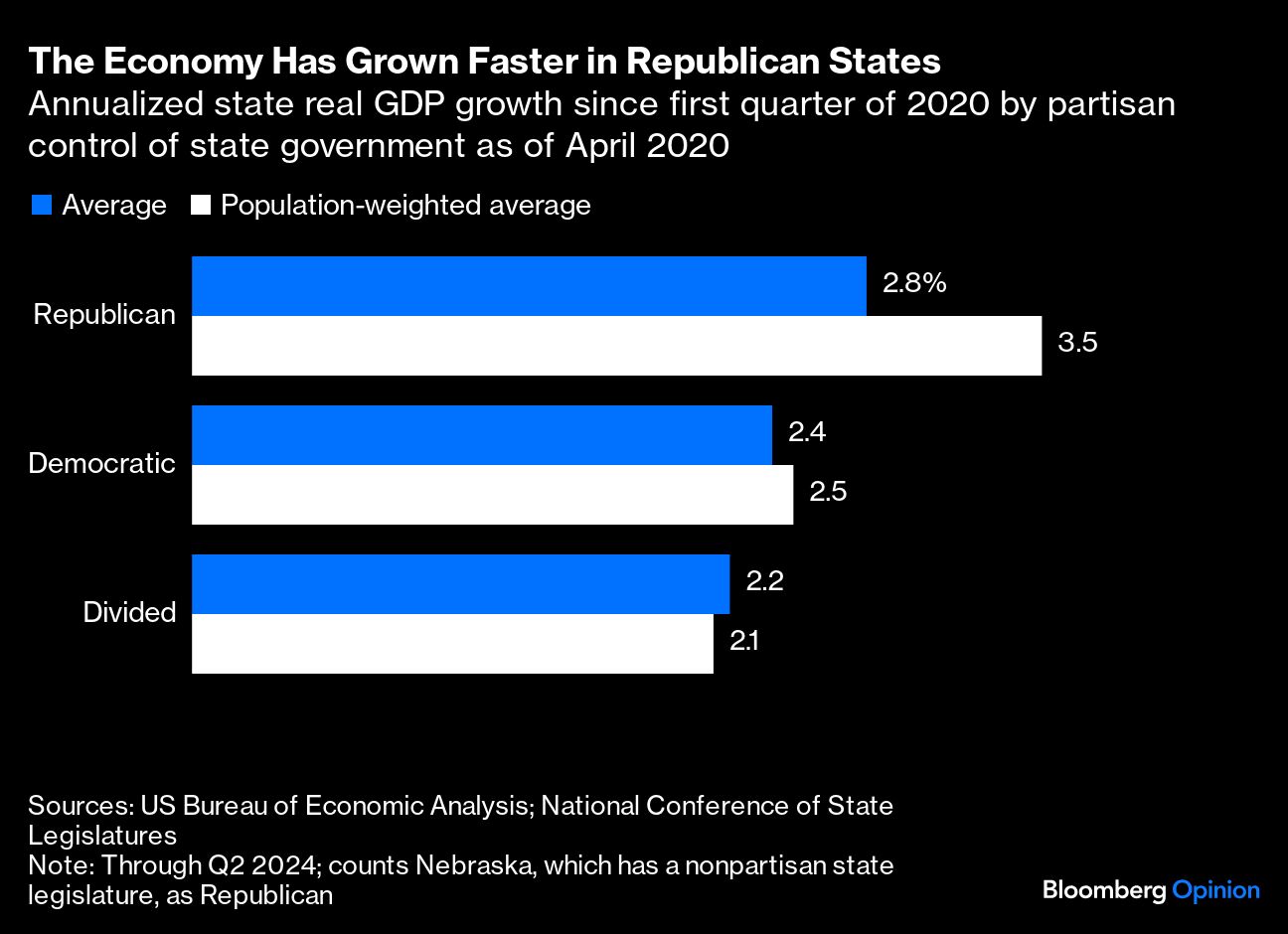
There are more sophisticated ways of doing this analysis, of course. I chose this one because it was (1) quick and (2) transparent. There haven't been all that many changes in state partisan control since 2020, so that didn't seem like a big issue. To check if timing was, I also ran the numbers starting from the first quarters of 2021 and 2022. Growth since Q1 2022 showed a pattern similar to the above, but Democratic-run states managed a slight edge in unweighted average growth since Q1 2021 that I think can be attributed to Democratic-run states shutting down more of their economies in 2020 and thus experiencing more of a rebound the next year. Even then the Republican states outperformed on a population-weighted basis, mainly because of rapid growth in the country's second and third most populous states, Texas (5% annualized GDP growth since Q1 2021) and Florida (5.4%).
Again, I think these differences are probably too big to be attributed to pure chance, although I wouldn't be too sure about the direction of causality. Democratic-run states tend to be richer and more crowded than Republican-run ones, so perhaps growth is harder there. I do think it's fair to say that Republican state officials have been more focused on promoting economic growth than their Democratic counterparts. But this has been true rhetorically at least at the national level, too, with much different results.
It's another puzzle. One possible solution to it is that the centerpiece of Republican economic policy for the past half century — cutting taxes — has less of an economic impact at the federal level than in the states. It's a lot easier to move from New York to Florida to lower your income taxes than to move abroad and renounce your US citizenship. So at the federal level, other economic levers matter more.

-
One El Nino, India Can Handle. Two Could Break The Granary

India's grain stocks can absorb one bad year, but a second El Nino could drain the buffer in two to three years, economists say.
-
India's Troika Of Good Luck | Joining The Dots
As Jensen Huang's exit drags Nvidia down, a cooling AI trade and resilient earnings have revived investor interest in India. A likely RBI rate hike looms.
-
Talking Points This Week: Leadership Shock At Nvidia, Earnings Strength, And The Fog Over Hormuz
The Anthropic IPO pricing and first trading day, Nvidia's upcoming earnings, and any fresh signals from Iran will set the tone for the following week.
-
Signature Play: The Classic Cocktail Is Dead. Or Is It?
Classic cocktails are disappearing from India's cocktail menus. But they're still being ordered, taught to bartenders and borrowed from. So, who's really having the last drink?
-
A New Samvat Wishlist: Inclusive Prosperity And Human Development
India has strengthened its economic foundations through infrastructure, digital access and enterprise. Its next growth chapter must deepen productivity, create better livelihoods and widen participation in prosperity.
-
Love, Sex Aur Dhokha: The Audacious Plot To Spy On Jensen Huang
A Taipei dinner, a Singapore chip buyer and a suspected Chinese asset: inside the alleged spy operation that got close to NVIDIA's Jensen Huang.
-
Ten Things I Learnt This Samvat
Patience can be a trap. Cheap stocks can stay cheap. Leverage can wipe you out. What did Samvat 2082 teach us? Niraj Shah writes on 10 lessons from the year gone by.
-
Talking Points This Week: Tech Nerves, FII Buying, And A Faraway Banking Shock
The global markets are not shining this Diwali. The exception in the large markets is, India.
-
Midterm Rally Lasted A Day. The Hard Reality Of A Divided US May Last Two Years | Opinion
Between a contested AI boom, a debt ceiling that arrives in 2027 and a president with every incentive to act alone, the next two years may prove more volatile than the first day's rally suggests.
-
Blue Wave Will Derail the AI Trade but Won't Dismantle the AI Era | Unhedged Position
The Democrats' sweep of the US Congress will see politics collide with economic forces both over the long and short term.