G20: India Gets Support On Agenda, But Language Differences Hinder Joint Communique
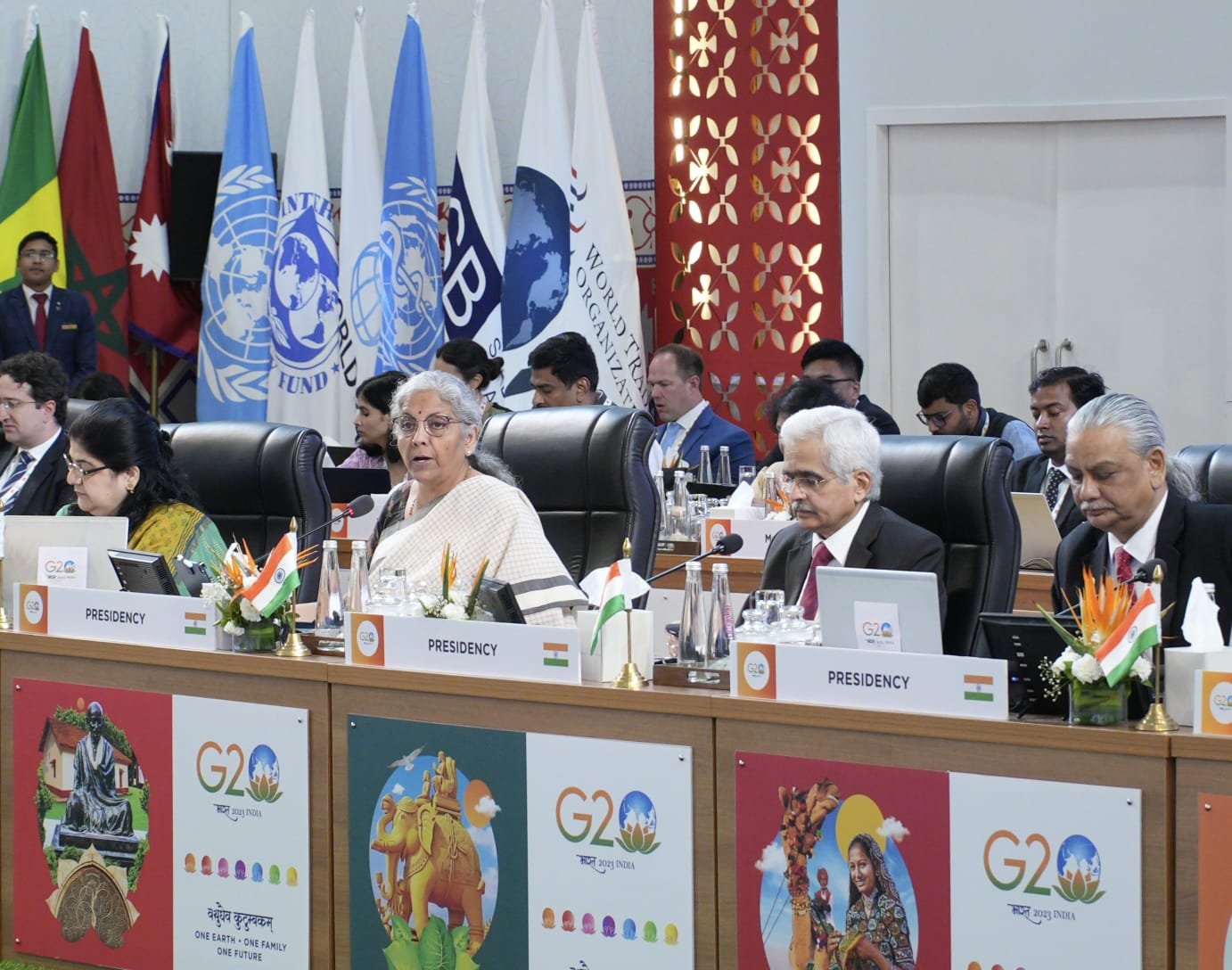
Leaders at the third finance heads' meeting retained their differences over the language of conflict in Ukraine.
World leaders offered support for India's agenda, though a joint communiqué from the Finance Ministers and Central Bank Governors meeting remained elusive. Instead, it concluded with a chair's summary on Tuesday in Gandhinagar.
Finance Minister Nirmala Sitharaman said that it is not the mandate of the finance heads' meeting to make changes to the language on war. It will be left to the leaders to take a call on the language, she said while speaking to the media at the G20 Presidency press conference.
Efforts to arrive at a joint communiqué will now be attempted at the upcoming Leaders' Summit, when G20 world leaders gather in New Delhi on Sept. 9 and 10.
The first Finance Ministers and Central Bank Governors meeting in Bengaluru in February reiterated the language on war used in the 2022 Bali Leader's Declaration in the chair's summary.
Broad agenda topics like the strengthening of multilateral development banks, debt treatment for distressed nations, and crypto regulation saw progress, according to Sitharaman.
The potential macro-financial implications arising from the introduction and adoption of central bank digital currencies for cross-border payments were discussed as well as the international monetary and financial system.
Point Of Contention
The 26-point chair's summary featuring two annexes was largely met with consensus, barring paragraphs 2, 3 and 5.
The second para condemns the aggression by the Russian Federation against Ukraine, and demands its "complete and unconditional withdrawal" from the territory of Ukraine. Prior to this meet, several G20 nations have highlighted this point at the UN Security Council and the UN General Assembly.
The third para states that today's era is not an era for war, and the use or threat of use of nuclear weapons is inadmissible.
According to China, the G20 FMCBG meeting was not the right forum to discuss geopolitical issues.
Russia dissociated itself from paragraphs 2, 3 and 5. The fifth paragraph said that the potential for high level of volatility in food and energy markets remain.
Russia recently exited an international deal to allow the safe shipment of Ukrainian grain through its ports in the Black Sea. IMF's Managing Director Kristalina Georgieva had termed the act "irresponsible", while speaking to NDTV on Tuesday.
"We have seen what happened last year … Those who have nothing to do with the conflict mustn't be impacted," she told NDTV.
Strengthening Of Multilateral Development Banks
The members recognised the urgent need to strengthen and evolve the MDB ecosystem, she said.
"G20 members also endorsed a ‘roadmap for implementation of recommendations of the G20 independent review of MDBs' capital adequacy frameworks'," Sitharaman said. It will help unlock more lending resources in MDBs, she said.
The initial measures hint at yielding additional lending headroom for MDBs amounting to approximately $200 billion over the next decade, as estimated in the G20 CAF Roadmap.
The Indian Presidency had previously constituted an independent expert group on strengthening MDBs—co-chaired by NK Singh, chairman of the 15th Finance Commission, and Larry Summers, former secretary of the U.S. Treasury.
The expert group submitted the first volume of the report, which was discussed by the leaders. Volume 2 is expected in October this year.
A high-level seminar is expected to be held on the sidelines of the Fourth FMCBG meeting in October on strengthening the financial capacity of MDBs.
Debt Treatment
A key item during the meeting was strengthening multilateral coordination to address the deteriorating debt situation and coordinate the debt treatment of distressed nations like Zambia, Ethiopia, and Sri Lanka, among others.
"G20 members welcomed the progress achieved on various ongoing debt treatment cases under the Common Framework and beyond and called for swift and timely resolution of these cases," Sitharaman said.
The Indian Presidency aims to step up the implementation of the "Common Framework in a predictable, timely, orderly and coordinated manner" to serve as a reference point for the debt treatment of debt distressed nations.
"To this end, we ask the G20 International Financial Architecture Working Group to continue discussing policy-related issues linked to implementation of the Common Framework and make appropriate recommendations," the chair's summary document said.
While the debt treatment of Zambia has reached some finality, an official creditor committee for Ghana has been formed. A debt treatment plan for Ethopia and Sri Lanka is awaited.
Crypto Regulatory Framework
According to Reserve Bank of India Governor Shaktikanta Das, the early enthusiasm around cryptocurrency became muted in the wake of the crash of a crypto exchange and the financial system uncertainties that followed, he said while speaking at the G20 Presidency press conference.
The common regulatory framework expected from India's Presidency will culminate in an IMF-Financial Stability Board synthesis paper. However, the paper has been delayed. In the meantime, India has submitted a 'Presidency Note' to the G20 membership, laying down important inputs for a roadmap on crypto assets.
"The roadmap, to be contained in the synthesis paper, will support a coordinated and comprehensive policy and regulatory framework taking into account the full range of risks,and risks specific to the emerging market and developing economies and ongoing global implementation of FATF standards to address money laundering and terrorism financing risks," the statement said.
The G20 will receive the IMF-FSB synthesis paper along with the roadmap before the Leaders' Summit in September.
'Cities of Tomorrow' And Climate Action
The G20 nations also endorsed the G20 Principles for Financing Cities of Tomorrow—which are voluntary and non-binding—and the G20/OECD Report on Financing Cities of Tomorrow.
"We encourage stakeholders, including the Development Financial Institutions and the MDBs, to explore the potential of drawing upon these principles in their planning and financing of urban infrastructure wherever applicable and share experiences from early pilot cases," the chair's summary said.
Financing of climate action and mobilising funds to support the transaction also ranked high on the agenda with recommendations made on scaling up blended finance and risk-sharing facilities, including the enhanced role of MDBs in mobilising climate finance.
There was agreement on looking at mixing fiscal, market and regulatory mechanisms to arrive at the use of carbon pricing and non-pricing mechanisms and incentives to contribute toward carbon neutrality and net zero.

-
AI Bias In Investing Cannot Be Eliminated, But It Can Be Governed

Framing is a particularly important example as identical financial information presented in terms of gains rather than losses can lead an LLM to reach a different assessment.
-
Joining The Dots | Dark Skies, Steady Diya: Why Hope Holds This Diwali
With war, a weak rupee and foreign outflows weighing on sentiment, policymakers at the NDTV World Summit and market veterans at NDTV Profit Ignite: Diwali Edition offered the same advice: stay invested and filter out the noise.
-
The Curious Case of Equitas Small Finance Bank And A CEO Who Quit For Stock
PN Vasudevan believes persistent investor concerns over a perceived conflict of interest had become a governance overhang on Equitas Small Finance Bank's stock, even as the lender improved profitability and asset quality.
-
Talking Points This Week: AI Cash Burn, A Tiger Comeback And An India That Still Finds Its Own Path
India is not immune to higher oil or tighter global liquidity, yet its earnings base is broader, its domestic policy levers are still available.
-
Foreign Investors Own Half Of HDFC Bank and ICICI Bank. An LTCG Cut Could Matter Most Here
Foreign portfolio investors have US$115 billion parked in HDFC Bank, ICICI Bank. If the government cuts long-term capital gains tax, Jefferies says returning foreign money could land here first.
-
'Never Seen This Level Of Negativity': Sandeep Tandon Says The Next Rally May Be Closer Than You Think
Veteran investor Sandeep Tandon says foreign selling is easing, large-caps are due a comeback and mid-caps are crowded, while he turns positive on gold, power and pharma this Diwali.
-
Indians Stay With Family, Not In Hotels | The Reason Why
India still lacks enough clean, reliable and affordable hotels for budget-conscious travellers.
-
The Economic Imperative: Analysing The Material Driving Force Behind India-Canada Strategic Reset
This economic complementarity is further reinforced by deep institutional investment ties and talent mobility, which form the bedrock of the bilateral framework.
-
Medicine Pricing: Where Must Profit Stop?
India must confront excessive margins, hidden incentives and regulatory gaps that threaten the integrity of medicine.
-
Why Amazon And Flipkart Are Struggling To Beat Meesho In India's Smaller Cities
With 274 million users and lowest-cost logistics, Meesho is defending its value commerce crown against giants like Amazon and Flipkart.










