Final Push For Bad Loan Clean-Up To Hurt Bank Profitability, Says Moody’s
.jpg?downsize=1010:568 "Final Push For Bad Loan Clean-Up To Hurt Bank Profitability, Says Moody’s")
The Reserve Bank of India's new stressed asset framework, which Moody's Investors Service sees as the final push to clean up bank balancesheets, will strain bank profitability in the near term, the rating agency said in a report on Wednesday.
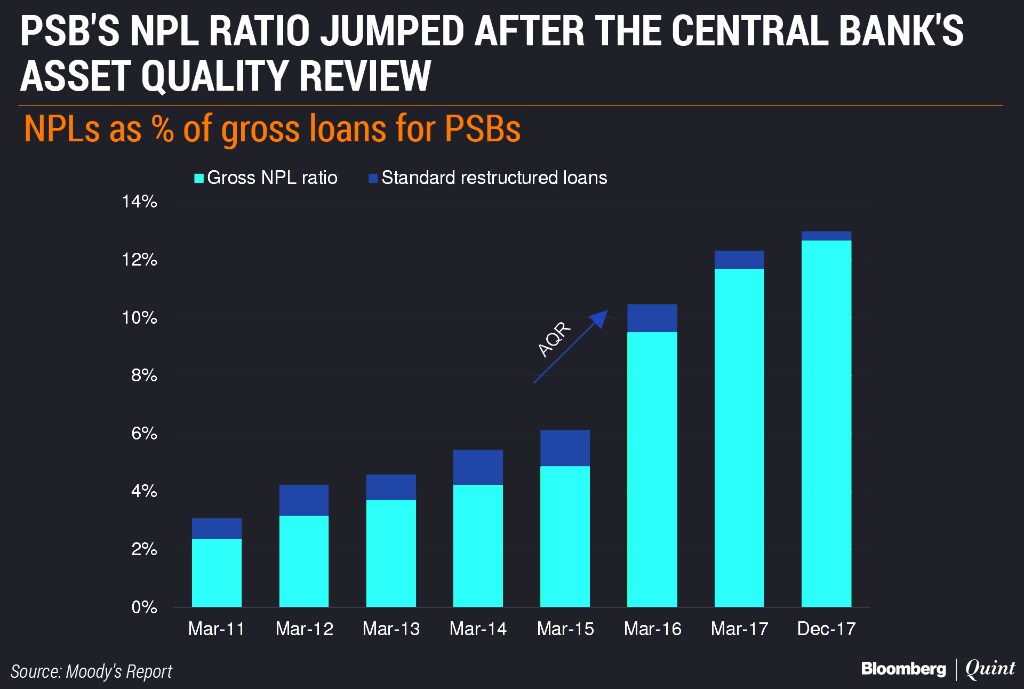
Moody's expects the new framework to lead to a reclassification of a large share of restructured loans into non performing loans. For Moody's rated public sector banks, the overall pool of stressed assets stood at about 16.5 percent of total outstanding loans as of December 2017. This is about 3.6 percentage points higher than the reported NPL ratio of 12.9 percent.
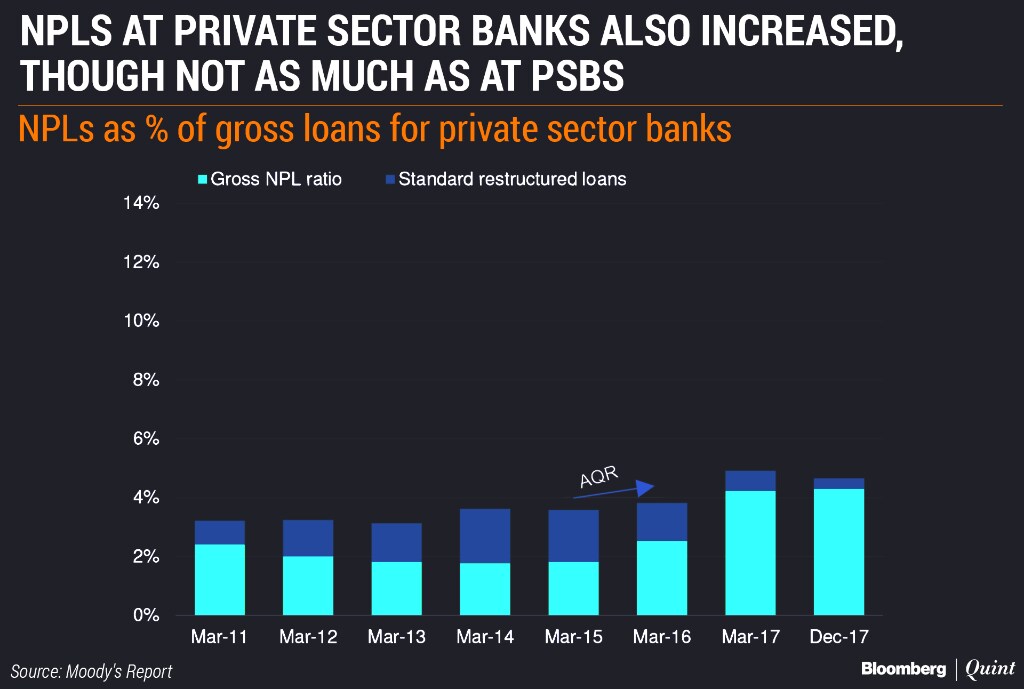
At private banks rated by Moody's, total stressed assets are at about 6.6 percent compared to reported NPLs of 4.7 percent, the rating agency said. Among private sector banks, ICICI Bank Ltd and Axis Bank Ltd have the highest ratio of stressed assets, about 4 percentage points higher than its reported NPL ratio as of December 2017.
The new framework will mean that this gap will converge and NPLs will move closer to the overall stressed asset pool. The result will be larger provisioning and lower profits in the near term.
This will mark the final stage of a multiyear initiative by the central bank to push banks to recognize problem assets more accurately. Consequent increases in already-high NPL ratios and provisioning burdens for banks will strain their profitability in the near term, although cleaner and recapitalized balance sheets are credit positive for the sector in the long term.Moody's Investors Service
In a February 12 circular, the RBI said that existing stressed asset resolution schemes were being withdrawn. Accounts where implementation of these schemes had not concluded would be marked down as NPLs. In addition, the regulator asked banks to start working on a resolution plan as soon as a company delayed payments by even a day. If a resolution plan is not finalised within 180 days, the account must be referred for resolution under the Insolvency & Bankruptcy Code (IBC).
Provisioning for assets affected by the rule change will jump to 40 percent from the current 5 percent, said Moody's. This will mean that credit costs at public sector banks (PSB's) rated by Moody's, will remain high, it said.
The credit profile of these banks, however, may not be affected as the rating agency was already taking into account restructured assets while judging the credit quality of the bank.
While the new rules will lead to an initial rise in NPL ratios, they are expected to stabilise and decline after the next few quarters, according to Moody's.
Deterioration in bank profitability will be largely offset by the government's capital infusion in the case of public sector banks, the rating agency said. In the long term, the new rules are largely expected to be credit positive since they will go further in providing clarity and a time bound process for stressed assets resolution.

-
Indians Stay With Family, Not In Hotels | The Reason Why

India still lacks enough clean, reliable and affordable hotels for budget-conscious travellers.
-
The Economic Imperative: Analysing The Material Driving Force Behind India-Canada Strategic Reset
This economic complementarity is further reinforced by deep institutional investment ties and talent mobility, which form the bedrock of the bilateral framework.
-
Medicine Pricing: Where Must Profit Stop?
India must confront excessive margins, hidden incentives and regulatory gaps that threaten the integrity of medicine.
-
Why Amazon And Flipkart Are Struggling To Beat Meesho In India's Smaller Cities
With 274 million users and lowest-cost logistics, Meesho is defending its value commerce crown against giants like Amazon and Flipkart.
-
High US Salaries, No Green Card Certainty: The Financial Calculation Facing Indian H-1B Families
The suspension of PERM processing at eight technology employers does not cancel existing H-1B visas. What it does is force a question many Indian families have been avoiding: is the US salary worth tying your career and family plans to one employer?
-
Swiggy vs Eternal: Food Delivery's Two Rivals Are No Longer In The Same Race
Eternal is building a private AI assistant, dark.ai. Swiggy is still working out how to make Instamart pay, with an operating loss of Rs 895 crore in the July-September quarter while Blinkit stayed profitable.
-
Where You Live Shapes How You Get To Work | The Reason Why
Two-wheelers are the most popular way to get to work in India, accounting for nearly 43% of workplace commutes.
-
Unhedged Position: Can India See An Indonesia-Style Time Correction?
The Nifty is trading below levels it first clocked in 2024. Is there, then, as I have suggested in the headline, potential that the current time correction drags on painfully for the next three-five, even ten years?
-
Navigating Friction And Energy Realities: An Analysis Of Marco Rubio's October Visit To India
Occurring at a critical juncture marked by stalled trade negotiations and escalating geopolitical pressures over global energy supplies, the visit offers a profound window into modern US-India relations.
-
India Exports Capital. Why Not Export Trusteeship?
The big question, then, is whether India can build an institution that global borrowers, investors, banks, and lawyers can trust, even without an Indian connection.










