Fed Starts Experiment Of Letting $8.9 Trillion Portfolio Shrink
(Bloomberg) --
The Federal Reserve is about to start shrinking its $8.9 trillion balance sheet, deploying a second tool along side higher interest rates to curb inflation, though officials don't know just how effective it will be.
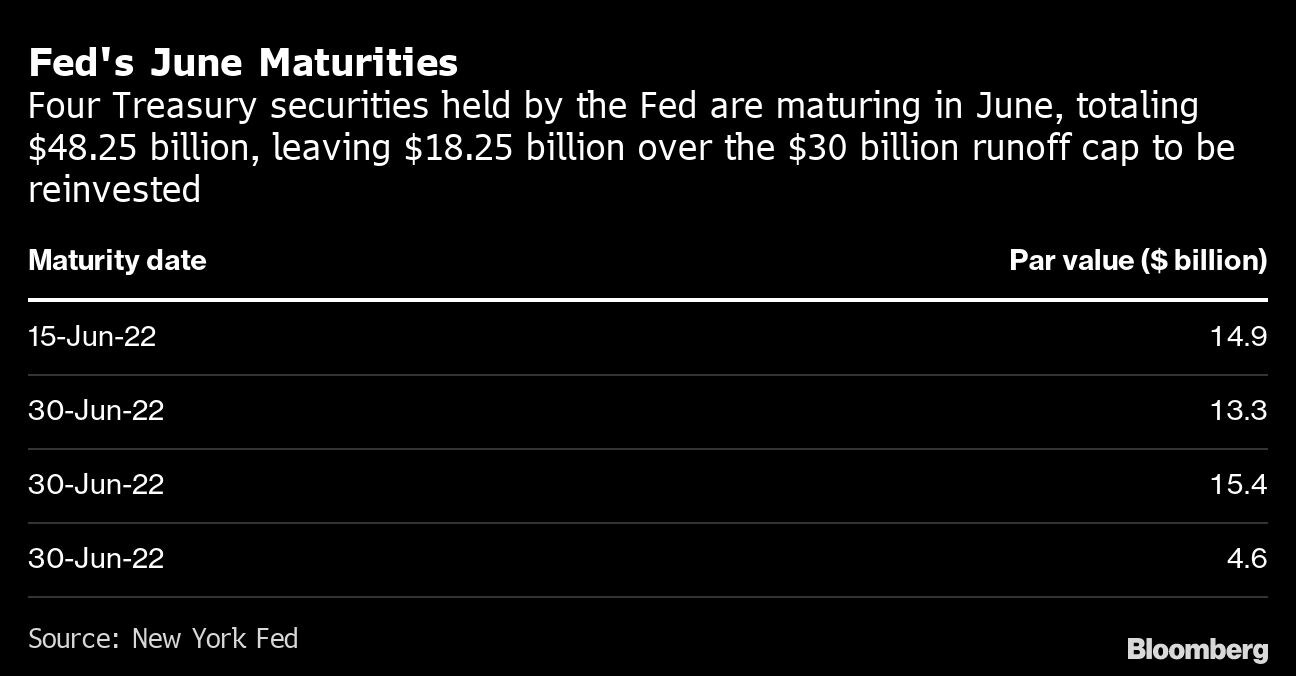
After doubling in size through asset purchases in the first two years of the pandemic, the balance sheet will be reduced at a pace that's almost twice as fast as after the last financial crisis. While the process officially commences on Wednesday, the first US Treasury securities won't run off until $15 billion mature on June 15.

The Fed is capping monthly runoff at $47.5 billion -- $30 billion for Treasuries and $17.5 billion for mortgage-backed securities -- until September. Those thresholds will then double to a combined $95 billion. That compares to a peak of $50 billion a month when the Fed performed the exercise starting in 2017.
Officials say the reduction will work in tandem with interest-rate increases to cool price pressures by tightening financial conditions. But it's not clear how much impact the balance sheet will have. As Fed Governor Christopher Waller put it in a speech on Monday, estimates “using a variety of models and assumptions” are “highly uncertain.”

The Fed deployed massive asset purchases during the 2008 financial crisis for the first time since World War II, expanding the balance sheet to about $4.5 trillion by the time it stopped buying at the end of 2014. It then waited three years before allowing it to begin shrinking at the end of 2017, reducing it to about $3.8 trillion by September 2019.
Uncertainty over the course of the balance sheet was said by commentators to have contributed to the market turmoil that ultimately helped bring an end to the Fed's last rate-hike campaign, which concluded in December 2018. Now, the Fed is also raising its benchmark rate at a faster pace in a bid to tighten financial conditions and tame inflation, which in recent months has reached the highest levels in four decades.
Minutes of the Fed's most recent policy meeting, on May 3-4, said that, “Regarding risks related to the balance-sheet reduction, several participants noted the potential for unanticipated effects on financial market conditions.” The next meeting is scheduled for June 14-15.
More stories like this are available on bloomberg.com
©2022 Bloomberg L.P.

-
Talking Points This Week: Leadership Shock At Nvidia, Earnings Strength, And The Fog Over Hormuz

The Anthropic IPO pricing and first trading day, Nvidia's upcoming earnings, and any fresh signals from Iran will set the tone for the following week.
-
Signature Play: The Classic Cocktail Is Dead. Or Is It?
Classic cocktails are disappearing from India's cocktail menus. But they're still being ordered, taught to bartenders and borrowed from. So, who's really having the last drink?
-
A New Samvat Wishlist: Inclusive Prosperity And Human Development
India has strengthened its economic foundations through infrastructure, digital access and enterprise. Its next growth chapter must deepen productivity, create better livelihoods and widen participation in prosperity.
-
Love, Sex Aur Dhokha: The Audacious Plot To Spy On Jensen Huang
A Taipei dinner, a Singapore chip buyer and a suspected Chinese asset: inside the alleged spy operation that got close to NVIDIA's Jensen Huang.
-
Ten Things I Learnt This Samvat
Patience can be a trap. Cheap stocks can stay cheap. Leverage can wipe you out. What did Samvat 2082 teach us? Niraj Shah writes on 10 lessons from the year gone by.
-
Talking Points This Week: Tech Nerves, FII Buying, And A Faraway Banking Shock
The global markets are not shining this Diwali. The exception in the large markets is, India.
-
Midterm Rally Lasted A Day. The Hard Reality Of A Divided US May Last Two Years | Opinion
Between a contested AI boom, a debt ceiling that arrives in 2027 and a president with every incentive to act alone, the next two years may prove more volatile than the first day's rally suggests.
-
Blue Wave Will Derail the AI Trade but Won't Dismantle the AI Era | Unhedged Position
The Democrats' sweep of the US Congress will see politics collide with economic forces both over the long and short term.
-
It's Time To Take The GST Council's Bet On Trust Global
Payment records can prove India's services exports, and clear, proportionate rules can bring foreign digital sellers into the tax net.
-
Opinion | India at 38: From Innovation Overperformer to Innovation Powerhouse
India now has 453 VC-backed deep science startups, 18 of them late-stage, after 117 percent growth since 2020. Laurus Labs, at USD 9.3 billion, is the most valuable deep science company in any middle-income economy outside China.









