FDI Up: Government Is Right, But Not When Compared To GDP
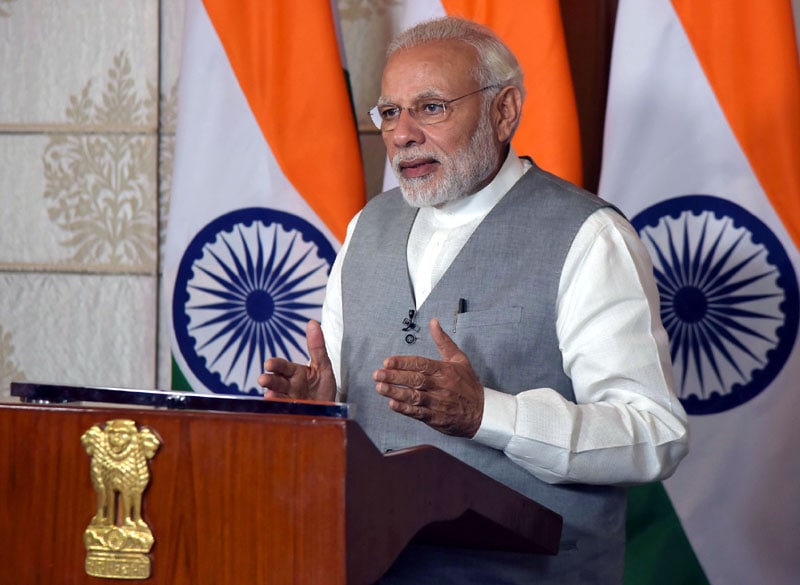
“Foreign direct investment in India increased from $36 billion to $60 billion,” Prime Minister Narendra Modi claimed in an infographic on May 25, 2018, as the Bharatiya Janata Party-led National Democratic Alliance government completed four years at the Centre.
The BJP claimed that the increase in foreign direct investment was from 2013-14 to 2016-17.
The claim is true in absolute terms: FDI increased from $36 billion in 2013-14 to $60 billion in 2016-17, according to data from the Department of Industrial Policy and Promotion, a division of the ministry of commerce and industry. But that increase does not hold good when FDI is considered as a proportion of gross domestic product, which increased 7.35 percent, on average, over three years to 2017.
We sought comments from the office of the minister for commerce by telephone on May 30, 2018, and were directed to a joint secretary, who asked us to send our queries to the press office. We emailed a detailed questionnaire to the office the same day, but have not received a response. We will update the story if and when we receive a response.
“It is good news that there has been an increase in FDI inflows,” said Madan Sabnavis, chief economist of CARE Ratings, a credit rating agency. The improvement in ease of doing business ranks for India and the reforms have played a role in attracting FDI to the country, he said.
FDI from April to December 2017 was $48.2 billion, a marginal increase (0.4 percent) from $48.03 billion during the same period of the previous financial year (2016-17). FDI increased from $34.5 billion to $44.4 billion from 2014-15 to 2016-17, according to World Bank data.
The difference between the DIPP numbers and the World Bank data is due to the definition of FDI. The World Bank definition does not include capital raised locally by foreign companies in a host country as FDI.
China Gets Maximum FDI Among BRICS Nations
China received the highest average FDI – with $227 billion for 2014-16 – 4.5 times more than India, which ranked fourth with $41 billion.
FDI as a percentage of gross domestic product–an indicator used to measure the strength of an economy–is down to 2 percent in 2016 from 2.1 percent in 2015, according to World Bank data. It was the highest at 3.6 percent in 2008.
“It is true that the FDI share of GDP has improved since the Modi government came to power but it is nowhere near the rate achieved under the UPA (United Progressive Alliance) at its peak,” economist Rupa Subramanya wrote in The Hindustan Times on May 26, 2018.
“Indeed, FDI's share of GDP actually dipped in 2016-2017, the last fiscal year for which we have full year data.”
During the Congress-led UPA-I (April 2004 to May 2009), FDI as a proportion of GDP increased from 0.9 percent to 2.7 percent, reaching a peak of 3.6 percent (the highest ever since 1975). During UPA-II (May 2009 to May 2014), the ratio declined from 2.7 percent to 1.7 percent.
FDI Higher Under NDA Than UPA
FDI inflow during the the first three years (2014-16) of the NDA government was $160.78 billion, up more than three times compared to UPA-I ($ 37.83 billion) and 35 percent higher than UPA-II ($119.14 billion).
“One needs to remember that the $60 billion number comes from equity (fresh foreign investments) and reinvestments from local companies, and the percentage of equity is lower this time,” said CARE's Sabnavis. “FDI and other foreign investments are important since India depends on them for funding the current account deficit.”
“The FDI inflows for 2017-18 (currently at $48.2 billion) will hover around $50-$60 billion, as there is some improvement in more stable economies,” said Sabnavis. “With increasing investment in infrastructure, FDI inflows may go there.”
With inputs from Manpreet Singh, an MSc student at the Symbiosis School of Economics, Pune, and an intern at IndiaSpend and FactChecker.
(Salve is an analyst at IndiaSpend and FactChecker.)
This article has been published in arrangement with IndiaSpend.

-
Indians Are Travelling, But Not Every Journey Is A Holiday | The Week In Whys

Pilgrims, patients and working women are the real travellers, and the system hasn't quite caught up with them.
-
Getting To Work Costs Women More | The Reason Why
It is not just about women paying more than men. It is about women paying much more in cities than in villages.
-
AI Bias In Investing Cannot Be Eliminated, But It Can Be Governed
Framing is a particularly important example as identical financial information presented in terms of gains rather than losses can lead an LLM to reach a different assessment.
-
Joining The Dots | Dark Skies, Steady Diya: Why Hope Holds This Diwali
With war, a weak rupee and foreign outflows weighing on sentiment, policymakers at the NDTV World Summit and market veterans at NDTV Profit Ignite: Diwali Edition offered the same advice: stay invested and filter out the noise.
-
The Curious Case of Equitas Small Finance Bank And A CEO Who Quit For Stock
PN Vasudevan believes persistent investor concerns over a perceived conflict of interest had become a governance overhang on Equitas Small Finance Bank's stock, even as the lender improved profitability and asset quality.
-
Talking Points This Week: AI Cash Burn, A Tiger Comeback And An India That Still Finds Its Own Path
India is not immune to higher oil or tighter global liquidity, yet its earnings base is broader, its domestic policy levers are still available.
-
Foreign Investors Own Half Of HDFC Bank and ICICI Bank. An LTCG Cut Could Matter Most Here
Foreign portfolio investors have US$115 billion parked in HDFC Bank, ICICI Bank. If the government cuts long-term capital gains tax, Jefferies says returning foreign money could land here first.
-
'Never Seen This Level Of Negativity': Sandeep Tandon Says The Next Rally May Be Closer Than You Think
Veteran investor Sandeep Tandon says foreign selling is easing, large-caps are due a comeback and mid-caps are crowded, while he turns positive on gold, power and pharma this Diwali.
-
Indians Stay With Family, Not In Hotels | The Reason Why
India still lacks enough clean, reliable and affordable hotels for budget-conscious travellers.
-
The Economic Imperative: Analysing The Material Driving Force Behind India-Canada Strategic Reset
This economic complementarity is further reinforced by deep institutional investment ties and talent mobility, which form the bedrock of the bilateral framework.










