ECB Cuts Rates For Third Time To Prop Up Weakening Economy

(Bloomberg) -- The European Central Bank lowered interest rates for the third time this year as a hastier retreat in inflation allows it to offer support to the region's stuttering economy.
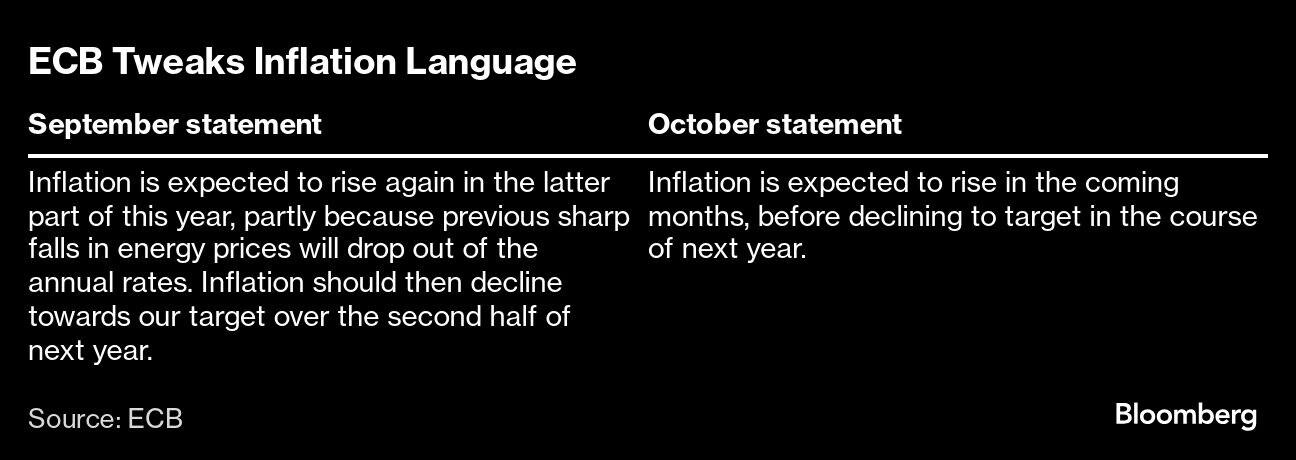
The key deposit rate was cut by a quarter-point to 3.25% — as predicted by all analysts in a Bloomberg survey. The ECB said the process of taming prices should be complete “in the course of next year” — tweaking its previous language for that landmark to only be reached in the second half of 2025.
Officials, however, didn't specify when or how quickly borrowing costs will be reduced from here.
“The incoming information on inflation shows that the disinflationary process is well on track,” the ECB said in its statement. The Governing Council “will keep policy rates sufficiently restrictive for as long as necessary.”
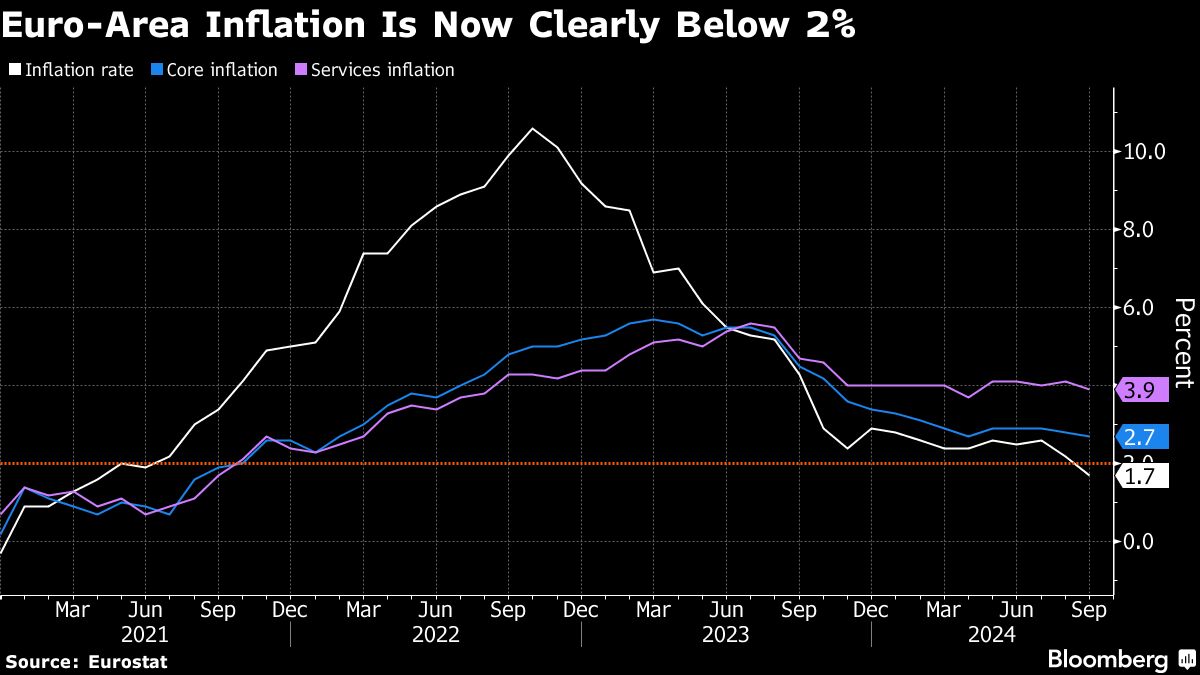
Thursday's move quickens the pace at which officials are removing the shackles on the euro-zone economy, whose early-year promise has petered out. While looking unlikely just five weeks ago, it follows a slump in inflation to below 2% for the first time since 2021, alongside softer private-sector activity and cracks in the so-far resilient jobs market.
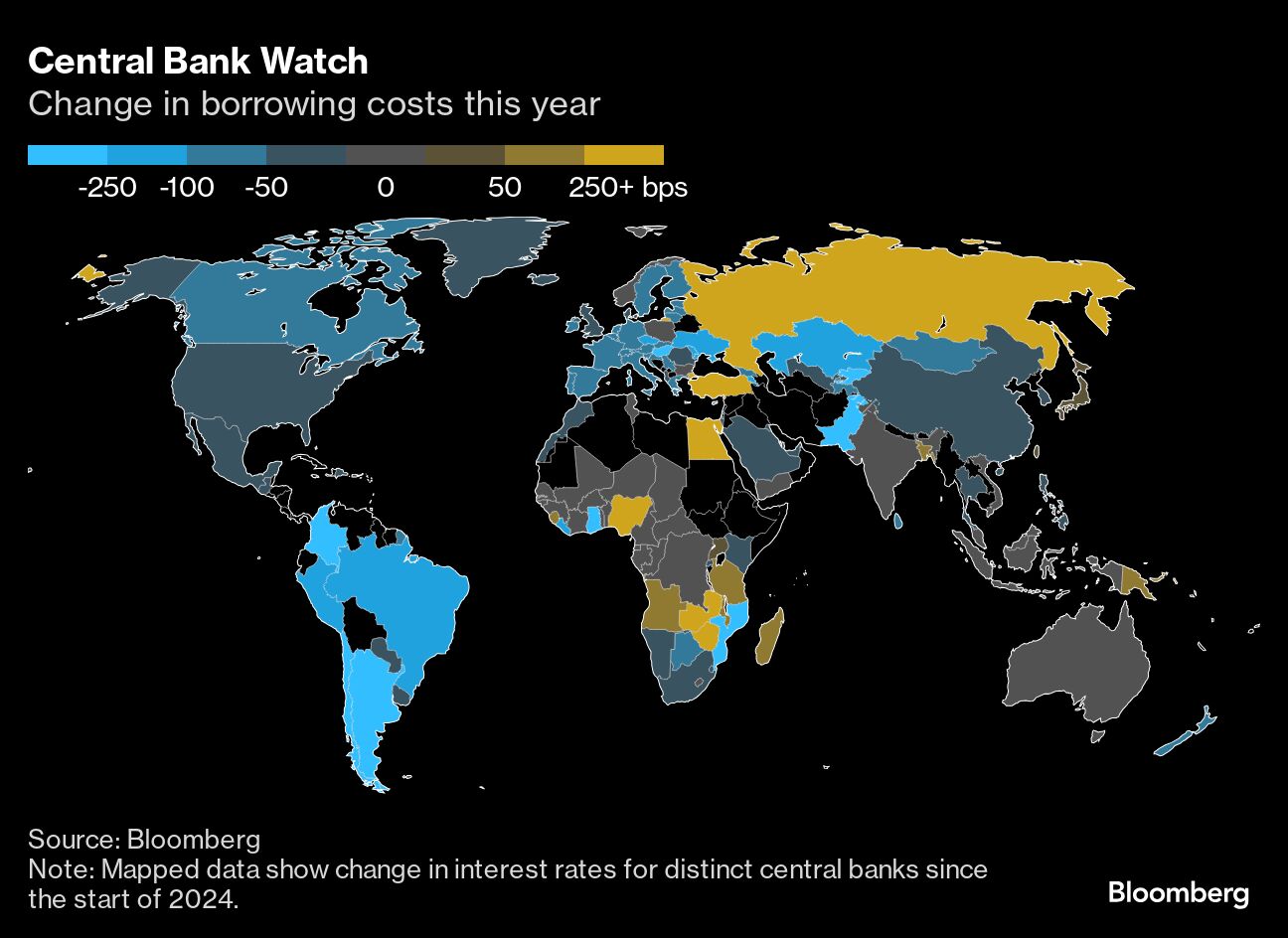
Dangers lurk further afield, too: The hostilities in the Middle East and the tariffs that could accompany another Donald Trump presidency risk sapping confidence. Policymakers are also keeping an eye on the Federal Reserve after it began its own loosening campaign.
Euro area bonds were little changed right after the decision, with yields on German 10-year bonds remaining slightly higher on the day at 2.20%. Wagers on another quarter-point cut in December were steady, with such a move fully priced by swaps.
President Christine Lagarde will discuss the ECB's decisions at a press conference at 2:45 p.m. in Brdo, Slovenia, where officials have gathered for the one policy meeting of the year that they hold outside of their Frankfurt headquarters.
Lagarde had given the clearest signal that a rate cut was in the pipeline by telling European lawmakers this month that “the latest developments strengthen our confidence that inflation will return to target in a timely manner.”
Even some hawks have acknowledged intensifying economic risks, with Executive Board member Isabel Schnabel saying officials “cannot ignore the headwinds to growth.”
Her remarks followed a first contraction since March in private-sector output, as the manufacturing sector's woes deepened and services slowed. Analysts in a Bloomberg poll have cut projections for the third and fourth quarters, and their 2025 outlook.
Strong demand in Mediterranean countries including Spain, Portugal and Greece is helping the 20-nation currency bloc to keep a recession at bay. But Germany, the region's biggest economy, remains the laggard and may see output dip for the second year running due to muted demand in key export markets like China.
A trade spat between Brussels and Beijing could yet make matters worse — part of rising geopolitical tensions that are worrying analysts.
Inflation, meanwhile, has been in a steep retreat — sliding to 1.7% in September. Officials highlight that their battle to tame prices isn't yet won, citing a gauge of pressures in the services industry that's stuck near 4%. But bets on monetary easing have been building.
Economists surveyed by Bloomberg agree with money markets that cuts are likely at every ECB meeting through March. After that, the pace of easing is likely to slow, with the deposit rate being brought to 2% by the end of 2025.
That would put it at the lower end of assessments for the so-called neutral rate that neither stimulates not restricts economic activity. Reaching the 2%-2.5% range estimated by analysts in Bloomberg's poll could happen quite quickly.
“It is a straight line to neutral,” Sören Radde, head of European economic research at Point72, told Bloomberg Television before the rate announcement. Recent weeks have seen dangers around the ECB's outlook shift “from there being risks to inflation overshooting — persistently — to there being now also risks that it may undershoot.”

-
One Battle After Another: India's Corporate Dynasties Battle For Control

2026 could go down as Corporate India's year of succession wars, governance battles and family fault lines.
-
Rs 50-Lakh Gold In Bank Locker, Rs 3 Lakh Of Protection: The Gap Most Families Don't Know About
The RBI ties a bank's liability to the annual locker rent and families who want to insure their jewellery face a separate question about how to prove what was inside.
-
The More Food Turns Into Fuel, The Harder It Is To Read Agricultural Markets | The Reason Why
A policy designed to reduce dependence on imported fuel can create new pressures elsewhere in the food economy.
-
Your iPhone Costs 12 Grams Of Gold, A Car About 100. What Does Your Life Weigh?
Measured in rupees, almost everything looks more expensive than it did a generation ago. Measured in grams of gold, a lot of it has become cheaper.
-
Gold Is Rs 22,000 Cheaper Than A Month Ago. Should You Buy Amid The Wedding Season?
Gold's potential slide to $3,500 could save around Rs 4,700 per 10 grams, but a soft inflation print could just as easily push prices back up. One way to split the risk is to buy in parts, some now and the rest after the Fed's Dec. 9 decision.
-
AI Agents Are Gaining Power. Who Governs Them?
Artificial intelligence agents promise to transform productivity by moving machines from assisting decisions to executing them. But as organisations delegate greater authority to these AI-agents, they must first establish who controls that authority and who remains accountable when things go wrong.
-
Why Swapping Your Old Gold Can Trigger A Rs 5 Lakh Tax Bill, And How You Can Avoid It Legally
Swapping old gold for new is taxed as a sale and a fresh purchase. Getting your own gold remade can cut most of that bill, though it has its own costs.
-
The AI Trade is Done. The Real Opportunity for Investors Starts in 2027 | Unhedged Position
As pureplay AI stocks plunge and circular, capex-led financing unwinds, 2027 is set to be a year of reckoning for AI companies. Yet the bust clears the way for a better opportunity for investors in 2027 -- shifting the spotlight from AI builders to the companies using AI.
-
Leadership As Mission: Why The Age Of AI Demands More Human Leadership
Debjani Ghosh examines how AI is changing leadership, arguing that its success must be measured by its impact on people and the accountability of those guiding its use.
-
We May Need Another Tukaram Mundhe To Fight Air Pollution | The Reason Why
Developers may install basic measures such as sprinklers and green nets, resume work, and continue violating rules when this equipment stops working.









