ECB Cuts For Third Straight Time To Prop Up Flagging Economy

(Bloomberg) -- The European Central Bank lowered interest rates for a third consecutive meeting, signaling more reductions next year as inflation nears 2% and the economy struggles.
The deposit rate was cut by a quarter-point to 3% — as predicted by all but one analyst in a Bloomberg survey. That brings total easing since June to 100 basis points.
Indicating its shifting stance, the ECB's statement dropped wording saying policy will remain “sufficiently restrictive” for as long as necessary.
“The Governing Council is determined to ensure that inflation stabilizes sustainably at its 2% medium-term target,” the ECB said Thursday. “It will follow a data-dependent and meeting-by-meeting approach to determining the appropriate monetary-policy stance.”
The euro fell 0.2% to a session low $1.0470, with investors focusing on the omitted reference to keeping rates “restrictive.” Traders are betting on about 125 basis points more of easing next year, broadly in line with pricing before the announcement.
Despite no firm commitment, back-to-back decreases in borrowing costs are widely expected to continue through mid-2025 as Europe's already sluggish economy endures political upheaval in Germany and France, plus a potential jolt to global trade from Donald Trump's return to the US presidency.
The fear is that sub-par growth drags inflation — currently 2.3% — below target, recalling the pre-Covid era when the focus was more on perking up prices than restraining them.
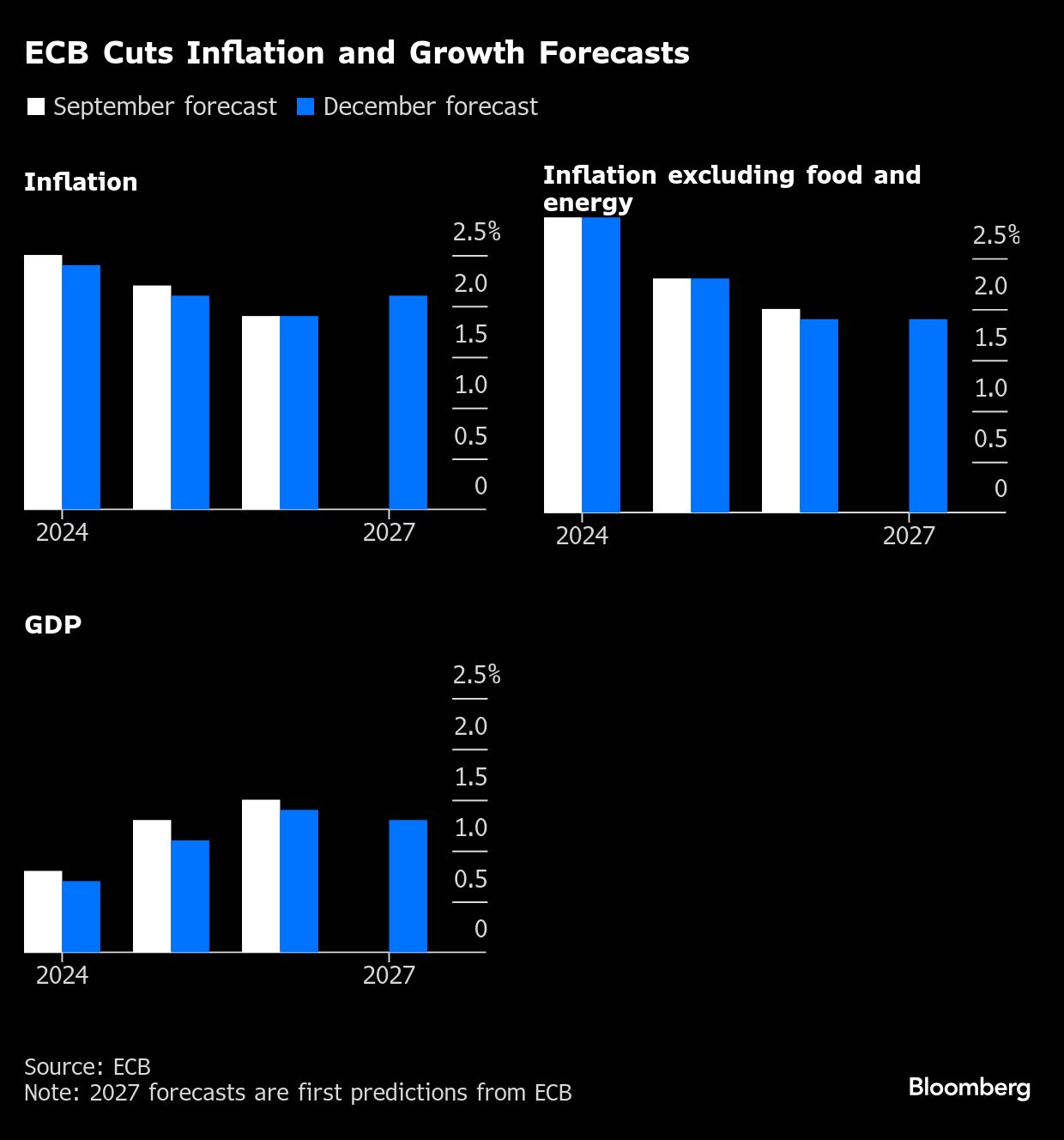
New quarterly projections from the ECB, published Thursday, reflect the fragile backdrop, revising down the outlook for economic expansion and inflation next year.
Dangers to growth remain tilted to the downside, according to President Christine Lagarde, who pointed to waning momentum in the 20-nation euro zone.
“The economy should strengthen over time, although more slowly than previously expected,” she told a press conference in Frankfurt. “The risk of greater friction in global trade could weigh on euro-area growth by dampening exports and weakening the global economy.”
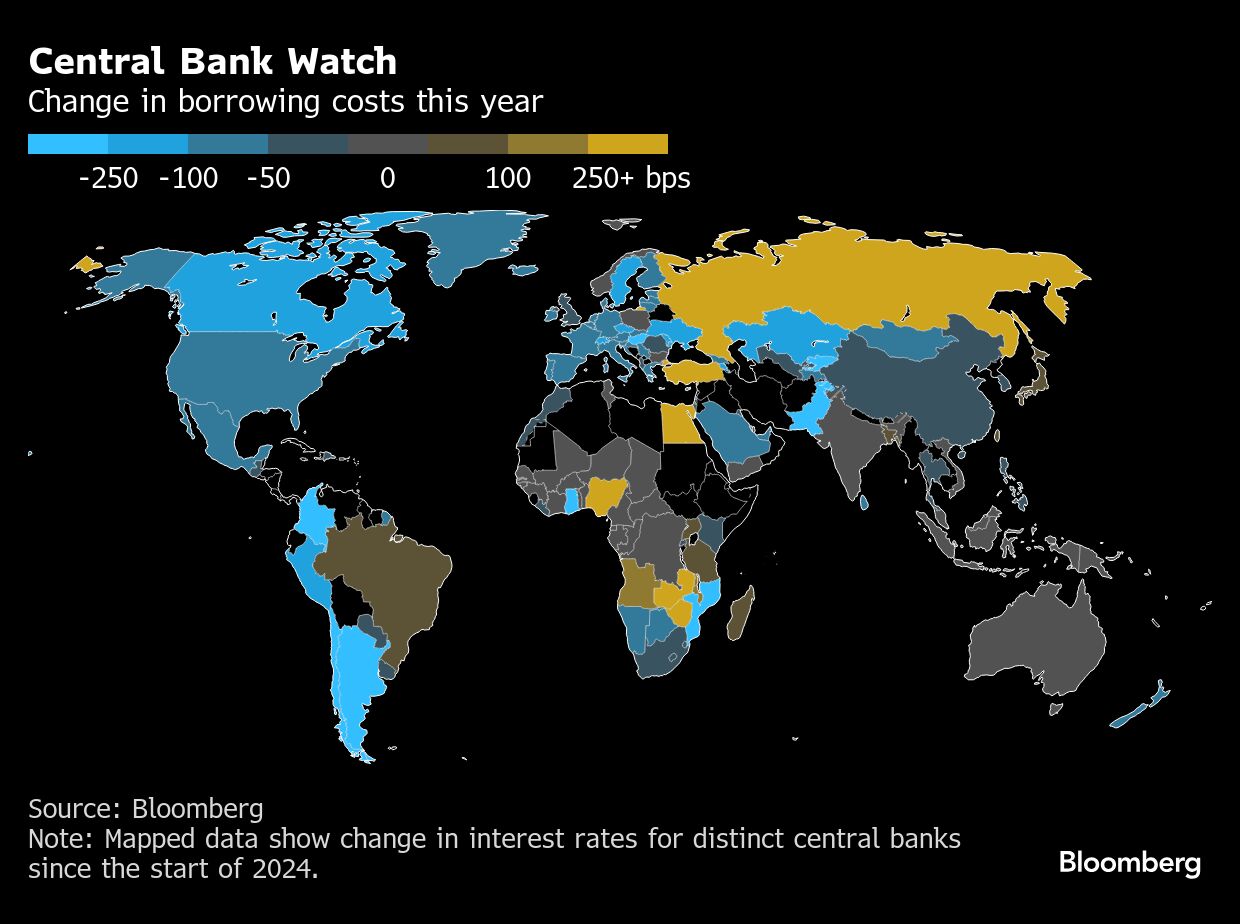
Lagarde isn't the only central-bank chief overseeing rate decreases. Earlier Thursday, the Swiss National Bank followed Wednesday's decision by the Bank of Canada to cut by 50 basis points. The Federal Reserve, meanwhile, will probably do likewise next week after data Wednesday showed US inflation for November in line with expectations.
The run-up to this week's ECB meeting was dominated by concerns over Europe's outlook. While growth unexpectedly quickened in the third quarter, recent data signaled a deterioration, particularly in the services sector, which had for most of the year been offsetting long-running weakness among manufacturers.
That's ignited debate over how far the ECB should lower borrowing costs, and how effective such monetary easing would be at a time when many challenges facing the bloc — like labor shortages and higher energy costs — are structural.
What Bloomberg Economics Says...
“Our base case is that the ECB feels its way toward a neutral policy stance next year, with the pace of cuts slowing after 1Q25. However, as inflation continues to decelerate and threats to the economy persist, the risk is skewed toward back-to-back cuts all the way to 2%.”
—David Powell, senior euro-area economist. Click here for full REACT
Economists see rates settling at 2%, while investors reckon a more aggressive campaign will leave them at 1.75%. If markets are right, that would probably result in policy turning stimulative by falling below so-called neutral levels.
Italy's Fabio Panetta and France's Francois Villeroy de Galhau aren't ruling out venturing into expansionary territory. But Executive Board member Isabel Schnabel and Bundesbank President Joachim Nagel have warned against pushing too far.

-
Gold Is Rs 22,000 Cheaper Than A Month Ago. Should You Buy Amid The Wedding Season?

Gold's potential slide to $3,500 could save around Rs 4,700 per 10 grams, but a soft inflation print could just as easily push prices back up. One way to split the risk is to buy in parts, some now and the rest after the Fed's Dec. 9 decision.
-
AI Agents Are Gaining Power. Who Governs Them?
Artificial intelligence agents promise to transform productivity by moving machines from assisting decisions to executing them. But as organisations delegate greater authority to these AI-agents, they must first establish who controls that authority and who remains accountable when things go wrong.
-
Why Swapping Your Old Gold Can Trigger A Rs 5 Lakh Tax Bill, And How You Can Avoid It Legally
Swapping old gold for new is taxed as a sale and a fresh purchase. Getting your own gold remade can cut most of that bill, though it has its own costs.
-
The AI Trade is Done. The Real Opportunity for Investors Starts in 2027 | Unhedged Position
As pureplay AI stocks plunge and circular, capex-led financing unwinds, 2027 is set to be a year of reckoning for AI companies. Yet the bust clears the way for a better opportunity for investors in 2027 -- shifting the spotlight from AI builders to the companies using AI.
-
Leadership As Mission: Why The Age Of AI Demands More Human Leadership
Debjani Ghosh examines how AI is changing leadership, arguing that its success must be measured by its impact on people and the accountability of those guiding its use.
-
We May Need Another Tukaram Mundhe To Fight Air Pollution | The Reason Why
Developers may install basic measures such as sprinklers and green nets, resume work, and continue violating rules when this equipment stops working.
-
Extracting Value From Battery Scrap Could Be Challenging For India | The Reason Why
A discarded lithium-ion battery still contains valuable materials such as lithium, nickel and cobalt. These can be recovered and reused. When such batteries are crushed and shredded, they produce a dark powder called black mass.
-
One El Nino, India Can Handle. Two Could Break The Granary
India's grain stocks can absorb one bad year, but a second El Nino could drain the buffer in two to three years, economists say.
-
India's Troika Of Good Luck | Joining The Dots
As Jensen Huang's exit drags Nvidia down, a cooling AI trade and resilient earnings have revived investor interest in India. A likely RBI rate hike looms.
-
Talking Points This Week: Leadership Shock At Nvidia, Earnings Strength, And The Fog Over Hormuz
The Anthropic IPO pricing and first trading day, Nvidia's upcoming earnings, and any fresh signals from Iran will set the tone for the following week.









