Does Currency Really Impact Exports: A Study Of The Textile Sector

The recent weakness in the Indian rupee has been seen as positive by those who fear that an overvalued currency has made India's exports uncompetitive. The Indian currency has weakened by about 7 percent since the start of the year. Recent comments from policy makers, suggest that a weaker currency will help rather than hurt the Indian economy. While most economists agree with that view, Axis Bank, in a recent research report, argues that there is no conclusive evidence that exports have been hurt by a strong currency or that a weaker currency will benefit exports.
“Global comparisons suggest that effects of trade drive currency rather than vice versa,” wrote Saugata Bhattacharya, chief economist at Axis Bank in a report on Friday.
A Case Study Of The Textile Sector
Textiles continue to make up a significant constituent of India's exports, accounting for $40 billion of a total of $220 billion. Overall, the textile export industry has been stagnating since 2014, having seen contraction in annual growth.
However, data released by the U.S. Office of Textiles and Apparel on Indian textile imports, reveals that India has actually not been losing ground to emerging economies, said Axis Bank in its report.
India has seen a rise in textile exports to the U.S., albeit a gradual one, while Vietnam's share has risen most significantly.
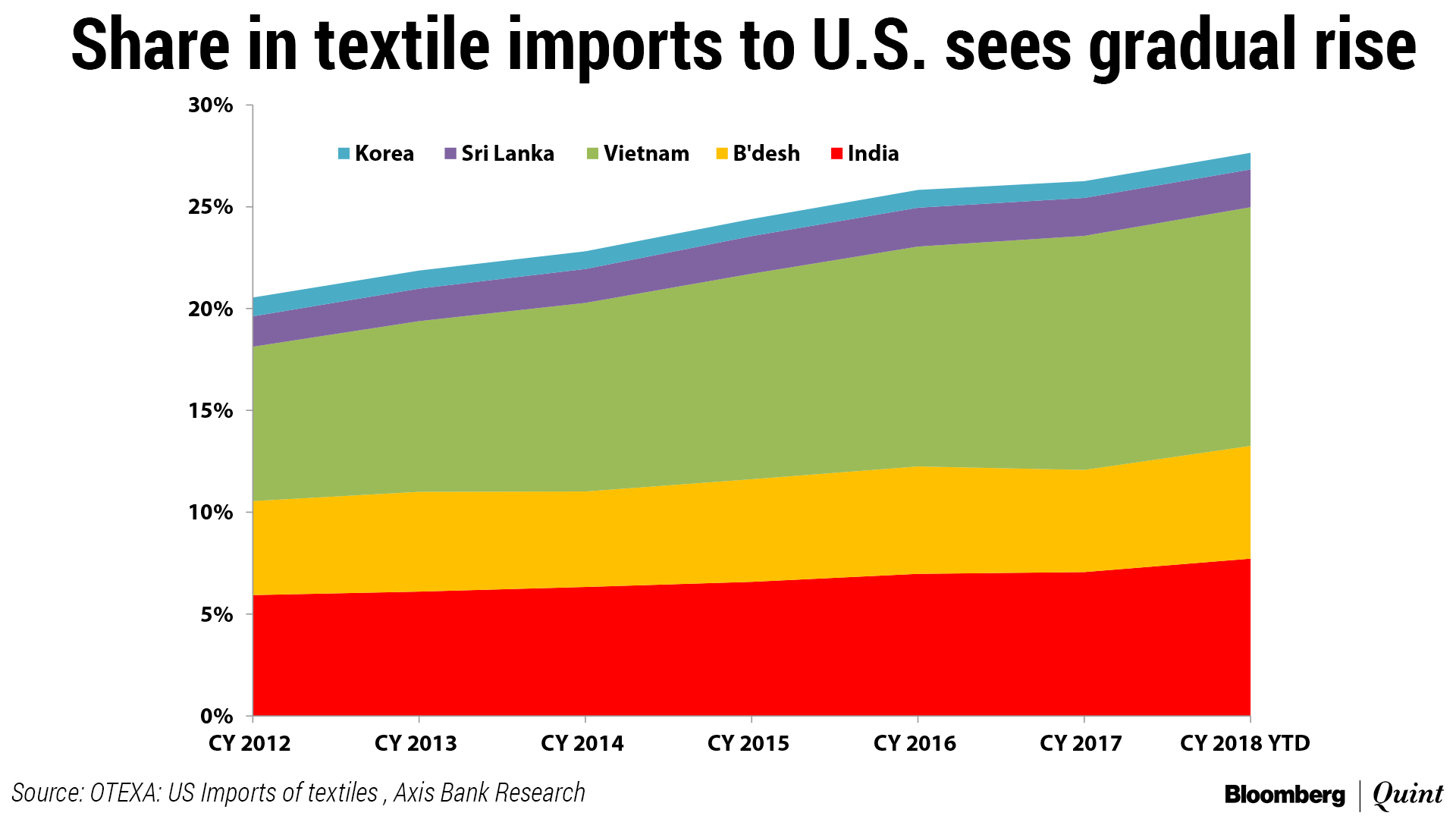
This performance in textile shipments has little direct correlation with the performance of the currency over this period, said Bhattacharya.
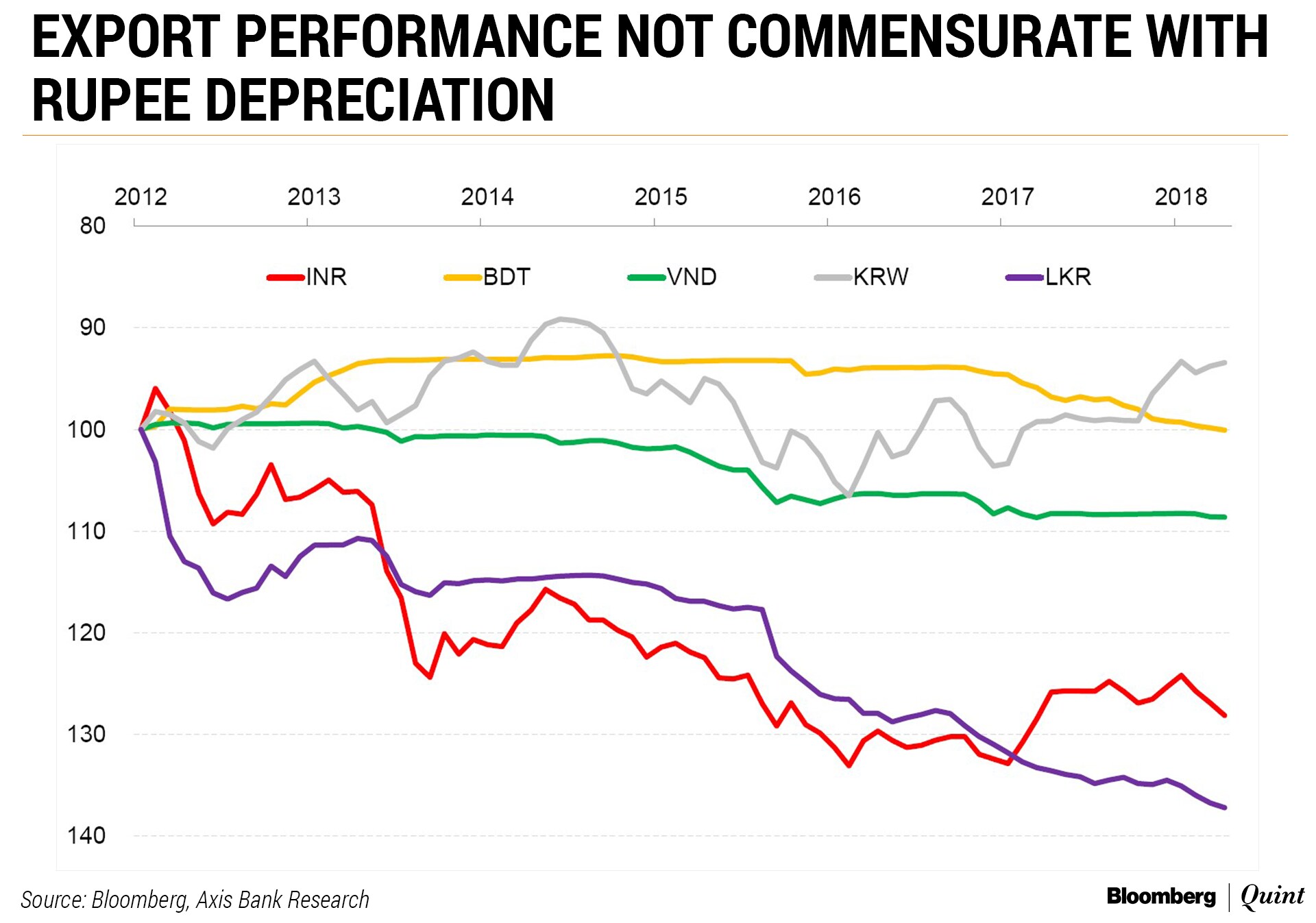
Relative to the countries used for the study, India has been one of the major depreciating currencies since 2012. Only the Sri Lankan Rupee has underperformed the Indian Rupee. The Bangladesh Taka has remained strong, as has the Korean Won. The Vietnam Dong has seen intermediate strength and weakness.
Compared to the export outcomes, the inescapable conclusion is that the role of currencies in exports is quite weak.
Conventionally theory dictates that when a currency depreciates, exports become cheaper and imports become more expensive. Demand for exports responds to the depreciation by rising and current account deficit improves.
However, Axis Bank's research across countries suggests that no causal relationship between a weakening currency and exports. It gives instances of China where the currency has appreciated on the back of strong export growth from 2011 to 2015. The appreciation has not dented the country's standing as an export powerhouse. In contrast, despite South African Rand's depreciation since 2010, the country's share of trade remains steady.
The report by Axis Bank further reiterates the importance of exports for India to grow at eight percent annually. While conventional knowledge dictates that a depreciating rupee is likely to boost exports, current evidence fails to support the same.
In line with expectations, India's exports appear to decline, with a lag, when the rupee appreciates. However, this trend is being seen to extend to imports as well. The net effect appears to have been a further decline in the current account deficit, notes the report.

-
Indians Stay With Family, Not In Hotels | The Reason Why

India still lacks enough clean, reliable and affordable hotels for budget-conscious travellers.
-
The Economic Imperative: Analysing The Material Driving Force Behind India-Canada Strategic Reset
This economic complementarity is further reinforced by deep institutional investment ties and talent mobility, which form the bedrock of the bilateral framework.
-
Medicine Pricing: Where Must Profit Stop?
India must confront excessive margins, hidden incentives and regulatory gaps that threaten the integrity of medicine.
-
Why Amazon And Flipkart Are Struggling To Beat Meesho In India's Smaller Cities
With 274 million users and lowest-cost logistics, Meesho is defending its value commerce crown against giants like Amazon and Flipkart.
-
High US Salaries, No Green Card Certainty: The Financial Calculation Facing Indian H-1B Families
The suspension of PERM processing at eight technology employers does not cancel existing H-1B visas. What it does is force a question many Indian families have been avoiding: is the US salary worth tying your career and family plans to one employer?
-
Swiggy vs Eternal: Food Delivery's Two Rivals Are No Longer In The Same Race
Eternal is building a private AI assistant, dark.ai. Swiggy is still working out how to make Instamart pay, with an operating loss of Rs 895 crore in the July-September quarter while Blinkit stayed profitable.
-
Where You Live Shapes How You Get To Work | The Reason Why
Two-wheelers are the most popular way to get to work in India, accounting for nearly 43% of workplace commutes.
-
Unhedged Position: Can India See An Indonesia-Style Time Correction?
The Nifty is trading below levels it first clocked in 2024. Is there, then, as I have suggested in the headline, potential that the current time correction drags on painfully for the next three-five, even ten years?
-
Navigating Friction And Energy Realities: An Analysis Of Marco Rubio's October Visit To India
Occurring at a critical juncture marked by stalled trade negotiations and escalating geopolitical pressures over global energy supplies, the visit offers a profound window into modern US-India relations.
-
India Exports Capital. Why Not Export Trusteeship?
The big question, then, is whether India can build an institution that global borrowers, investors, banks, and lawyers can trust, even without an Indian connection.










