Davos 2025: Davos Can’t Stop Worrying About Inflation Genie Escaping Bottle
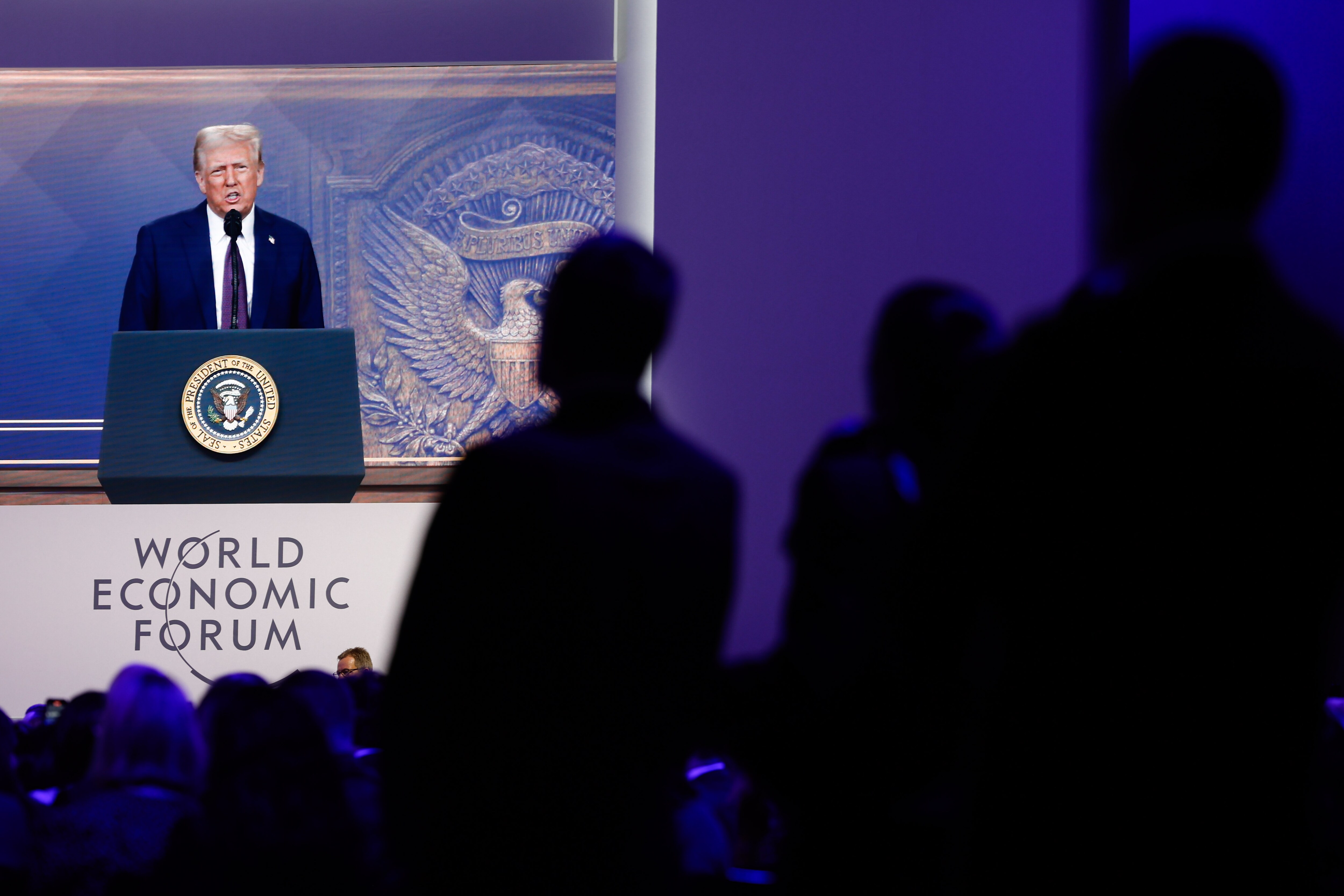
Global inflation hasn't yet died and advanced economies outside China can't be complacent at a time of fickle consumers and trade tensions, according to the last Davos panel of 2025.
Luminaries from International Monetary Fund chief Kristalina Georgieva to BlackRock Chief Executive Officer Larry Fink acknowledged that, for all the efforts by central banks to tame consumer prices, policymakers can't afford to take their eye off the ball.
“Most of the body of the genie is in the bottle, kind of getting stuck there,” the IMF managing director said. “But the legs are kind of hanging still out. We need to push it all the way down.”
The remarks chimed with concerns aired frequently during the past week in and around the World Economic Forum, a period coinciding with the first four days of Donald Trump's new term. While his arrival as US president excited finance executives, it's largely caused global economists and central bankers to wince at the possible fiscal, inflation or growth consequences.
That contrasts with the cautious optimism that featured during last year's Davos finale, where participants exuded nervousness at the possibility of a Trump comeback but did wonder aloud if the global inflation shock may fade. Fink isn't convinced.
“I believe the bond market is indicating that inflation may be higher than we think,” he said Friday. “The genie may be coming out of the bottle.”
Market gauges of future inflation expectations have been rising for some time. The 10-year US breakeven rate, the difference between inflation-linked and nominal yields of similar maturities and a proxy for the average rate of price rises over the period, has climbed by nearly 50 basis points since September to around 2.50%. Inflation swaps have also climbed.
Singapore President Tharman Shanmugaratnam, a veteran economist and former finance minister of his country who was also on the panel, observed a longer-term backdrop that's stoked consumer prices.
“Central banks and fiscal authorities have made mistakes in the last 15 years that set us on a somewhat higher plane of inflation for the medium term than we otherwise would be,” he said.
The emphasis in Davos contrasted slightly with that from the IMF itself just a week ago. It upgraded its global growth forecast then for this year, spurred by stronger-than-expected US demand and moderating inflation worldwide, and said that backdrop should let central banks continue cutting borrowing costs.
Worries about consumer prices have still abounded throughout the week. As the forum began, former Swiss central bank chief Philipp Hildebrand — vice chair of BlackRock — worried that inflation could turn out to be “stubbornly sticky” and predicted “not many, if any” US rate reductions. Ken Rogoff, once a chief economist at the IMF, said that the “odds of a hike as as good as the odds of a cut.”
That's not an outlook Trump is likely to welcome. Speaking by video to the forum on Thursday, he pledged to the biggest tax cut in US history, repeated threats of tariffs, called on Saudi Arabia and OPEC to “bring down the cost of oil,” and added that when that happens, “I'll demand that interest rates drop immediately.”
The Saudi Arabian economy chief, Faisal Alibrahim, didn't rise to that demand when speaking on the panel. Meanwhile Fink, though perhaps less hawkish than Hildebrand or Rogoff, said the outlook doesn't promise much in the way of easing from the Fed.
“They still have room to cut,” he said. Still, “the economy is very strong” and “I see probabilities” that the Fed might need to “revert and go back up,” he added.
For her own part, European Central Bank President Christine Lagarde, also speaking on the panel, expressed “strong confidence” that inflation is going down.
That chimes with the sanguine view shown by several of her ECB colleagues in Davos, suggesting they and peers aren't yet flinching in the face of Trump's threats. While the Europeans have reiterated signals of successive cuts in borrowing costs, on Friday, The Bank of Japan followed through with a rate hike to the highest level in 17 years.

-
We May Need Another Tukaram Mundhe To Fight Air Pollution | The Reason Why

Developers may install basic measures such as sprinklers and green nets, resume work, and continue violating rules when this equipment stops working.
-
Extracting Value From Battery Scrap Could Be Challenging For India | The Reason Why
A discarded lithium-ion battery still contains valuable materials such as lithium, nickel and cobalt. These can be recovered and reused. When such batteries are crushed and shredded, they produce a dark powder called black mass.
-
One El Nino, India Can Handle. Two Could Break The Granary
India's grain stocks can absorb one bad year, but a second El Nino could drain the buffer in two to three years, economists say.
-
India's Troika Of Good Luck | Joining The Dots
As Jensen Huang's exit drags Nvidia down, a cooling AI trade and resilient earnings have revived investor interest in India. A likely RBI rate hike looms.
-
Talking Points This Week: Leadership Shock At Nvidia, Earnings Strength, And The Fog Over Hormuz
The Anthropic IPO pricing and first trading day, Nvidia's upcoming earnings, and any fresh signals from Iran will set the tone for the following week.
-
Signature Play: The Classic Cocktail Is Dead. Or Is It?
Classic cocktails are disappearing from India's cocktail menus. But they're still being ordered, taught to bartenders and borrowed from. So, who's really having the last drink?
-
A New Samvat Wishlist: Inclusive Prosperity And Human Development
India has strengthened its economic foundations through infrastructure, digital access and enterprise. Its next growth chapter must deepen productivity, create better livelihoods and widen participation in prosperity.
-
Love, Sex Aur Dhokha: The Audacious Plot To Spy On Jensen Huang
A Taipei dinner, a Singapore chip buyer and a suspected Chinese asset: inside the alleged spy operation that got close to NVIDIA's Jensen Huang.
-
Ten Things I Learnt This Samvat
Patience can be a trap. Cheap stocks can stay cheap. Leverage can wipe you out. What did Samvat 2082 teach us? Niraj Shah writes on 10 lessons from the year gone by.
-
Talking Points This Week: Tech Nerves, FII Buying, And A Faraway Banking Shock
The global markets are not shining this Diwali. The exception in the large markets is, India.









