Chinese Spacecraft Makes Historic Landing On Far Side Of Moon
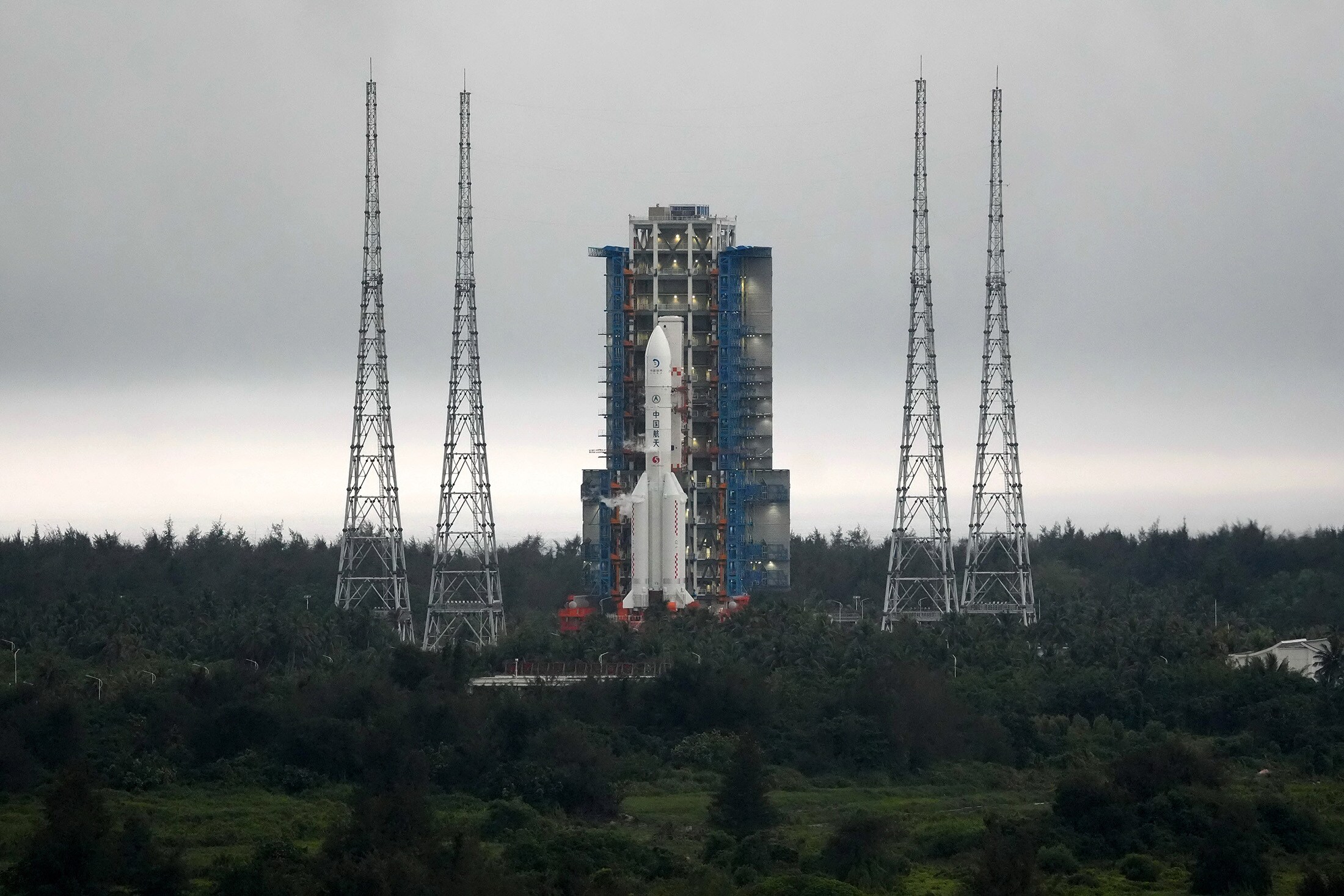
(Bloomberg) -- A Chinese spacecraft landed on the far side of the moon, boosting the nation's efforts to compete with the US in a race to send people back to the lunar surface for the first time in more than half a century.
The China National Space Administration announced that Chang'e-6 “successfully landed at the designated landing area,” the Xinhua News Agency reported Sunday.
Chang'e-6 will attempt to be the first to collect samples from the moon's far side and transport them back to Earth. The mission is China's second to the far side, following a landing by the Chang'e-4 spacecraft in 2019.
No other country has landed on that half of the moon, a more difficult area for communications because it never faces Earth.
Read More: Why Everyone Is Heading Back to the Moon
Within 48 hours of landing, Chang'e-6 is scheduled to begin drilling below ground while also extending a robotic arm to gather material from the surface.
The landing site, an impact crater in the South Pole-Aitken Basin, may contain water ice, a resource that could potentially be used to make oxygen and rocket fuel for long-term human habitation on the moon.
The site, known as the Apollo Basin, was chosen because of its potential value of scientific exploration, as well as the conditions of the landing area, including communication and telemetry conditions and the flatness of the terrain, Xinhua cited Huang Hao, an offficial at the China Aerospace Science and Technology Corporation, as saying.
The mission, which launched on May 6, is expected to last about 53 days, the China National Space Administration said.
“First-hand, direct samples from the moon's far side are essential to giving us a deeper understanding of the characteristics and differences of the two sides of the moon, and to revealing the secrets of the moon,” state media reported Zeng Xingguo, a scientist at the National Astronomical Observatories of the Chinese Academy of Sciences, saying when Chang'e-6 launched on May 3.
Chang'e-6 is part of a series of missions designed to culminate with the first Chinese astronauts traveling to the moon before the end of the decade.
By then, the US wants to have returned to the moon for the first time since the end of the Apollo program in 1972, with NASA's Artemis program targeting to land astronauts near its south pole in 2026.
The Chang'e-6 landing came just days after Russia's State Duma, the lower house of parliament, ratified an agreement with Beijing to collaborate on a joint project to create a permanent base, the International Lunar Research Station, near the lunar south pole.
The agreement “strengthens the strategic partnership with China, advances Russian space activities, and reinforces Russia's leading role in space exploration, including lunar research and utilization,” the Tass news agency reported on May 28.
More stories like this are available on bloomberg.com
©2024 Bloomberg L.P.

-
India's Troika Of Good Luck | Joining The Dots

A weaker Trump, a cooling AI trade and resilient earnings have put Indian markets back in favour. Rising inflation could spoil the party.
-
Talking Points This Week: Leadership Shock At Nvidia, Earnings Strength, And The Fog Over Hormuz
The Anthropic IPO pricing and first trading day, Nvidia's upcoming earnings, and any fresh signals from Iran will set the tone for the following week.
-
Signature Play: The Classic Cocktail Is Dead. Or Is It?
Classic cocktails are disappearing from India's cocktail menus. But they're still being ordered, taught to bartenders and borrowed from. So, who's really having the last drink?
-
A New Samvat Wishlist: Inclusive Prosperity And Human Development
India has strengthened its economic foundations through infrastructure, digital access and enterprise. Its next growth chapter must deepen productivity, create better livelihoods and widen participation in prosperity.
-
Love, Sex Aur Dhokha: The Audacious Plot To Spy On Jensen Huang
A Taipei dinner, a Singapore chip buyer and a suspected Chinese asset: inside the alleged spy operation that got close to NVIDIA's Jensen Huang.
-
Ten Things I Learnt This Samvat
Patience can be a trap. Cheap stocks can stay cheap. Leverage can wipe you out. What did Samvat 2082 teach us? Niraj Shah writes on 10 lessons from the year gone by.
-
Talking Points This Week: Tech Nerves, FII Buying, And A Faraway Banking Shock
The global markets are not shining this Diwali. The exception in the large markets is, India.
-
Midterm Rally Lasted A Day. The Hard Reality Of A Divided US May Last Two Years | Opinion
Between a contested AI boom, a debt ceiling that arrives in 2027 and a president with every incentive to act alone, the next two years may prove more volatile than the first day's rally suggests.
-
Blue Wave Will Derail the AI Trade but Won't Dismantle the AI Era | Unhedged Position
The Democrats' sweep of the US Congress will see politics collide with economic forces both over the long and short term.
-
It's Time To Take The GST Council's Bet On Trust Global
Payment records can prove India's services exports, and clear, proportionate rules can bring foreign digital sellers into the tax net.









