China’s Deflation Risk Fuels Calls For Interest Rate Cuts

(Bloomberg) -- China's inflation remained close to zero in May, giving the central bank scope to ease monetary policy as calls grow louder for more interest rate cuts to spur the economy's recovery.
The consumer price index rose 0.2% from a year earlier, the National Bureau of Statistics said Friday, in line with forecasts and up from 0.1% in April. Producer prices declined 4.6% on the back of lower commodity prices and weak domestic and foreign demand. Economists had expected a 4.3% decrease.
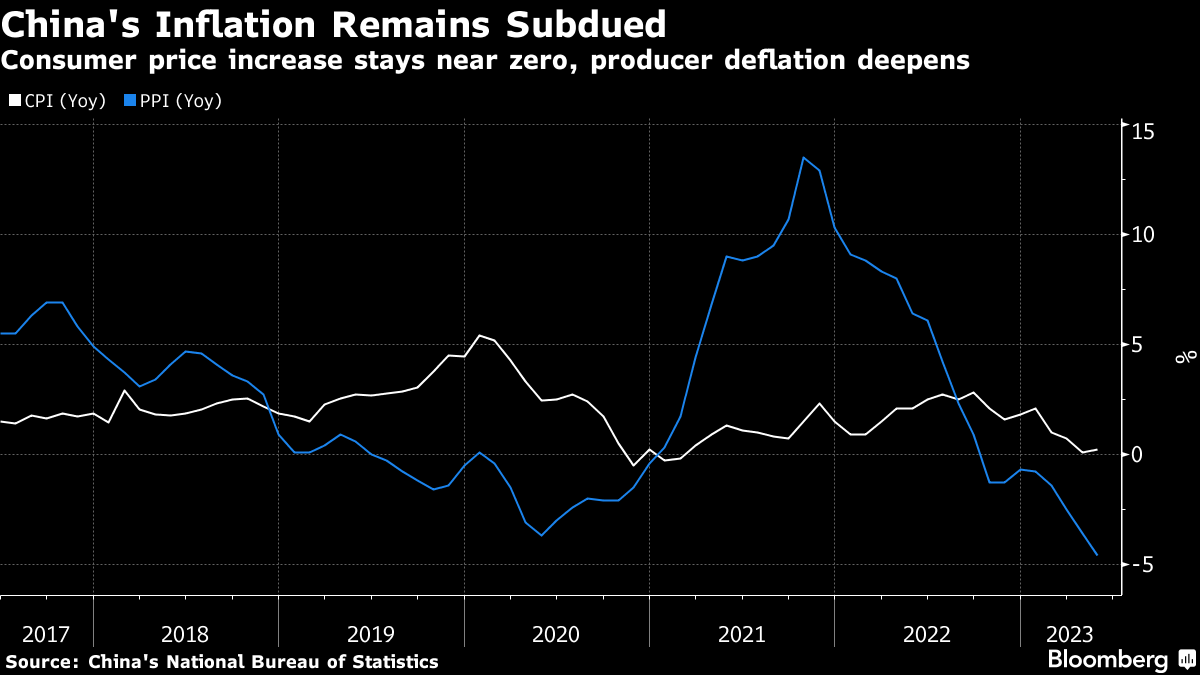
The inflation data provide fresh evidence that the world's second-largest economy cooled further in May, coming on the back of recent reports showing manufacturing activity contracted, exports shrank for the first time in three months and a rebound in the housing market has faded.
“The risk of deflation is still weighing on the economy,” said Zhiwei Zhang, chief economist of Pinpoint Asset Management. “Recent economic indicators send consistent signals that the economy is cooling.”
Calls are growing for the People's Bank of China to cut interest rates, with a prominent economist and government adviser the latest to argue for more easing. Liu Yuanchun, president of Shanghai University of Finance & Economics, said China should lower rates to alleviate the financing burdens on private businesses and boost the economic recovery. Liu has previously consulted with President Xi Jinping and former Premier Li Keqiang.
The yuan dropped further after the inflation report, and was set for its fifth week of declines. The onshore yuan traded 0.16% weaker as of 1:25 p.m. local time at 7.1235 per dollar. China's benchmark CSI 300 Index of stocks fell 0.2% as Asia peers broadly rose.
Core inflation, which excludes volatile food and energy costs, slowed to 0.6% in May from 0.7% in the previous month, a sign of very little domestic-driven inflation in the economy. Food prices rose 1% in May from a year ago, after gaining 0.4% in April, as meat, edible oil and fresh fruit prices went up.
The price of pork, the staple meat for most Chinese people and a key driver of CPI, declined for the first time in a year, falling 3.2% in May from a year earlier, and dragging down the headline number by 0.04 percentage points, according to the NBS.
Raymond Yeung, chief economist for Greater China at Australia & New Zealand Banking Group, said he focuses more on PPI, which provides a good guide of China's business cycle. The PPI data showed a contraction in consumer products, he said, a sign of weaker demand.
“We expect China's monetary policy will continue to be accommodative,” he said. Chances are high that the central bank will probably lower the reserve requirement ratio for banks, he said.
Aside from a RRR move, some economists say an interest rate could come as early as next week. The PBOC has kept the rate on its one-year medium-term lending facility unchanged since September, relying instead on other tools, such as targeted loans, to support sectors like small businesses.
What Bloomberg Economics Says...
China's slackening prices reflect a weakening post-Covid rebound in demand and are likely to put pressure on the People's Bank of China to loosen policy... We expect the PBOC to cut its one-year rate by 10 basis points on June 15.
For the full report, click here
David Qu, China economist
A rate cut would further widen the gap between interest rates in China and the US, where the Federal Reserve has been tightening policy to curb rampant inflation. Lower interest rates in China compared to the US have fueled capital outflows and weighed on the yuan, which is down 3.1% against the dollar so far this year. Expectations are rising that the Fed will likely keep interest rates higher for longer.
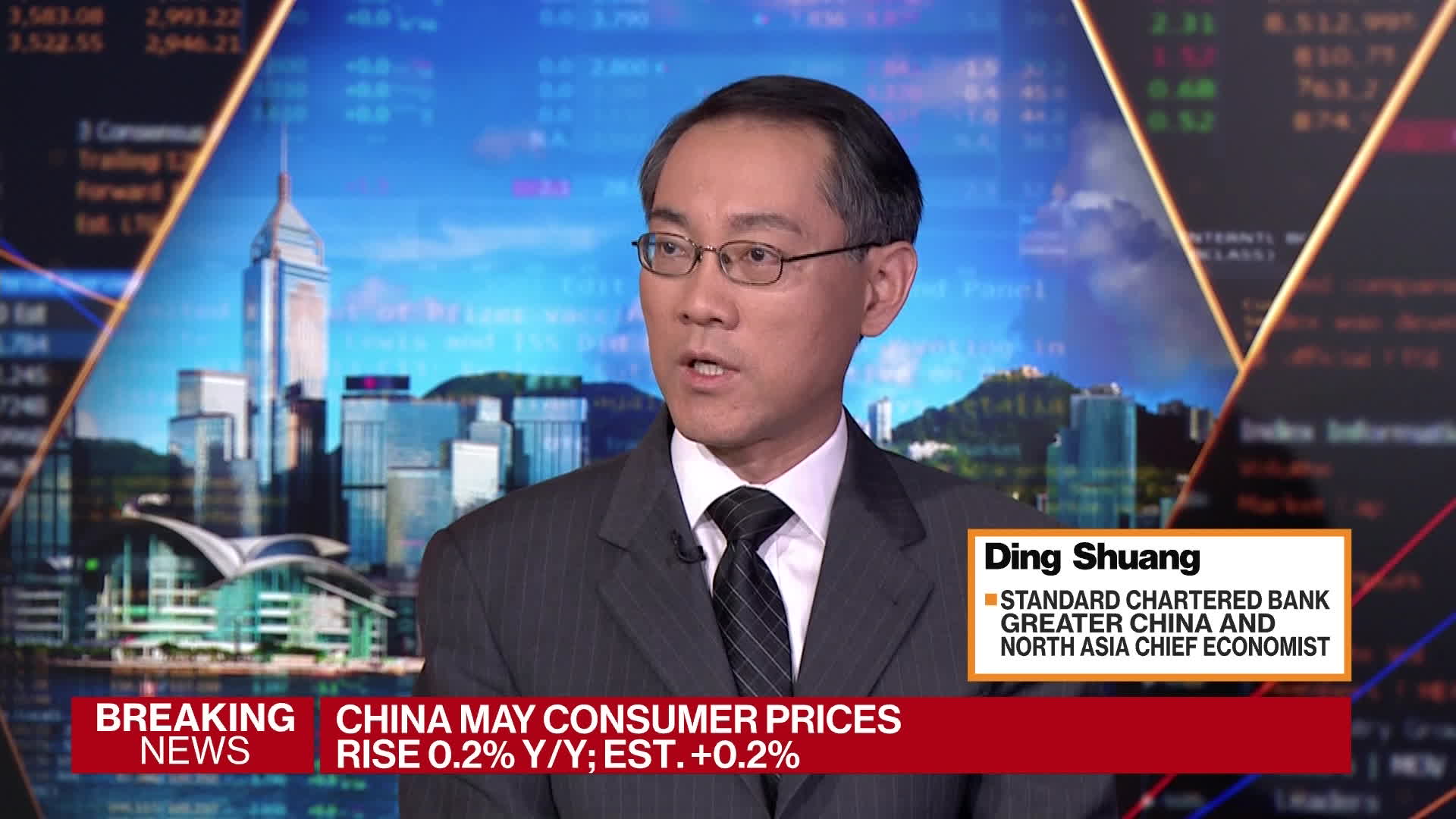
Ding Shuang, chief economist for Greater China at Standard Chartered Plc, said the bar for rolling out broad-based stimulus is high, given China's growth target of around 5% will likely be comfortably achieved this year.
“It's widely recognized in policymaking circles that macro policy is already quite accommodative and more stimulus would have diminishing impact on the real economy,” he said in an interview on Bloomberg TV. He cited the latest State Council meeting as an example, which focused on what it saw as the real issue in the economy, “which is a lack of confidence on the part of private entrepreneurs.”
--With assistance from Zhu Lin and Yujing Liu.
(Updates with yuan's slide, comment from economist.)
More stories like this are available on bloomberg.com
©2023 Bloomberg L.P.

-
Getting To Work Costs Women More | The Reason Why

It is not just about women paying more than men. It is about women paying much more in cities than in villages.
-
AI Bias In Investing Cannot Be Eliminated, But It Can Be Governed
Framing is a particularly important example as identical financial information presented in terms of gains rather than losses can lead an LLM to reach a different assessment.
-
Joining The Dots | Dark Skies, Steady Diya: Why Hope Holds This Diwali
With war, a weak rupee and foreign outflows weighing on sentiment, policymakers at the NDTV World Summit and market veterans at NDTV Profit Ignite: Diwali Edition offered the same advice: stay invested and filter out the noise.
-
The Curious Case of Equitas Small Finance Bank And A CEO Who Quit For Stock
PN Vasudevan believes persistent investor concerns over a perceived conflict of interest had become a governance overhang on Equitas Small Finance Bank's stock, even as the lender improved profitability and asset quality.
-
Talking Points This Week: AI Cash Burn, A Tiger Comeback And An India That Still Finds Its Own Path
India is not immune to higher oil or tighter global liquidity, yet its earnings base is broader, its domestic policy levers are still available.
-
Foreign Investors Own Half Of HDFC Bank and ICICI Bank. An LTCG Cut Could Matter Most Here
Foreign portfolio investors have US$115 billion parked in HDFC Bank, ICICI Bank. If the government cuts long-term capital gains tax, Jefferies says returning foreign money could land here first.
-
'Never Seen This Level Of Negativity': Sandeep Tandon Says The Next Rally May Be Closer Than You Think
Veteran investor Sandeep Tandon says foreign selling is easing, large-caps are due a comeback and mid-caps are crowded, while he turns positive on gold, power and pharma this Diwali.
-
Indians Stay With Family, Not In Hotels | The Reason Why
India still lacks enough clean, reliable and affordable hotels for budget-conscious travellers.
-
The Economic Imperative: Analysing The Material Driving Force Behind India-Canada Strategic Reset
This economic complementarity is further reinforced by deep institutional investment ties and talent mobility, which form the bedrock of the bilateral framework.
-
Medicine Pricing: Where Must Profit Stop?
India must confront excessive margins, hidden incentives and regulatory gaps that threaten the integrity of medicine.










