China’s Fiscal Spending Will Rise This Year, Finance Chief Says
.jpg?downsize=1010:568 "China’s Fiscal Spending Will Rise This Year, Finance Chief Says")
(Bloomberg) -- China's government spending will rise this year, the nation's Minister of Finance said, as authorities look for ways to bolster domestic demand and help the world's second-largest economy regain momentum.
“We will make sure the overall size of fiscal spending increases,” Finance Minister Lan Fo'an said in an interview published Thursday by the People's Daily, the Communist Party's mouthpiece.
Lan's remarks add to pledges from top Chinese officials who have stressed the need to strengthen fiscal support for the economy this year. Those vows have raised expectations that Beijing may set an ambitious economic growth target during a year in which it still faces several challenges to growth, including from an ongoing property slump and still-weak confidence among businesses and consumers.
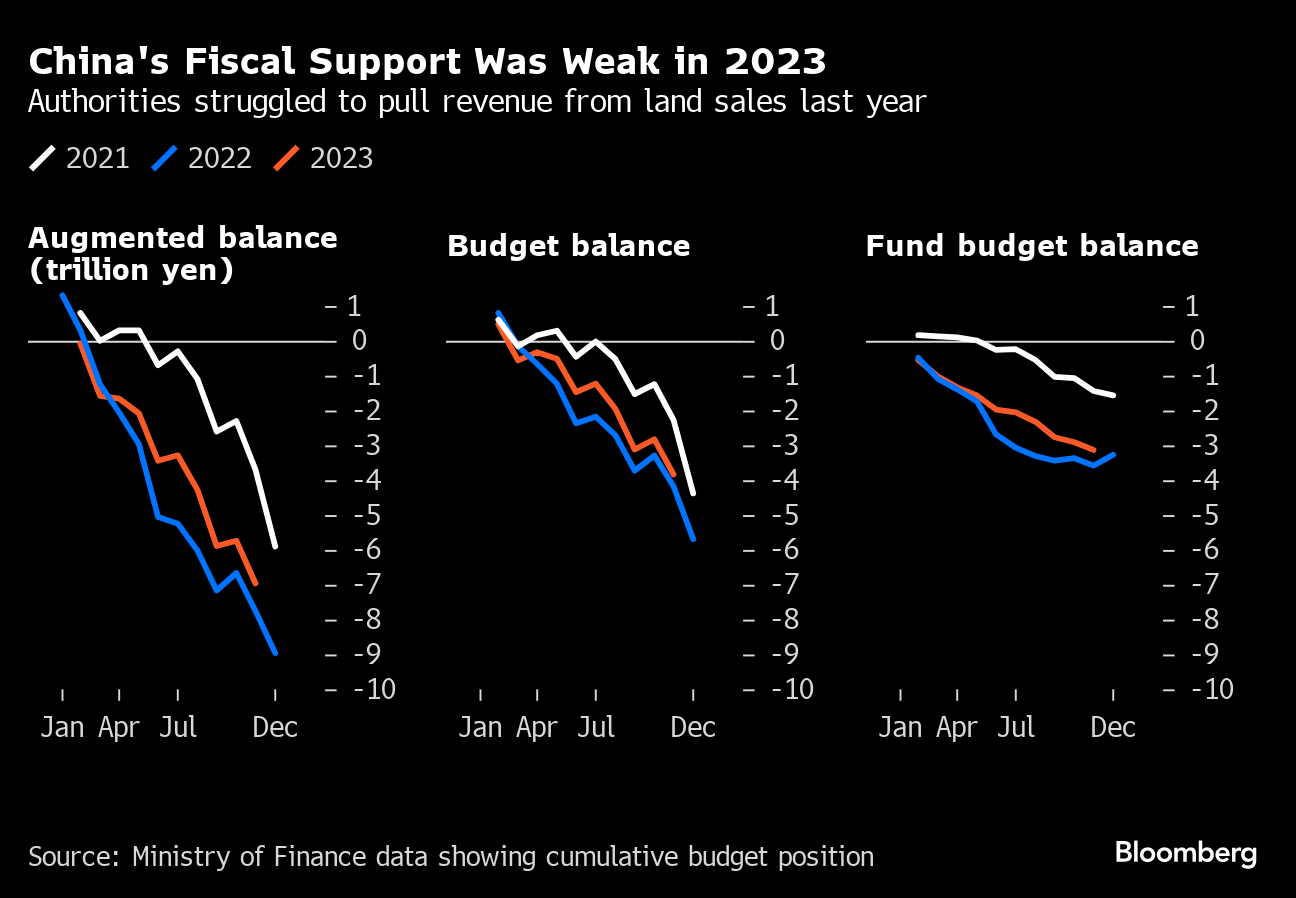
Lan also told the newspaper that the size of the country's budget deficit will be maintained at a “certain level” in 2024, and added that authorities will continue to set an “appropriate” quota for new special local government bonds, a key source of infrastructure investment. That way, overall government spending will increase and “play a better role stimulating domestic demand.”
To help cash-strapped local authorities meet basic spending needs, Lan said the central government would continue transferring funds to them, with poorer areas receiving preference. He also said officials would roll out some tax cuts focusing on support for technological innovation and manufacturing development.
Government fiscal support was generally weak last year as authorities struggled to pull revenue from selling land, a consequence of the property crisis. The most recently available official data showed a broad measure of government spending falling 0.5% through the first 11 months of last year compared to 2022. That put Beijing's initial goal of boosting that so-called augmented expenditure by about 6% for the year far beyond reach.
Some economists expect the official budget deficit this year to be similar, if not slightly bigger, than last year's. Beijing set that deficit-to-gross domestic product ratio at 3% last March, but made a rare mid-year revision to 3.8% by issuing more sovereign debt for disaster relief and construction.
Lan described the government's debt ratio in the interview as being “in a reasonable range,” adding that officials have been “appropriately expanding spending and meeting realistic needs, while saving room for tackling potential risks and challenges in the future.”
There will be additional support not accounted for in the official budget deficit ratio. For example, some economists see the government keeping its quota for new special local government bonds unchanged from last year at around 3.8 trillion yuan ($531 billion). The central bank could also keep making use of its Pledged Supplemental Lending program, a tool used to give policy-oriented banks low-cost funds for housing and infrastructure projects.
More stories like this are available on bloomberg.com
©2024 Bloomberg L.P.

-
Getting To Work Costs Women More | The Reason Why

It is not just about women paying more than men. It is about women paying much more in cities than in villages.
-
AI Bias In Investing Cannot Be Eliminated, But It Can Be Governed
Framing is a particularly important example as identical financial information presented in terms of gains rather than losses can lead an LLM to reach a different assessment.
-
Joining The Dots | Dark Skies, Steady Diya: Why Hope Holds This Diwali
With war, a weak rupee and foreign outflows weighing on sentiment, policymakers at the NDTV World Summit and market veterans at NDTV Profit Ignite: Diwali Edition offered the same advice: stay invested and filter out the noise.
-
The Curious Case of Equitas Small Finance Bank And A CEO Who Quit For Stock
PN Vasudevan believes persistent investor concerns over a perceived conflict of interest had become a governance overhang on Equitas Small Finance Bank's stock, even as the lender improved profitability and asset quality.
-
Talking Points This Week: AI Cash Burn, A Tiger Comeback And An India That Still Finds Its Own Path
India is not immune to higher oil or tighter global liquidity, yet its earnings base is broader, its domestic policy levers are still available.
-
Foreign Investors Own Half Of HDFC Bank and ICICI Bank. An LTCG Cut Could Matter Most Here
Foreign portfolio investors have US$115 billion parked in HDFC Bank, ICICI Bank. If the government cuts long-term capital gains tax, Jefferies says returning foreign money could land here first.
-
'Never Seen This Level Of Negativity': Sandeep Tandon Says The Next Rally May Be Closer Than You Think
Veteran investor Sandeep Tandon says foreign selling is easing, large-caps are due a comeback and mid-caps are crowded, while he turns positive on gold, power and pharma this Diwali.
-
Indians Stay With Family, Not In Hotels | The Reason Why
India still lacks enough clean, reliable and affordable hotels for budget-conscious travellers.
-
The Economic Imperative: Analysing The Material Driving Force Behind India-Canada Strategic Reset
This economic complementarity is further reinforced by deep institutional investment ties and talent mobility, which form the bedrock of the bilateral framework.
-
Medicine Pricing: Where Must Profit Stop?
India must confront excessive margins, hidden incentives and regulatory gaps that threaten the integrity of medicine.










