Xi Is On A Mission To Drive A Wedge Between Europe And The US
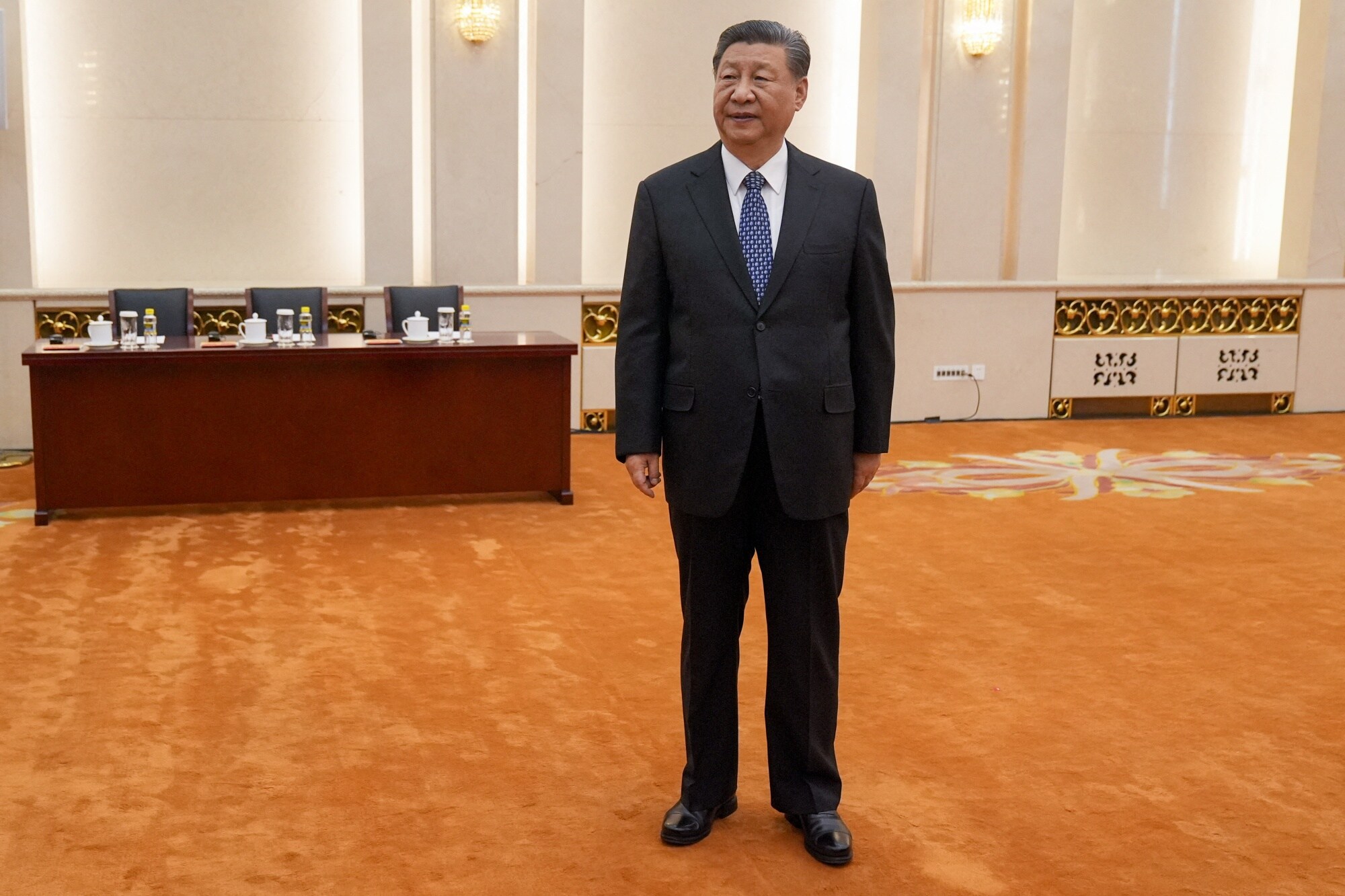
(Bloomberg) -- Chinese President Xi Jinping is heading to the European Union for the first time in five years with a clear message: Beijing offers much more of an economic opportunity for the bloc than the US wants to admit.
The Chinese leader will begin his five-day trip to France, Serbia and Hungary on May 5, according to the Foreign Ministry in Beijing. Those nations are seeking investment from China, despite a litany of EU probes into Beijing's industrial policy and the warnings from officials in Washington about the risks.
President Emmanuel Macron aims to deepen his personal connection with Xi during the two-day visit to France, as he appeals to the Chinese leader to urge Vladimir Putin to end Russia's war in Ukraine, according to people familiar with the plans who asked not to be identified discussing the approach from Paris. Macron also aims to entice Chinese spending into France's EV battery sector, they said.
That charm offensive will include hosting Xi for dinner at the Elysee Palace in Paris, where the menu may feature French cognac, according to the people — a liquor subject to a Beijing anti-dumping probe. Macron will then invite his Chinese counterpart to a corner of the Pyrenees mountains where the French president used to visit his grandmother as a child, the people added.
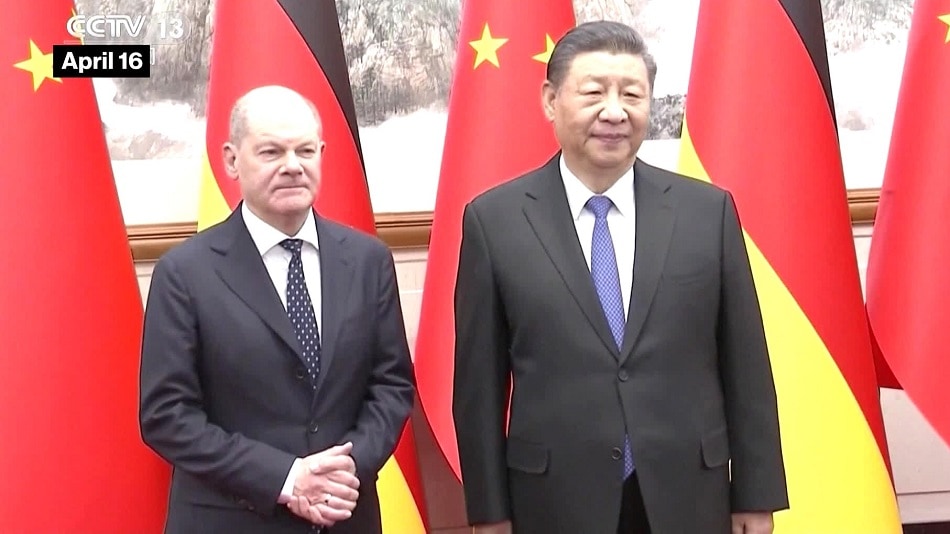
“France's Emmanuel Macron offers Xi the opportunity to negotiate with a leading EU power that's proved willing to carve a more independent path,” said Chong Ja Ian, an associate professor of political science at the National University of Singapore. This trip “is an effort to try to pull at parts of Europe that Xi feels might be more sympathetic to his position.”
China's Foreign Minister Wang Yi told Macron's diplomatic adviser on Saturday that he hopes Paris can push the EU to pursue a pragmatic policy toward Beijing. Macron and European Commission President Ursula von der Leyen will also hold a trilateral meeting with Xi during his visit, her chief spokesman wrote on social media platform X.
Xi's trip comes as the EU is steadily forging a more unified voice with Washington in opposing China's capacity for cheap exports and perceived national security risks. After years serving as a buffer between the world's superpowers, distrust in Brussels is growing: Germany last week arrested four alleged Chinese spies, the latest in a spate of such cases, while EU diplomats are reportedly mulling more curbs on Chinese companies for their support of Russia's war machine.
“I think it's part of an attempt to persuade the Europeans that there are better options, that better relations are possible,” Duncan Freeman, a lecturer on China-Europe relations at the Brussels Management School in Belgium, said ahead of Xi's trip. “We're not yet in the last chance saloon, but I think even the Chinese would agree the relationship is far from ideal.”
Xi's visit to Europe comes weeks after US Treasury Secretary Janet Yellen warned Communist Party leaders in Beijing that Chinese overcapacity was a problem for the world — a message echoed days later by German Chancellor Olaf Scholz. Exemplifying how both blocs are coalescing around a joined-up China policy, they are both pursuing a strategy of “derisking” from the world's second-largest economy.
Xi and Russian President Vladimir Putin have united in challenging the US-led world order, which Beijing says is trying to contain its development. The Chinese leader's stop in Belgrade, which is not an EU member state, will come in the week of the 25th anniversary of the US bombing of China's embassy in the Serbian capital, an event that brought Russia and China closer over shared anti-American sentiment.
During the Europe trip, Putin will also be inaugurated into a fifth term that Xi has congratulated him over, spotlighting a pro-Russia policy that's increased tensions between Beijing and Brussels.
Xi is visiting nations “where selling the dislike for the US-led global security architecture is easier,” said Una Aleksandra Berzina-Cerenkova, director of the China Studies Centre at Riga Stradins University. Scooping up endorsements in friendly nations will help Beijing send the message that “Europe is on China's side, no matter what Brussels says,” she added.
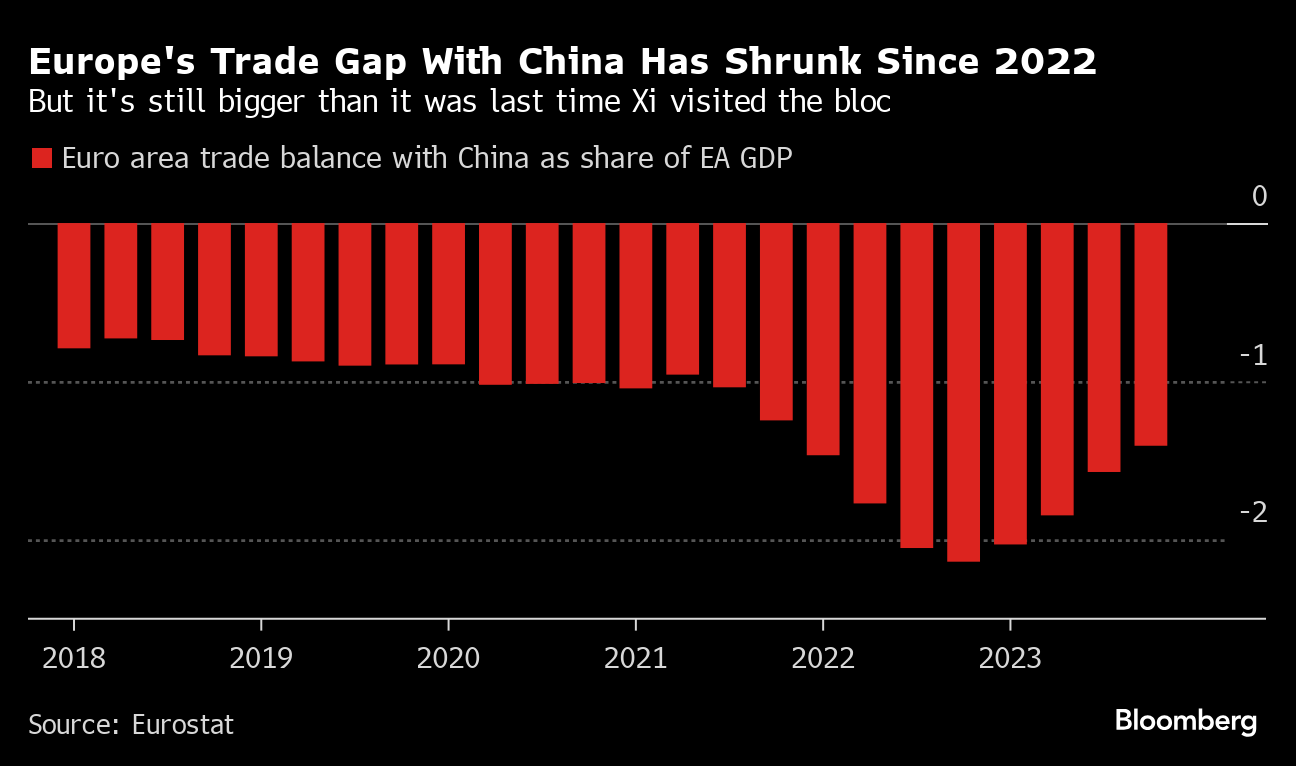
When Xi last visited Western Europe in 2019, the economies of China and the euro area — measured in dollars — were roughly the same size. Today, China's is almost 15% bigger, with that gap forecast to double before the end of this decade. While the bloc's trade deficit with China has been narrowing, it still remains bigger than it was back then.
That trade imbalance has triggered alarm in Brussels, which has launched a probe into Beijing's subsidies for its booming EV brands. Investigations have also targeted medical devices and clean-tech industries such as bids on a Romanian solar park. Such action is creating friction before official probe findings are announced, with one Chinese company abandoning a €610 million ($650 million) Bulgarian railway tender.
Hungary is potentially a major strategic asset for Beijing in slowing that momentum as it has the power to dilute or even block EU policy. In December, Hungarian Prime Minister Viktor Orban was the sole holdout on an EU aid package for Ukraine, delaying critical supplies for about six weeks.
Orban's ability to stymie trade restrictions is more limited, as measures only require a qualified majority of nations to be put into force. Still, Hungary was among a group of countries that initially opposed an EU plan to blacklist some Chinese firms for supplying technology used in Russian weapons.
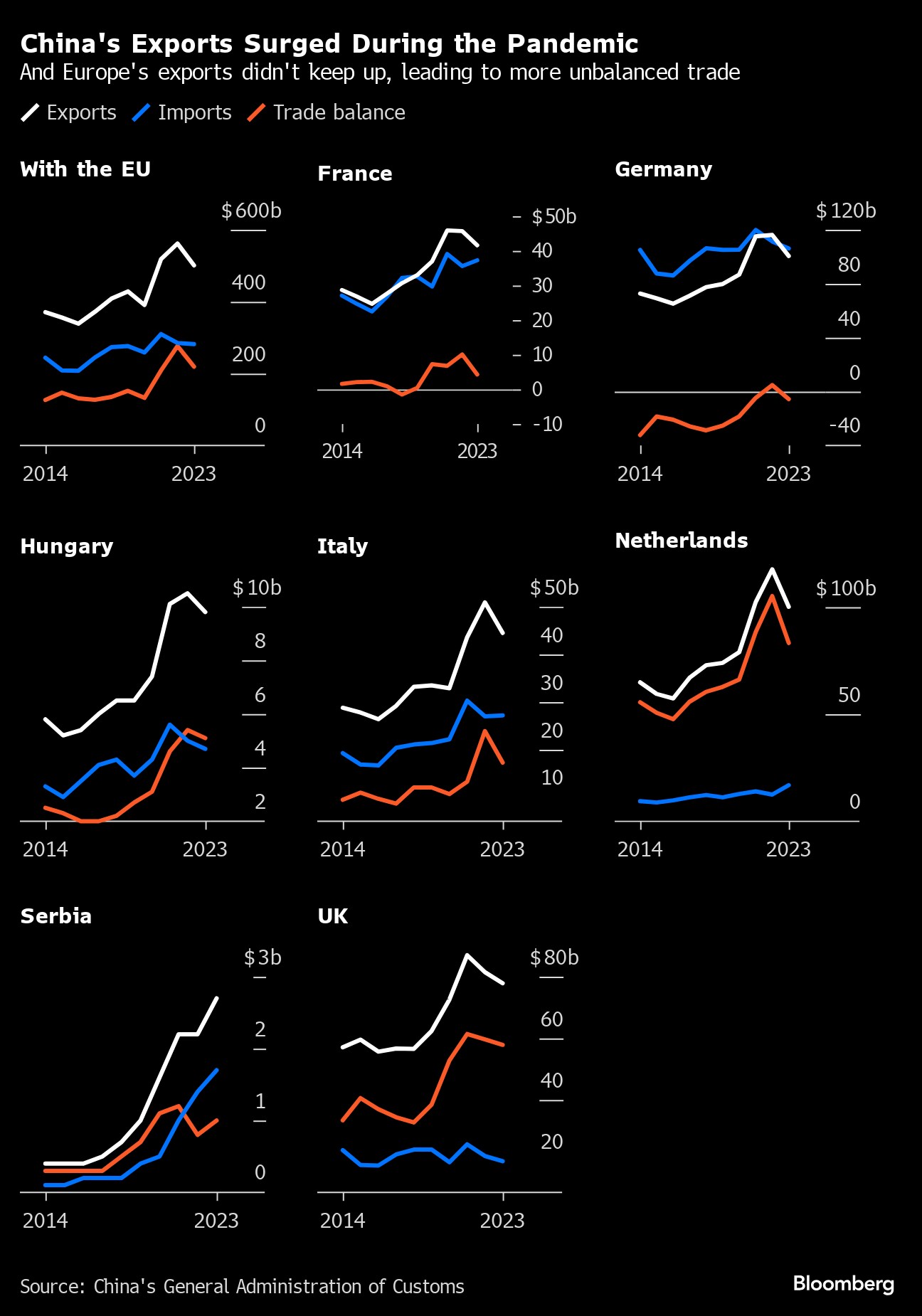
Hungary also shows the rewards possible for loyalty to Beijing. Xi and Orban are set to announce during his visit that Chinese automaker Great Wall Motor Ltd. will open a plant in Hungary, Radio Free Europe reported.
China's Contemporary Amperex Technology Co. Ltd. has already committed to building a $7.6 billion facility there in partnership with Mercedes-Benz AG, heralded as Hungary's biggest ever foreign direct investment that will create about 9,000 jobs.
Firms from the world's No. 2 economy are investing abroad at their fastest pace in eight years as they open more factories overseas, which could soften trade tensions. Automaker BYD Co. last year announced plans to build a factory in Hungary, while Chery Automobile Co. signed a deal in April to take over an old Nissan Motor Co factory in Spain to produce EVs.
“China needs to give a clearer message to the European public that it is still a reliable partner,” said Cui Hongjian, a professor at Beijing Foreign Studies University and a former diplomat. That boils down to one thing, he added: “Providing more favorable policies to European countries and companies.”
--With assistance from Siuming Ho, Alberto Nardelli, Ben Sills and James Mayger.
(Updates with European Commission President Ursula von der Leyen trilateral meeting with Xi and Macron.)
More stories like this are available on bloomberg.com
©2024 Bloomberg L.P.

-
Indians Are Travelling, But Not Every Journey Is A Holiday | The Week In Whys

Pilgrims, patients and working women are the real travellers, and the system hasn't quite caught up with them.
-
Getting To Work Costs Women More | The Reason Why
It is not just about women paying more than men. It is about women paying much more in cities than in villages.
-
AI Bias In Investing Cannot Be Eliminated, But It Can Be Governed
Framing is a particularly important example as identical financial information presented in terms of gains rather than losses can lead an LLM to reach a different assessment.
-
Joining The Dots | Dark Skies, Steady Diya: Why Hope Holds This Diwali
With war, a weak rupee and foreign outflows weighing on sentiment, policymakers at the NDTV World Summit and market veterans at NDTV Profit Ignite: Diwali Edition offered the same advice: stay invested and filter out the noise.
-
The Curious Case of Equitas Small Finance Bank And A CEO Who Quit For Stock
PN Vasudevan believes persistent investor concerns over a perceived conflict of interest had become a governance overhang on Equitas Small Finance Bank's stock, even as the lender improved profitability and asset quality.
-
Talking Points This Week: AI Cash Burn, A Tiger Comeback And An India That Still Finds Its Own Path
India is not immune to higher oil or tighter global liquidity, yet its earnings base is broader, its domestic policy levers are still available.
-
Foreign Investors Own Half Of HDFC Bank and ICICI Bank. An LTCG Cut Could Matter Most Here
Foreign portfolio investors have US$115 billion parked in HDFC Bank, ICICI Bank. If the government cuts long-term capital gains tax, Jefferies says returning foreign money could land here first.
-
'Never Seen This Level Of Negativity': Sandeep Tandon Says The Next Rally May Be Closer Than You Think
Veteran investor Sandeep Tandon says foreign selling is easing, large-caps are due a comeback and mid-caps are crowded, while he turns positive on gold, power and pharma this Diwali.
-
Indians Stay With Family, Not In Hotels | The Reason Why
India still lacks enough clean, reliable and affordable hotels for budget-conscious travellers.
-
The Economic Imperative: Analysing The Material Driving Force Behind India-Canada Strategic Reset
This economic complementarity is further reinforced by deep institutional investment ties and talent mobility, which form the bedrock of the bilateral framework.










