Chastened Economists Hopeful For U.S. Soft Landing, Fed Rate Cuts

(Bloomberg) -- Inflation's roller-coaster ride over the last couple of years has left economists humbled about their forecasting abilities but hopeful for a soft landing in the US and eventually lower Federal Reserve interest rates.
At the three-day annual meeting of the economics profession that wrapped up in San Antonio on Sunday, numerous participants acknowledged the difficulties they've faced in predicting the outlook for the economy and inflation in the post-pandemic world. Many failed to anticipate a burst in inflation to multi-decade highs and then mistakenly believed that it would take a recession to bring it back down.
“We didn't really understand why inflation spiked in the first place,” said University of Michigan professor James Hines. “We maybe shouldn't be surprised it came down faster than we thought.”
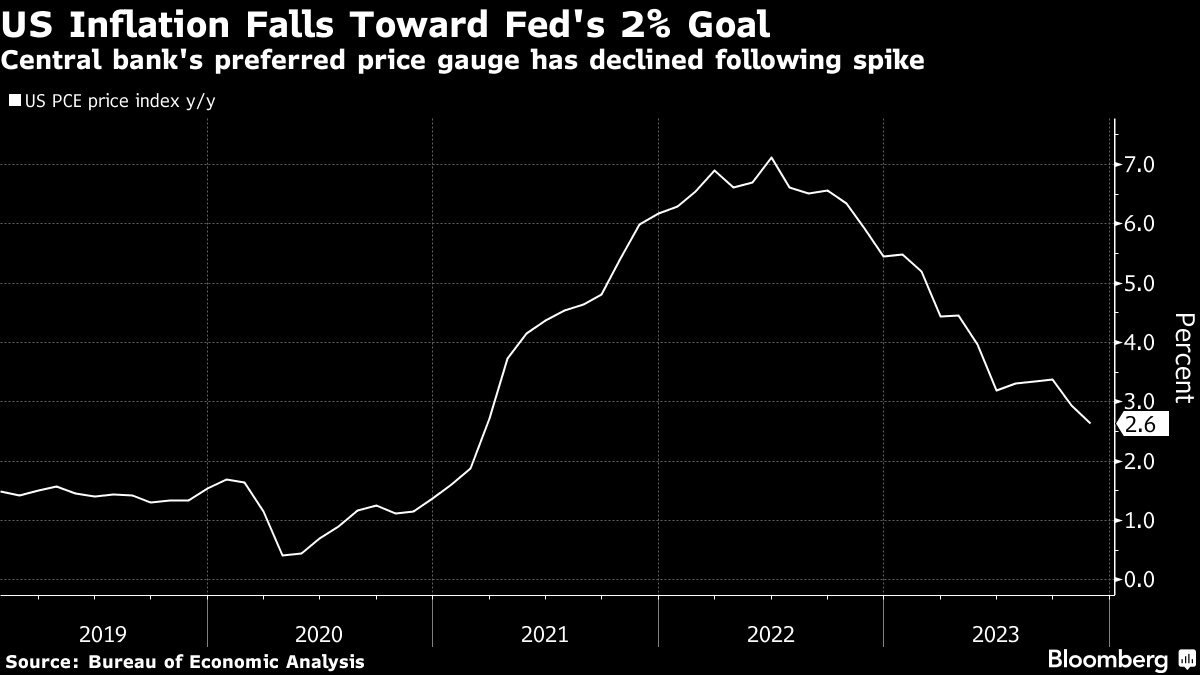
The fall in inflation – the Fed's favorite measure dropped to 2.6% in November from a high of 7.1% in June 2022 – fanned hopes among economists gathered in Texas that it will return to the Fed's 2% target without a downturn in the economy.
“Turning points are hard to forecast so I think we should be humble about it,” said professor Emi Nakamura of the University of California, Berkeley. But “it's pretty plausible at this point.”
That would be good news for President Joe Biden. He has seen his poll numbers sag amid voter anxiety over a surge in the cost of living, and he would face a bigger headwind to winning another term in November if the US tumbled into a recession.
The ebbing price pressure should also allow the Fed to lower interest rates, according to economists at the American Economic Association meeting, though perhaps not as soon or as quickly as investors expect.
Traders in the federal funds futures market are betting that the first Fed cut will come in March and that the central bank will reduce rates to around 4% by the end of the year. The Fed is currently targeting a 5.25 to 5.5% range for the funds rate.
Rate Cuts
“Make no mistake, they will be cutting rates this year,” Morgan Stanley chief US economist Ellen Zentner told the conference. But “they can be patient and they can take their time.” She's forecasting the Fed's first rate cut will come in June.
Stanford University professor John Taylor, who was sharply critical of the Fed's initial delay in tightening credit, said the central bank is much less behind the curve in fighting inflation after its steep rate increases starting in March 2022.
If inflation continues to come down, “we'll have lower interest rates,” said Taylor, whose eponymous economic rule is used by central banks to help guide monetary policy. He suggested rates may eventually fall to 3% to 4%.
That doesn't mean it's all clear sailing ahead. Chief among the risks: a geopolitical shock, such a widening of the war in the Middle East that sends oil prices surging.
That could unhinge still-fragile inflation expectations and risk a rerun of the sort of inflationary spiral seen in the 1970s and the deep recession that followed, said Ricardo Reis of the London School of Economics.
“I think we're one shock away from having a permanent problem,” he said. But he put a small chance of that happening and is otherwise confident that inflation will be back at 2% even by the end of the year.
Model Reliance
In doing a post-mortem on what economists got wrong last year, Northwestern University professor Janice Eberly told the conference the profession relied too heavily on computer models built on past economic relationships. Those suggested a recession would be needed to break the back of inflation, just as occurred in the 1970s.
“We should never have trusted our models,” especially after a once-in-a-century pandemic, the former US Treasury official said, adding she had suspected at the time they were too pessimistic. “Models are drastic simplifications.”
In a paper he presented to the conference, Columbia University's Martin Uribe proposed extending the period covered by the models to before World War II, when inflation spikes were more common and when a pandemic previously struck.
A big reason why the US has been able to dodge a recession has been an increase in the so-called supply side of the economy. That's partly due to an untangling of pandemic-driven supply-chain snarls that sent prices of cars and other goods sharply higher.
Those pressures “were not transitory. They were persistent,” Eberly said, harking back to a debate at the onset of the inflation surge in 2021 about how long it would last. “But they were not permanent.”
Even more of a surprise to economists was a jump in the number of workers, through a rise in labor-force participation, particularly among women, and increased immigration.
“The supply side of the economy has come back in a much more supportive way than most people had anticipated,” Eberly said. “That is the most hopeful part for getting a soft landing because it means you can maintain strong growth without putting upward pressure on inflation.”
--With assistance from Catarina Saraiva.
More stories like this are available on bloomberg.com
©2024 Bloomberg L.P.

-
Getting To Work Costs Women More | The Reason Why

It is not just about women paying more than men. It is about women paying much more in cities than in villages.
-
AI Bias In Investing Cannot Be Eliminated, But It Can Be Governed
Framing is a particularly important example as identical financial information presented in terms of gains rather than losses can lead an LLM to reach a different assessment.
-
Joining The Dots | Dark Skies, Steady Diya: Why Hope Holds This Diwali
With war, a weak rupee and foreign outflows weighing on sentiment, policymakers at the NDTV World Summit and market veterans at NDTV Profit Ignite: Diwali Edition offered the same advice: stay invested and filter out the noise.
-
The Curious Case of Equitas Small Finance Bank And A CEO Who Quit For Stock
PN Vasudevan believes persistent investor concerns over a perceived conflict of interest had become a governance overhang on Equitas Small Finance Bank's stock, even as the lender improved profitability and asset quality.
-
Talking Points This Week: AI Cash Burn, A Tiger Comeback And An India That Still Finds Its Own Path
India is not immune to higher oil or tighter global liquidity, yet its earnings base is broader, its domestic policy levers are still available.
-
Foreign Investors Own Half Of HDFC Bank and ICICI Bank. An LTCG Cut Could Matter Most Here
Foreign portfolio investors have US$115 billion parked in HDFC Bank, ICICI Bank. If the government cuts long-term capital gains tax, Jefferies says returning foreign money could land here first.
-
'Never Seen This Level Of Negativity': Sandeep Tandon Says The Next Rally May Be Closer Than You Think
Veteran investor Sandeep Tandon says foreign selling is easing, large-caps are due a comeback and mid-caps are crowded, while he turns positive on gold, power and pharma this Diwali.
-
Indians Stay With Family, Not In Hotels | The Reason Why
India still lacks enough clean, reliable and affordable hotels for budget-conscious travellers.
-
The Economic Imperative: Analysing The Material Driving Force Behind India-Canada Strategic Reset
This economic complementarity is further reinforced by deep institutional investment ties and talent mobility, which form the bedrock of the bilateral framework.
-
Medicine Pricing: Where Must Profit Stop?
India must confront excessive margins, hidden incentives and regulatory gaps that threaten the integrity of medicine.










