Boeing Beats Lockheed For Next-Gen US Fighter Jet Contract
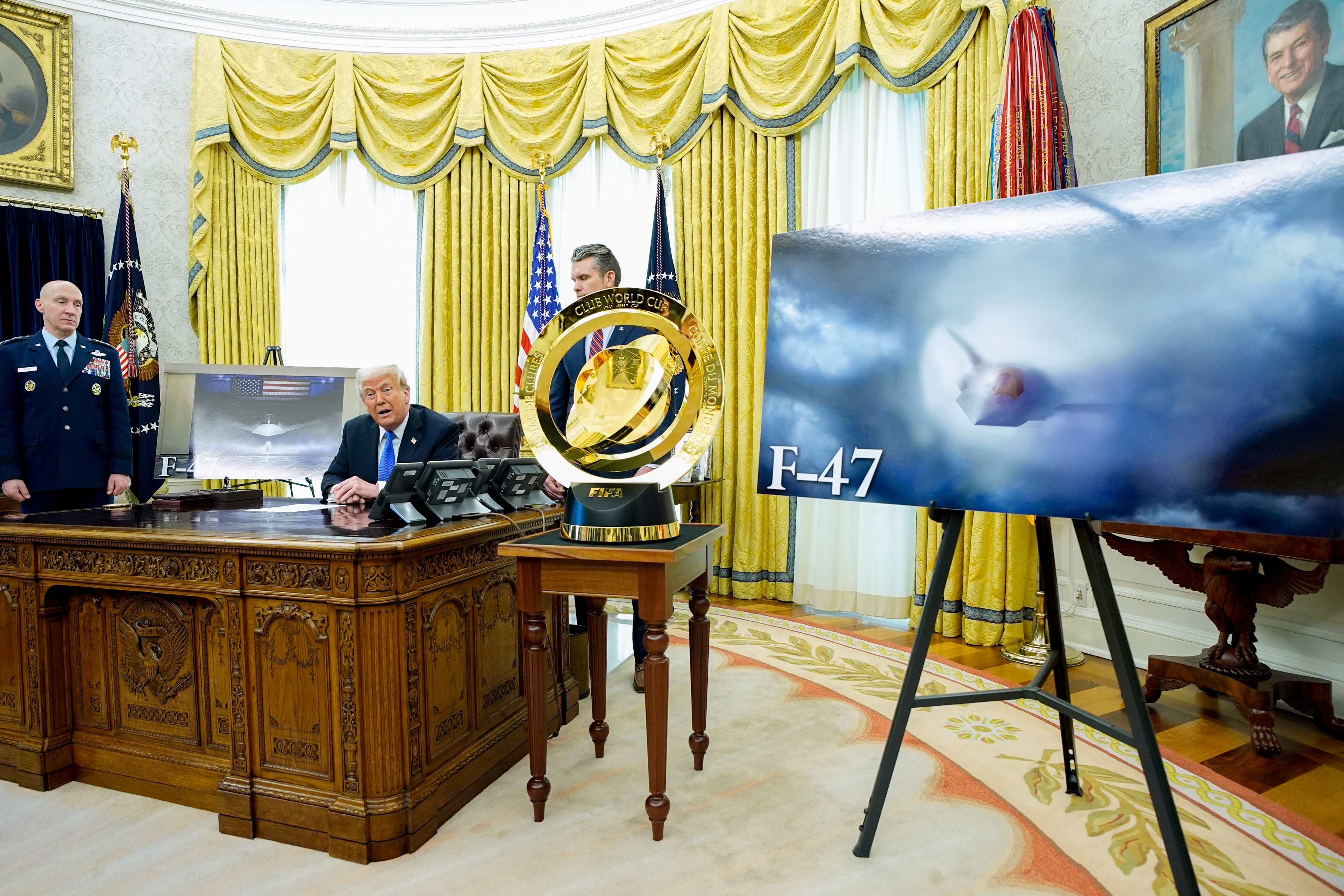
Boeing Co. won a contract to design and build the US's next-generation fighter jet, called the F-47, beating out rival Lockheed Martin Corp. for the multibillion dollar program.
President Donald Trump announced the decision Friday morning at the White House alongside Defense Secretary Pete Hegseth.
The new sixth-generation fighter jet “will ensure that the USA continues to dominate the skies,” Trump said. “The F-47 will be the most advanced, most capable, most lethal aircraft ever built.”
Boeing shares rose 5.7% while Lockheed erased earlier gains to fall 6.8% as of 1:06 p.m. in New York.
The award caps more than two years of competition between the defense giants for the full-scale development phase of the Next Generation Air Dominance manned fighter, or NGAD. The jet, which will replace the F-22 Raptor, is envisioned to operate in tandem with drones, which are being developed in a separate program.
While little has been made public about the project, budget figures released last year showed the the Air Force plans to spend as much as $20 billion on NGAD research and development through 2029.
A key driver for developing the F-47 has been keeping pace with China's air defense and electronic warfare systems, which have become more sophisticated since the F-22 entered service in 2005, according to a January report by the Congressional Research Service. It also notes that the Raptor could be hamstrung in a potential conflict over the Pacific due to its fuel and payload limitations.
“This is the right decision to avoid costly delays and move forward with our next generation fighter,” Senator Mark Kelly, a Democrat from Arizona and a member of the Armed Services Committee, said in a statement. “It will allow us to maintain our competitive edge over the Chinese military and deter our adversaries, in large part due to the cutting-edge combination of manned and unmanned systems.”
For Boeing, winning NGAD is a rebound after losing the F-35 fighter program to Lockheed Martin in 2001. Boeing's defense business has been hammered by billions of dollars in cost overruns on fixed-price development programs such as the KC-46 aerial refueling tanker and the next-generation Air Force One presidential aircraft.
It's also a boost for the company as it recovers from a rough 2024, including a major labor strike and regulatory scrutiny after a panel blew out from one of its planes midair.
“While disappointed with this outcome, we are confident we delivered a competitive solution,” Lockheed Martin said in a statement. “We will await further discussions with the US Air Force.”
The US plans to sell the jets to “certain allies,” though “perhaps toned-down versions,” Trump said during the White House announcement, where he quipped that “47” in the name is “a beautiful number” — an apparent reference to himself as the 47th president.
In addition to the usual challenges of such a large and complex defense contract, the winner will need to account for Trump's billionaire cost-cutting adviser Elon Musk, who's publicly derided the F-35 and questioned the need for manned warplanes given advances in drone technology.
“We think this award indicates Defense Department will continue with manned aviation programs despite rising importance of drones,” analysts at TD Cowen said in a research note.
The new fighter is expected to enter service in the 2030s if everything goes according to plan. While the F-22 boasts stealth capabilities and a supersonic cruise speed, the plane was developed and fielded before the military's all-in bet on drones as an extension of US power.
Like the F-22, the next-gen jet is intended to be an air-to-air fighter. While the better-known F-35 also has an air-to-air role, it's additionally relied upon to collect and distribute air and ground target information.
This win ensures Boeing maintains its historic role as a designer and producer of military fighter planes. It's also a likely tailwind for its fighter jet manufacturing hub in St. Louis. Boeing is phasing out production of the F/A-18 Super Hornet, leaving a jet whose design dates back a half century — the F-15 — as its mainstay.
Securing the program also ends speculation that Boeing might break up its commercial and defense businesses, a move Chief Executive Officer Kelly Ortberg has signaled he opposes.

-
Indians Are Travelling, But Not Every Journey Is A Holiday | The Week In Whys

Pilgrims, patients and working women are the real travellers, and the system hasn't quite caught up with them.
-
Getting To Work Costs Women More | The Reason Why
It is not just about women paying more than men. It is about women paying much more in cities than in villages.
-
AI Bias In Investing Cannot Be Eliminated, But It Can Be Governed
Framing is a particularly important example as identical financial information presented in terms of gains rather than losses can lead an LLM to reach a different assessment.
-
Joining The Dots | Dark Skies, Steady Diya: Why Hope Holds This Diwali
With war, a weak rupee and foreign outflows weighing on sentiment, policymakers at the NDTV World Summit and market veterans at NDTV Profit Ignite: Diwali Edition offered the same advice: stay invested and filter out the noise.
-
The Curious Case of Equitas Small Finance Bank And A CEO Who Quit For Stock
PN Vasudevan believes persistent investor concerns over a perceived conflict of interest had become a governance overhang on Equitas Small Finance Bank's stock, even as the lender improved profitability and asset quality.
-
Talking Points This Week: AI Cash Burn, A Tiger Comeback And An India That Still Finds Its Own Path
India is not immune to higher oil or tighter global liquidity, yet its earnings base is broader, its domestic policy levers are still available.
-
Foreign Investors Own Half Of HDFC Bank and ICICI Bank. An LTCG Cut Could Matter Most Here
Foreign portfolio investors have US$115 billion parked in HDFC Bank, ICICI Bank. If the government cuts long-term capital gains tax, Jefferies says returning foreign money could land here first.
-
'Never Seen This Level Of Negativity': Sandeep Tandon Says The Next Rally May Be Closer Than You Think
Veteran investor Sandeep Tandon says foreign selling is easing, large-caps are due a comeback and mid-caps are crowded, while he turns positive on gold, power and pharma this Diwali.
-
Indians Stay With Family, Not In Hotels | The Reason Why
India still lacks enough clean, reliable and affordable hotels for budget-conscious travellers.
-
The Economic Imperative: Analysing The Material Driving Force Behind India-Canada Strategic Reset
This economic complementarity is further reinforced by deep institutional investment ties and talent mobility, which form the bedrock of the bilateral framework.










