Bank Of Korea Expected To Keep Policy Restrictive For Now
(Bloomberg) -- The Bank of Korea is poised to stand pat on policy and push back against any expectations it might join the Federal Reserve in signaling a potential pivot.
All 12 economists surveyed by Bloomberg expect South Korea's central bank to keep its benchmark interest rate at 3.5%, a level it characterizes as restrictive, when the board meets Thursday for the first decision of 2024. If the BOK holds, it would mark a full year that authorities have kept the rate steady.
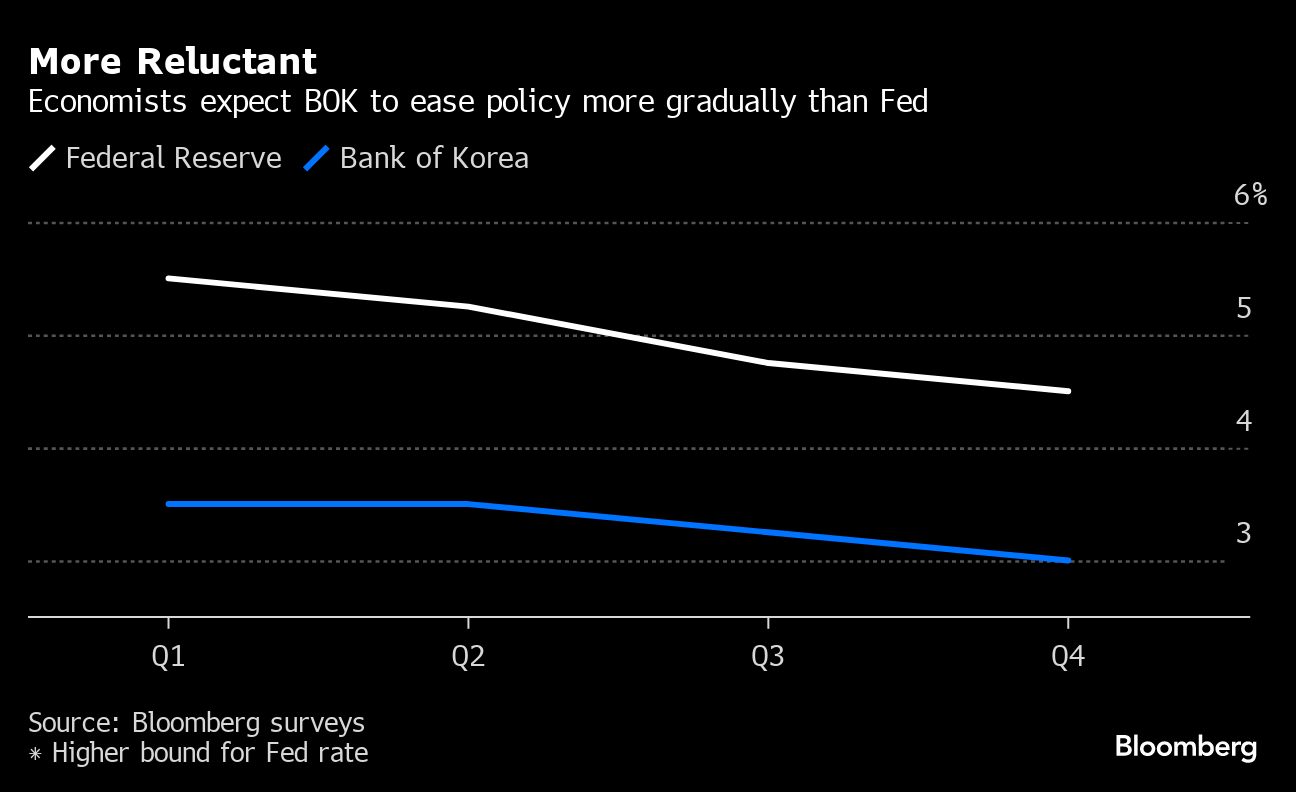
BOK Governor Rhee Chang-yong has warned in recent weeks against prematurely relaxing the fight against inflation after the Fed signaled an earlier-than-expected pivot. Rhee said each central bank has more scope this year to chart its own path compared with last year, when the US led the global campaign against price growth.
The US announces its latest inflation data later this week following a 3.1% reading in November. South Korea's consumer-price growth slowed to 3.2% in December for a second month of cooling, even though household debt remains elevated due to a stronger-than-expected recovery in housing.
“We expect a ‘tad dovish' rate hold,” Citi Research economists Jin-Wook Kim and Jiuk Choi said in a report. “Still, the BOK is highly likely to keep the official restrictive policy stance due to slow inflation stabilization to the target, robust economic growth and larger-than-expected household debt.”
A risk associated with household debt is so-called project financing, a major source of funding for South Korean developers. Taeyoung Engineering & Construction is struggling to survive a crisis stemming from its over-reliance on project financing, with officials pledging efforts to limit any spillover to the broader economy. The builder got a cash infusion from its parent on Monday.
In 2022, a default by a government-backed developer of Legoland Korea sent ripples through the financial industry before authorities stepped in with a rescue plan. That prompted the BOK to slow the pace of rate hikes.
Read More: South Korea Unveils Steps Aimed at Suppressing Inflation Quickly
The BOK began its tightening campaign in August 2021, launching its fight against inflation earlier than most peers including the Fed. Over the course of the cycle, it raised rates by a cumulative three percentage points to a 15-year high.
The economy showed resilience last year even with the restrictive policy. Authorities estimate gross domestic product grew 1.4% last year, and the expansion may gain momentum this year, as exports perform better, backing the BOK case for staying hawkish.
In contrast, consumption is likely to slow this year along with the growth in jobs, according to the Finance Ministry. The ministry projects growth in jobs will moderate by almost a third.
The forecasts paint a picture of an economy that will grow unevenly, resulting in pressure on the BOK to ease policy to some degree out of concern for private spending. Economists surveyed by Bloomberg expect about two cuts by the end of 2024. Those expectations helped push yields on three-year debt lower last month.
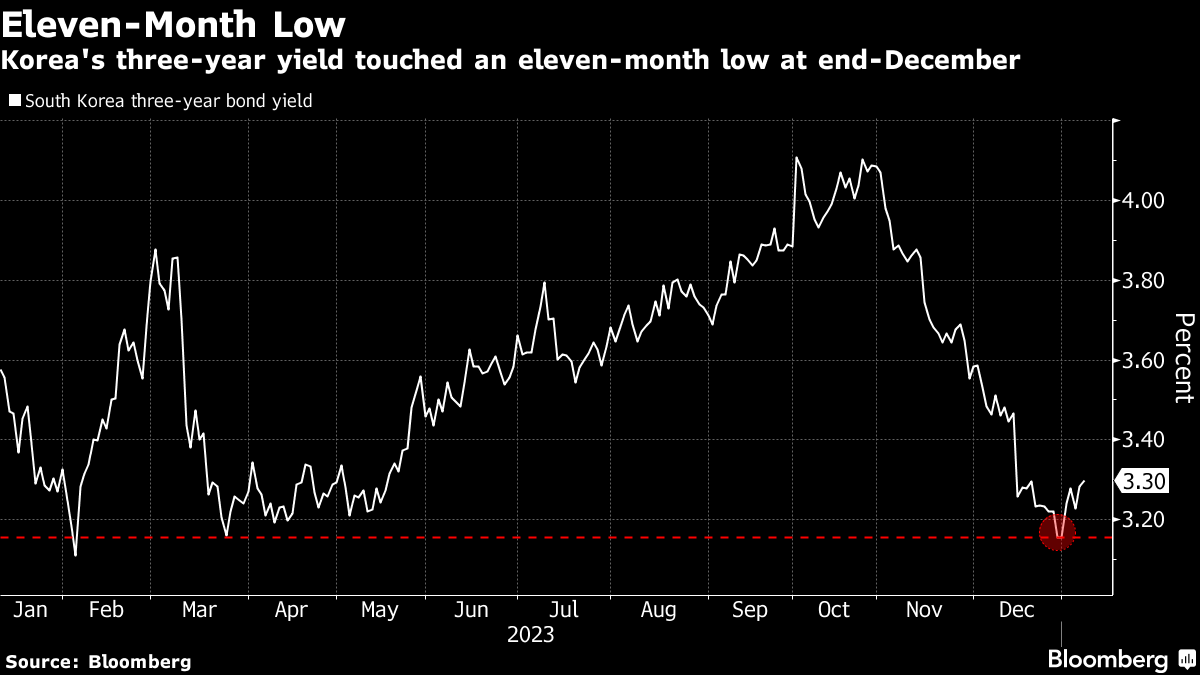
“Markets are somewhat ahead of the central bank in terms of the timing of the first rate cut,” said Woo Hye-young, fixed-income analyst at Ebest Investment & Securities Co. “It will be difficult for the BOK to make any drastic moves now with credit risk concerns linked to the nation's real estate market resurfacing,” she said.
It's unclear how the BOK would signal any repositioning if it decided to do so. In November, two members said they saw the rate as having reached a peak, compared with four who remained opened to another hike. That gave the board a slightly less hawkish tilt compared with the previous decision.
“No changes to monetary policy are expected, but the market will likewise be watching for signs of the central bank pivoting towards a rate cut,” said Jingyi Pan, economics associate director at S&P Global Market Intelligence.
--With assistance from Hooyeon Kim and Tomoko Sato.
More stories like this are available on bloomberg.com
©2024 Bloomberg L.P.

-
We May Need Another Tukaram Mundhe To Fight Air Pollution | The Reason Why

Developers may install basic measures such as sprinklers and green nets, resume work, and continue violating rules when this equipment stops working.
-
Extracting Value From Battery Scrap Could Be Challenging For India | The Reason Why
A discarded lithium-ion battery still contains valuable materials such as lithium, nickel and cobalt. These can be recovered and reused. When such batteries are crushed and shredded, they produce a dark powder called black mass.
-
One El Nino, India Can Handle. Two Could Break The Granary
India's grain stocks can absorb one bad year, but a second El Nino could drain the buffer in two to three years, economists say.
-
India's Troika Of Good Luck | Joining The Dots
As Jensen Huang's exit drags Nvidia down, a cooling AI trade and resilient earnings have revived investor interest in India. A likely RBI rate hike looms.
-
Talking Points This Week: Leadership Shock At Nvidia, Earnings Strength, And The Fog Over Hormuz
The Anthropic IPO pricing and first trading day, Nvidia's upcoming earnings, and any fresh signals from Iran will set the tone for the following week.
-
Signature Play: The Classic Cocktail Is Dead. Or Is It?
Classic cocktails are disappearing from India's cocktail menus. But they're still being ordered, taught to bartenders and borrowed from. So, who's really having the last drink?
-
A New Samvat Wishlist: Inclusive Prosperity And Human Development
India has strengthened its economic foundations through infrastructure, digital access and enterprise. Its next growth chapter must deepen productivity, create better livelihoods and widen participation in prosperity.
-
Love, Sex Aur Dhokha: The Audacious Plot To Spy On Jensen Huang
A Taipei dinner, a Singapore chip buyer and a suspected Chinese asset: inside the alleged spy operation that got close to NVIDIA's Jensen Huang.
-
Ten Things I Learnt This Samvat
Patience can be a trap. Cheap stocks can stay cheap. Leverage can wipe you out. What did Samvat 2082 teach us? Niraj Shah writes on 10 lessons from the year gone by.
-
Talking Points This Week: Tech Nerves, FII Buying, And A Faraway Banking Shock
The global markets are not shining this Diwali. The exception in the large markets is, India.









