Shippers In Baltimore Disaster Face ‘General Average,’ MSC Says
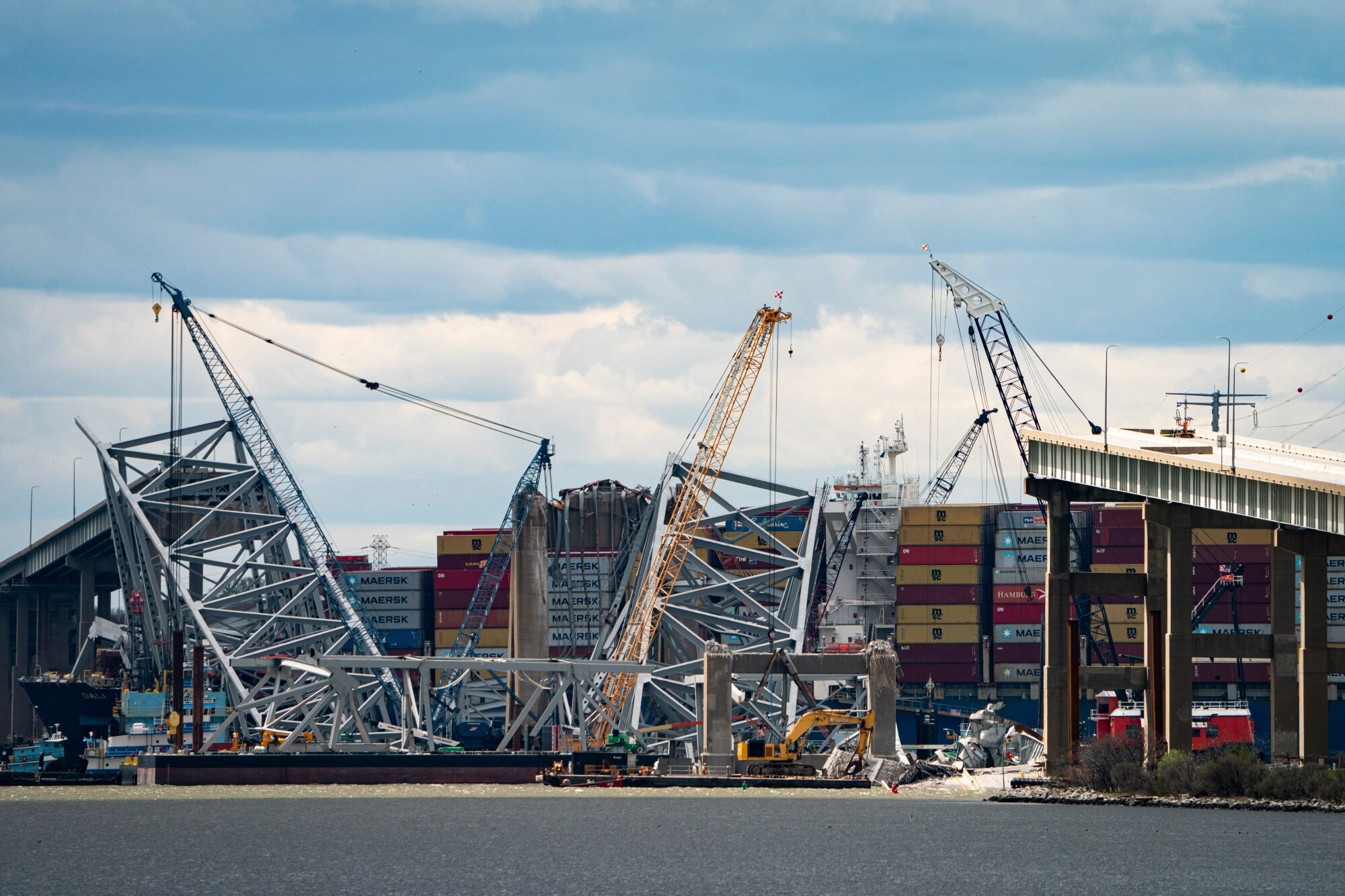
(Bloomberg) -- The owner of the ship that destroyed Baltimore's Francis Scott Key Bridge has started a formal process in which companies that own goods on the stricken Dali will have to share some of the financial losses, according to the world's leading container carrier.
A.P. Moller-Maersk A/S has indicated that the process, known as “general average,” was declared by Singapore-based Grace Ocean, according to a customer advisory Friday from Geneva, Switzerland-based MSC Mediterranean Shipping Co. SA.
“This decision indicates that the owners expect the salvage operations to result in high extraordinary costs for which they expect contribution from all salvaged parties under general average,” the advisory stated.
MSC and Maersk, the world's largest container lines, are relaying the information to their customers that own freight on the ship. The Dali was on charter to Copenhagen-based Maersk with Synergy Marine acting as its manager and operator when it destroyed the bridge and blocked the port of Baltimore on March 26.
Richards Hogg Lindley, a maritime claims adviser in the UK, was appointed as general adjuster, MSC said.
“They notified us of their intention to keep all containers, including MSC's containers, under their control until security arrangements have been made with the average adjusters, both for general average and salvage,” according to the advisory.
Emails sent to RHL and Maersk for comment weren't immediately returned early Saturday.
Ancient Concept
General average is a maritime legal concept usually written into bills of lading or other contracts signed among parties to shipping transactions. It revolves around the principle of shared sacrifice and dates back to ancient times, before insurance, when ships often ran aground and needed to jettison someone's merchandise in order to save everyone else's.
Nowadays, the costs that become part of a general average calculation would include a tally of the losses incurred to move the vessel to safety, including any damage to cargo, tug and salvage operations, any losses to the containers themselves, and other expenses, including crew and fuel.
“Hopefully shippers with cargo on the Dali all have proper insurance, as otherwise they will be liable for their share of what is likely going to be a very large salvage bill,” shipping analyst Lars Jensen wrote in a LinkedIn post on Saturday.
If a cargo owner's contribution to the GA fund exceeds the value of their goods, they typically walk away from the cargo, according to Duncan Cox, maritime claims leader for North America with Marsh McLennan. He said such cases can be litigated for as long as five years, “and we've even seen some go on for 10.”
Crews working on the wreckage site had removed 38 containers as of Thursday, according to a joint command that's orchestrating the salvage operation. Until Baltimore is able to reopen to large ships, shipments are being rerouted to ports including New York-New Jersey and the Port of Virginia.
More stories like this are available on bloomberg.com
©2024 Bloomberg L.P.

-
Why Swapping Your Old Gold Can Trigger A Rs 5 Lakh Tax Bill, And How You Can Avoid It Legally

Swapping old gold for new is taxed as a sale and a fresh purchase. Getting your own gold remade can cut most of that bill, though it has its own costs.
-
The AI Trade is Done. The Real Opportunity for Investors Starts in 2027 | Unhedged Position
As pureplay AI stocks plunge and circular, capex-led financing unwinds, 2027 is set to be a year of reckoning for AI companies. Yet the bust clears the way for a better opportunity for investors in 2027 -- shifting the spotlight from AI builders to the companies using AI.
-
Leadership As Mission: Why The Age Of AI Demands More Human Leadership
Debjani Ghosh examines how AI is changing leadership, arguing that its success must be measured by its impact on people and the accountability of those guiding its use.
-
We May Need Another Tukaram Mundhe To Fight Air Pollution | The Reason Why
Developers may install basic measures such as sprinklers and green nets, resume work, and continue violating rules when this equipment stops working.
-
Extracting Value From Battery Scrap Could Be Challenging For India | The Reason Why
A discarded lithium-ion battery still contains valuable materials such as lithium, nickel and cobalt. These can be recovered and reused. When such batteries are crushed and shredded, they produce a dark powder called black mass.
-
One El Nino, India Can Handle. Two Could Break The Granary
India's grain stocks can absorb one bad year, but a second El Nino could drain the buffer in two to three years, economists say.
-
India's Troika Of Good Luck | Joining The Dots
As Jensen Huang's exit drags Nvidia down, a cooling AI trade and resilient earnings have revived investor interest in India. A likely RBI rate hike looms.
-
Talking Points This Week: Leadership Shock At Nvidia, Earnings Strength, And The Fog Over Hormuz
The Anthropic IPO pricing and first trading day, Nvidia's upcoming earnings, and any fresh signals from Iran will set the tone for the following week.
-
Signature Play: The Classic Cocktail Is Dead. Or Is It?
Classic cocktails are disappearing from India's cocktail menus. But they're still being ordered, taught to bartenders and borrowed from. So, who's really having the last drink?
-
A New Samvat Wishlist: Inclusive Prosperity And Human Development
India has strengthened its economic foundations through infrastructure, digital access and enterprise. Its next growth chapter must deepen productivity, create better livelihoods and widen participation in prosperity.









