Europe, Asian Factories Under Pressure On China, War In Ukraine
(Bloomberg) -- Key gauges of activity at European and Asian factories remained under pressure in May from China's economic slowdown and the fallout from the war in Ukraine.
New orders in the euro area fell for the first time since June 2020, with overall output growth picking up marginally, but still staying “sluggish,” according to S&P Global's manufacturing Purchasing Managers Index. That trend was also on display in Germany and France, the region's two biggest economies.
The euro zone is facing the threat of stagflation because of the war on its doorstep. The manufacturing sector's deterioration has also been “exacerbated by demand shifting to services, as consumers boost their spending on activities such as tourism and recreation,” according to S&P Global's Chris Williamson.
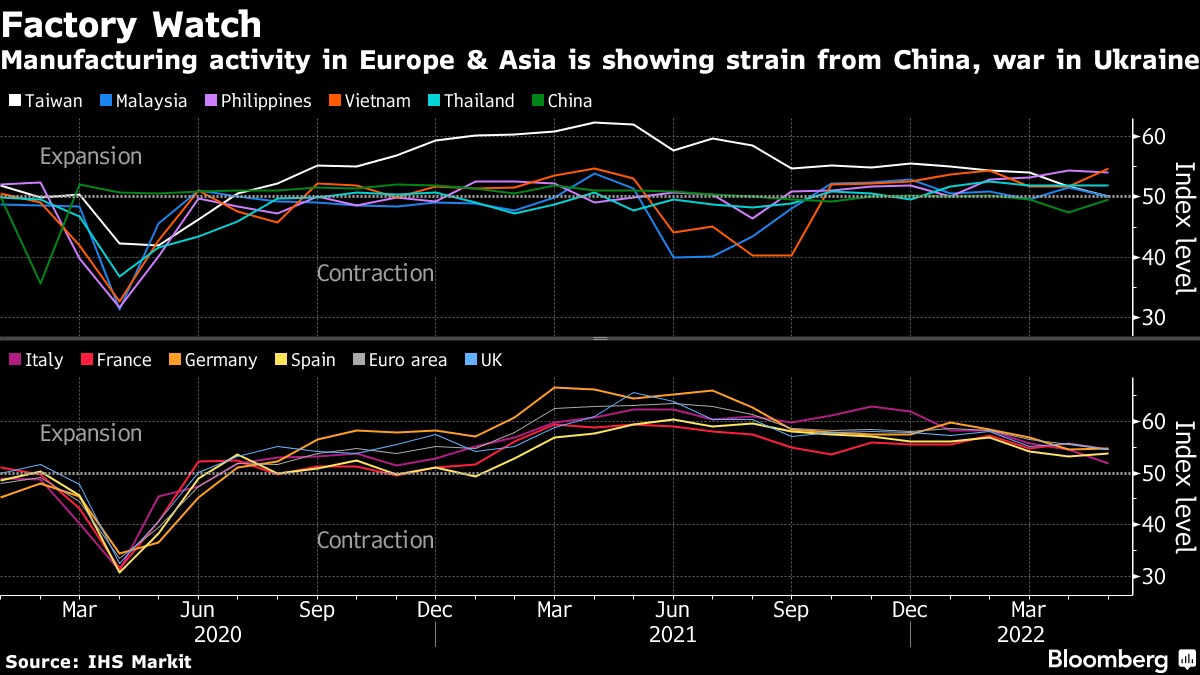
In Asia, Taiwan's manufacturing PMI fell to the level 50 point level that separates contraction from expansion as both output and new orders declined. Gauges for Malaysia, the Philippines and Australia also slid.
Exporters across trade-heavy Asia are juggling an increasingly complex set of risks, as China's Covid-19 lockdowns stifle activity, supply issues emanate from the ongoing conflict in Ukraine and demand-side worries emerge as accelerating inflation dents consumption in the world's biggest economies. While central bankers charge ahead with fighting price gains, economists are tracking a more subdued trajectory ahead for global goods trade.
The latest PMI data continues to highlight a challenging second quarter for Taiwanese manufacturers, who are facing further supply chain disruption due to lockdowns in mainland China as well as a general weakening of client demand amid strong global inflationary pressures,” Annabel Fiddes, Economics Associate Director at S&P Global Market Intelligence said in a release.
Malaysia's manufacturing PMI slipped to 50.1 from 51.6 in April with output and new orders also falling. The Philippines index dipped to 54.1, from 54.3, while Thailand was unchanged at 51.9. Australia's gauge fell to 55.7 from 58.8.
Vietnam bucked the softening with its reading leaping to 54.7, from 51.7 in April, the highest since April 2021 and its eighth consecutive month of expansion.
“Vietnamese manufacturers are increasingly able to operate normally as pandemic disruption fades, with May seeing sharp accelerations in growth of output and new orders, in turn boosting employment and purchasing,” Andrew Harker, Economics Director at S&P Global Market Intelligence, said in a release.
Trinh Nguyen, an economist at Natixis SA in Hong Kong, said the regional data points to some bright spots.
“Manufacturers benefit from domestic demand recovering in the region, and secondly they benefit from external demand still not significantly down,” she said.
Data released Tuesday showed that China's factories continued to contract in May, though at a slower pace as some of the country's tightest Covid restrictions began to loosen. The official manufacturing purchasing managers index rose to 49.6 from 47.4 in April, according to data released by the National Bureau of Statistics. That compares with the median estimate of 49 in a Bloomberg survey of economists.
The Caixin Manufacturing Purchasing Managers' Index for last month, released Wednesday, came in at 48.1 from April's 46. Although that was an improvement, it remained in contractionary territory as both production and new orders fell.
Hong Kong-based Willy Lin, whose company Milo's Knitwear (International) Ltd. makes high-end sweaters for clients in Europe from its factory in Dongguan, is among those seeing signs that inflation is impacting demand.
“My customers are starting to feel the pinch,” Lin said. “Their demand is softer.”
More stories like this are available on bloomberg.com
©2022 Bloomberg L.P.

-
Talking Points This Week: Leadership Shock At Nvidia, Earnings Strength, And The Fog Over Hormuz

The Anthropic IPO pricing and first trading day, Nvidia's upcoming earnings, and any fresh signals from Iran will set the tone for the following week.
-
Signature Play: The Classic Cocktail Is Dead. Or Is It?
Classic cocktails are disappearing from India's cocktail menus. But they're still being ordered, taught to bartenders and borrowed from. So, who's really having the last drink?
-
A New Samvat Wishlist: Inclusive Prosperity And Human Development
India has strengthened its economic foundations through infrastructure, digital access and enterprise. Its next growth chapter must deepen productivity, create better livelihoods and widen participation in prosperity.
-
Love, Sex Aur Dhokha: The Audacious Plot To Spy On Jensen Huang
A Taipei dinner, a Singapore chip buyer and a suspected Chinese asset: inside the alleged spy operation that got close to NVIDIA's Jensen Huang.
-
Ten Things I Learnt This Samvat
Patience can be a trap. Cheap stocks can stay cheap. Leverage can wipe you out. What did Samvat 2082 teach us? Niraj Shah writes on 10 lessons from the year gone by.
-
Talking Points This Week: Tech Nerves, FII Buying, And A Faraway Banking Shock
The global markets are not shining this Diwali. The exception in the large markets is, India.
-
Midterm Rally Lasted A Day. The Hard Reality Of A Divided US May Last Two Years | Opinion
Between a contested AI boom, a debt ceiling that arrives in 2027 and a president with every incentive to act alone, the next two years may prove more volatile than the first day's rally suggests.
-
Blue Wave Will Derail the AI Trade but Won't Dismantle the AI Era | Unhedged Position
The Democrats' sweep of the US Congress will see politics collide with economic forces both over the long and short term.
-
It's Time To Take The GST Council's Bet On Trust Global
Payment records can prove India's services exports, and clear, proportionate rules can bring foreign digital sellers into the tax net.
-
Opinion | India at 38: From Innovation Overperformer to Innovation Powerhouse
India now has 453 VC-backed deep science startups, 18 of them late-stage, after 117 percent growth since 2020. Laurus Labs, at USD 9.3 billion, is the most valuable deep science company in any middle-income economy outside China.









