Aging Boomers Explain Shrinking Labor Force, NY Fed Study Says
(Bloomberg) -- Why are there so many workers missing from the labor force? Researchers at the Federal Reserve Bank of New York say the biggest factor may be simple: Workers are just getting older.
While much attention has been paid to an increase in retirements during the pandemic, the analysis found that there wasn't necessarily a rise in the share of people who are retired for each age group. Instead, the researchers found that more baby boomers reached retirement age during the pandemic, making age the main contributor behind the increase in retirements.

“The aging of the baby boomers between 2020 and 2022 led to a significant rise in retirements, reducing participation,” wrote New York Fed researchers Mary Amiti, Sebastian Heise, Giorgio Topa and Julia Wu in a blog post published Thursday.
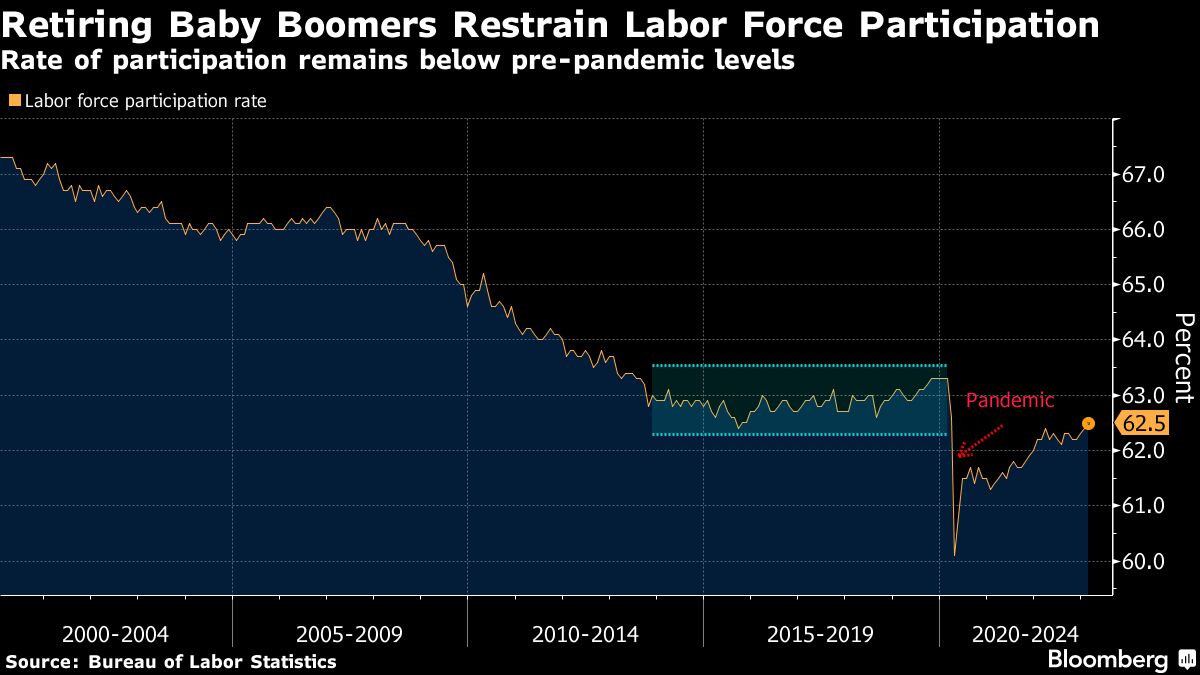
The researchers focused on the labor force participation rate, or the share of the population that is working or looking for work. After plunging at the start of the recession, that metric has since climbed up to 62.5%. However, that's still down 0.8 percentage point from where it was in February 2020, amounting to gap of about 2.1 million fewer workers, they estimate.
Read more: Can't Find Workers? Blame Retirees. Or Immigration. Or Covid...
The analysis looked at the share of people who are retired in different age groups and found that there was not a notable increase in the percentage of people who were retired for certain age ranges when compared to before the pandemic.
Take people between the ages of 60 and 69, for example. The share who are retired averaged 39.7% in 2018 and 2019, and 40% in the second half of 2022. For people aged 70 to 79, some 77.5% were retired before the pandemic, compared to 78.8% at the end of last year. And for workers above age 79, the share who are retired rose from 88.5% to 90.5%.
A rise in disability, including people affected by Covid-19, is another factor that could have explained the drop in labor force participation. But the research found that many of the people who became disabled during the pandemic continued to work and cited previous research finding almost no change in the average number of hours worked.
“The increase in disability has virtually no effect on the participation gap because, as discussed above, the increase is entirely accounted for by individuals that remain in the labor force,” the researchers wrote.
Labor Shortages
Labor markets have recovered substantially since the pandemic forced the shutdown of businesses across the country and pushed millions of Americans out of work. As the economy opened back up and demand for restaurants, travel and other services rebounded, many employers have been struggling to staff up.
Demand for workers remains high, with about two job openings for each unemployed person. The dynamic has some employers reluctant to let go of workers and hiring has stayed strong, fueling wage growth.
Fed officials battling high inflation cite the imbalance between the demand and supply of workers as one of the factors that could be fueling price growth. The US central bank is aggressively raising interest rates to cool the economy and lessen demand for workers.
But there is little officials can do address the supply shortages adding to inflation, including questions over the availability of workers.
The research suggests those worker shortages could persist.
“Population aging is likely to continue to exert strong downward pressure on participation going forward, as more of the baby boomer generation continue to enter retirement,” the researchers wrote.
--With assistance from Vince Golle.
(Adds graphic)
More stories like this are available on bloomberg.com
©2023 Bloomberg L.P.

-
The Economic Imperative: Analysing The Material Driving Force Behind India-Canada Strategic Reset

This economic complementarity is further reinforced by deep institutional investment ties and talent mobility, which form the bedrock of the bilateral framework.
-
Medicine Pricing: Where Must Profit Stop?
India must confront excessive margins, hidden incentives and regulatory gaps that threaten the integrity of medicine.
-
Why Amazon And Flipkart Are Struggling To Beat Meesho In India's Smaller Cities
With 274 million users and lowest-cost logistics, Meesho is defending its value commerce crown against giants like Amazon and Flipkart.
-
High US Salaries, No Green Card Certainty: The Financial Calculation Facing Indian H-1B Families
The suspension of PERM processing at eight technology employers does not cancel existing H-1B visas. What it does is force a question many Indian families have been avoiding: is the US salary worth tying your career and family plans to one employer?
-
Swiggy vs Eternal: Food Delivery's Two Rivals Are No Longer In The Same Race
Eternal is building a private AI assistant, dark.ai. Swiggy is still working out how to make Instamart pay, with an operating loss of Rs 895 crore in the July-September quarter while Blinkit stayed profitable.
-
Where You Live Shapes How You Get To Work | The Reason Why
Two-wheelers are the most popular way to get to work in India, accounting for nearly 43% of workplace commutes.
-
Unhedged Position: Can India See An Indonesia-Style Time Correction?
The Nifty is trading below levels it first clocked in 2024. Is there, then, as I have suggested in the headline, potential that the current time correction drags on painfully for the next three-five, even ten years?
-
Navigating Friction And Energy Realities: An Analysis Of Marco Rubio's October Visit To India
Occurring at a critical juncture marked by stalled trade negotiations and escalating geopolitical pressures over global energy supplies, the visit offers a profound window into modern US-India relations.
-
India Exports Capital. Why Not Export Trusteeship?
The big question, then, is whether India can build an institution that global borrowers, investors, banks, and lawyers can trust, even without an Indian connection.
-
France's Economy & Politics Are In Crisis | The Reason Why
Let's look at how the French economy and politics evolved under Nicolas Sarkozy, Franois Hollande and Emmanuel Macron.










