15 Million Indian Households Have Meters But No Electricity
An electricity meter hangs on the mud wall of Deenbandhu's house in Goiya Khurd village in Uttar Pradesh's Chitrakoot, one of the most backward districts of India.
Similar meters are installed at many houses in Goiya Khurd, but none connected to the grid. Electricity poles have not yet reached this village.

“My meter was installed on April 27, 2018. I have no idea when the electricity connection will reach here,” Deenbandhu, who uses only one name, told FactChecker when we visited the village on May 19, 2018. Nearly a month after the prime minister claimed 100 percent rural electrification, this village was unconnected.
The central government's data on village-wise household electrification show the number of electricity connections in Goiya Khurd are “saturated”–all the houses in the village have either been connected to the grid or their connections have been approved and are to be installed.

Based on the same data, two days after a meter was installed in Deenbandhu's house, Prime Minister Narendra Modi on April 29, 2018, declared that India has electrified 100 percent of its 600,000-plus villages, the last village being Leisang in Manipur in north-eastern India.
I salute the efforts of all those who worked tirelessly on the ground, including the team of officials, the technical staff and all others, to make this dream of a #PowerfulIndia a reality. Their efforts today will help generations of Indians in the coming years. pic.twitter.com/t8WjZgpNuT
April 29, 2018Soon after, an internal report by the union rural development ministry revealed that the prime minister's claim was incorrect and about 5,000 villages were yet to be electrified, The New Indian Express reported on July 8, 2018. “It has been observed that a certain percentage of villages in almost every state have not been provided with electricity,” the report was quoted as saying.
A separate 2018 survey of 360,000 villages by the central rural development ministry found more than 14,700 villages without electricity for domestic use.
This is the third of a FactChecker series evaluating the government's flagship programmes in the run-up to the 2019 general elections. The first of this series was a three-part investigation of the government's rural-jobs programme (here, here and here) and the second was an analysis of the Swachh Bharat (Clean India) Mission's sewage problem.
The present investigation of India's village electrification programme has three parts. Today, the first part will explain why despite “100 percent electrification” of India's 600,000 villages, there are 25 million homes without electricity. The second part will take you to Manipur's remote Leisang village–declared by the Prime Minister as the last Indian village to be connected to grid electricity on April 28, 2018–and explain why after a high-profile event and great hope, it has lapsed back into darkness. The third part will take you to Sarwara village in central Uttar Pradesh to reveal why a village that has been declared electrified cannot keep the lights on.
25 Million Rural Houses Remain Without Power
Uttar Pradesh has the highest number of non-electrified villages, 1,044, followed by Odisha with 666 and Bihar with 533, according to the ministry's internal report as cited in The New Indian Express.
Even in villages considered electrified, not all households have electricity. As per the central power ministry's definition, a village is considered electrified if at least 10 percent of its households have power connections and if electricity is provided in public places such as schools, panchayat offices, health centres and community centres.
Therefore, despite the government's claims of 100 percent electrification, 15 million rural homes—equal to the total number of households in South Korea–still do not get electricity, as per the government's own figures (as on Oct. 12, 2018) from the Saubhagya dashboard.
Saubhagya was launched in Sept. 2017 with a target of electrifying 35 million households by March 2019. Later, the government brought forward the deadline and said it would electrify all households by Dec. 31, 2018.
Yet, in four states—Uttar Pradesh, Arunachal Pradesh, Nagaland and Meghalaya—about 25-30 of rural households are yet to be electrified, according to the Saubhagya Dashboard data, as on Oct. 12, 2018.
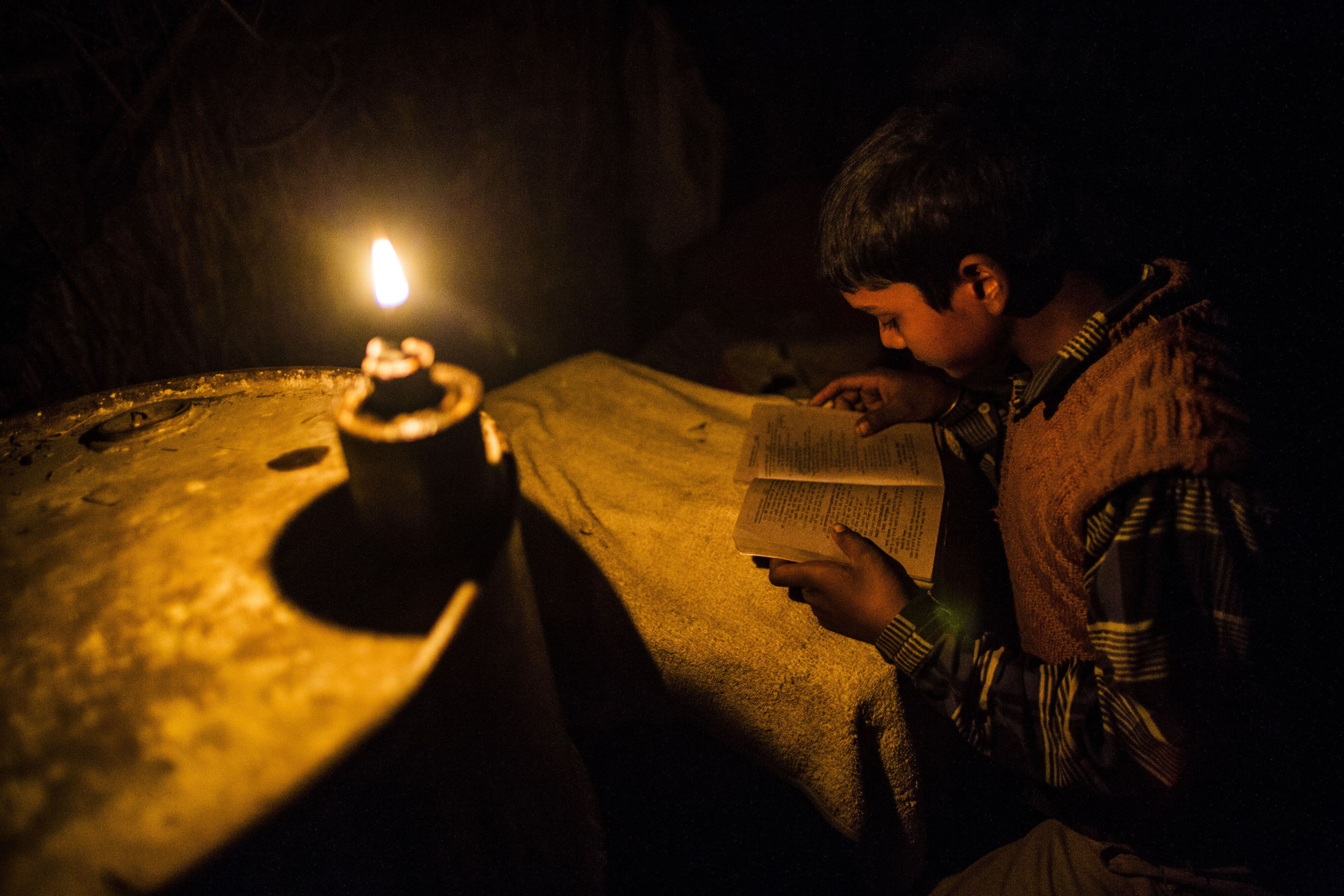
There is no light for the kids to study at night, no light to cook or eat dinner. People sometimes eat food into which bugs have fallen, and fall sick, Deenbandhu of Goiya Khurd told FactChecker.
Slow Rate Of Electrification
Under Saubhagya, about 16 million households across the country have been connected to the grid over the 12 months between October 11, 2017 and October 12, 2018.
This means that the government will have to electrify about 5 million households every month—about four times the current rate of 1.3 million households every month–over the next two and a half months to Dec. 2018 to meet its target.
At the current rate, it will take one more year (until Nov. 2019) for the government to electrify the more than 15 million rural homes yet to be electrified, as per FactChecker's analysis.
Questionable Government Data
Our reporting from Khichari village in Chitrakoot district shows that government data on villages marked as having 100 percent of their households connected to the grid are faulty.
The government data show that 100 percent houses in Khichari village have been electrified. Muknu Lal, gram pradhan (village head) of Khichari village, however, paints a different picture.
“Some houses in Khichari have been installed with wires and meters but the supplyline of the village has not been connected at the town level, and no house in the village has seen light till now,” Lal told FactChecker over the phone on Oct. 19, 2018.
About 60-70 connections in Khichari are yet to be completed and “people from the electricity department said that they will come to complete the work after Durga Pooja and Dussehra [the 10-day festive period celebrated across India],” said Lal.
Another inconsistency is that Khichari has only 64 houses, as per government data, whereas village head Lal claims there are more than 100 houses.
This variation in the number of houses is not limited to Khichari village. In government data, the total number of houses with electricity connections keep varying, the newspaper Mint reported in Feb. 2018. The data is directly fed by power distribution companies and there appears no provision for validation, Debajit Patil, a senior fellow at The Energy and Resource Institute (TERI), told Mint.
BJP Government's Achievements Versus UPA's
The previous Congress-led United Progressive Alliance (UPA) government, under the Rajiv Gandhi Grameen Vidyutikaran Yojana (RGGVY, a rural electrification scheme), had connected 108,280 villages to the grid between 2005-06 and 2013-14. This works out to about 12,000 villages every year on average over nine years, IndiaSpend had reported in May 2017.
Prime Minister Modi in 2015 launched the Deen Dayal Upadhyaya Gram Jyoti Yojana (DDUGJY) to replace RGGVY and connect about 18,374 un-electrified villages to the grid. As per the prime minister, this target was achieved in April 2018.
This means that the current Bharatiya Janata Party (BJP)-led National Democratic Alliance (NDA) government electrified about 4,600 villages every year—less than half the UPA's average of 12,000 villages–over four years to April 2018.
However, most of the 18,374 villages electrified by the current government were in difficult-to-reach, remote locations. “It is worthwhile to mention that most of the remaining villages were located in remote and inaccessible areas with difficult hilly terrain, deep forest areas, Left Wing Extremism (LWE) affected areas and therefore probably remained neglected for electrification,” the power ministry said in a statement on May 1, 2018.
Nevertheless, of these villages, just 8 percent or 1,424 villages, have all households connected to electricity, according to the DDUGJY data.
(Tripathi is a principal correspondent with IndiaSpend and FactChecker.)
(With inputs from Swagata Yadavar.)
This copy was published in arrangement with IndiaSpend



-
The Economic Imperative: Analysing The Material Driving Force Behind India-Canada Strategic Reset

This economic complementarity is further reinforced by deep institutional investment ties and talent mobility, which form the bedrock of the bilateral framework.
-
Medicine Pricing: Where Must Profit Stop?
India must confront excessive margins, hidden incentives and regulatory gaps that threaten the integrity of medicine.
-
Why Amazon And Flipkart Are Struggling To Beat Meesho In India's Smaller Cities
With 274 million users and lowest-cost logistics, Meesho is defending its value commerce crown against giants like Amazon and Flipkart.
-
High US Salaries, No Green Card Certainty: The Financial Calculation Facing Indian H-1B Families
The suspension of PERM processing at eight technology employers does not cancel existing H-1B visas. What it does is force a question many Indian families have been avoiding: is the US salary worth tying your career and family plans to one employer?
-
Swiggy vs Eternal: Food Delivery's Two Rivals Are No Longer In The Same Race
Eternal is building a private AI assistant, dark.ai. Swiggy is still working out how to make Instamart pay, with an operating loss of Rs 895 crore in the July-September quarter while Blinkit stayed profitable.
-
Where You Live Shapes How You Get To Work | The Reason Why
Two-wheelers are the most popular way to get to work in India, accounting for nearly 43% of workplace commutes.
-
Unhedged Position: Can India See An Indonesia-Style Time Correction?
The Nifty is trading below levels it first clocked in 2024. Is there, then, as I have suggested in the headline, potential that the current time correction drags on painfully for the next three-five, even ten years?
-
Navigating Friction And Energy Realities: An Analysis Of Marco Rubio's October Visit To India
Occurring at a critical juncture marked by stalled trade negotiations and escalating geopolitical pressures over global energy supplies, the visit offers a profound window into modern US-India relations.
-
India Exports Capital. Why Not Export Trusteeship?
The big question, then, is whether India can build an institution that global borrowers, investors, banks, and lawyers can trust, even without an Indian connection.
-
France's Economy & Politics Are In Crisis | The Reason Why
Let's look at how the French economy and politics evolved under Nicolas Sarkozy, Franois Hollande and Emmanuel Macron.










