Delhi Pollution Latest News: Check Today's AQI, PM Levels, Air Quality And More
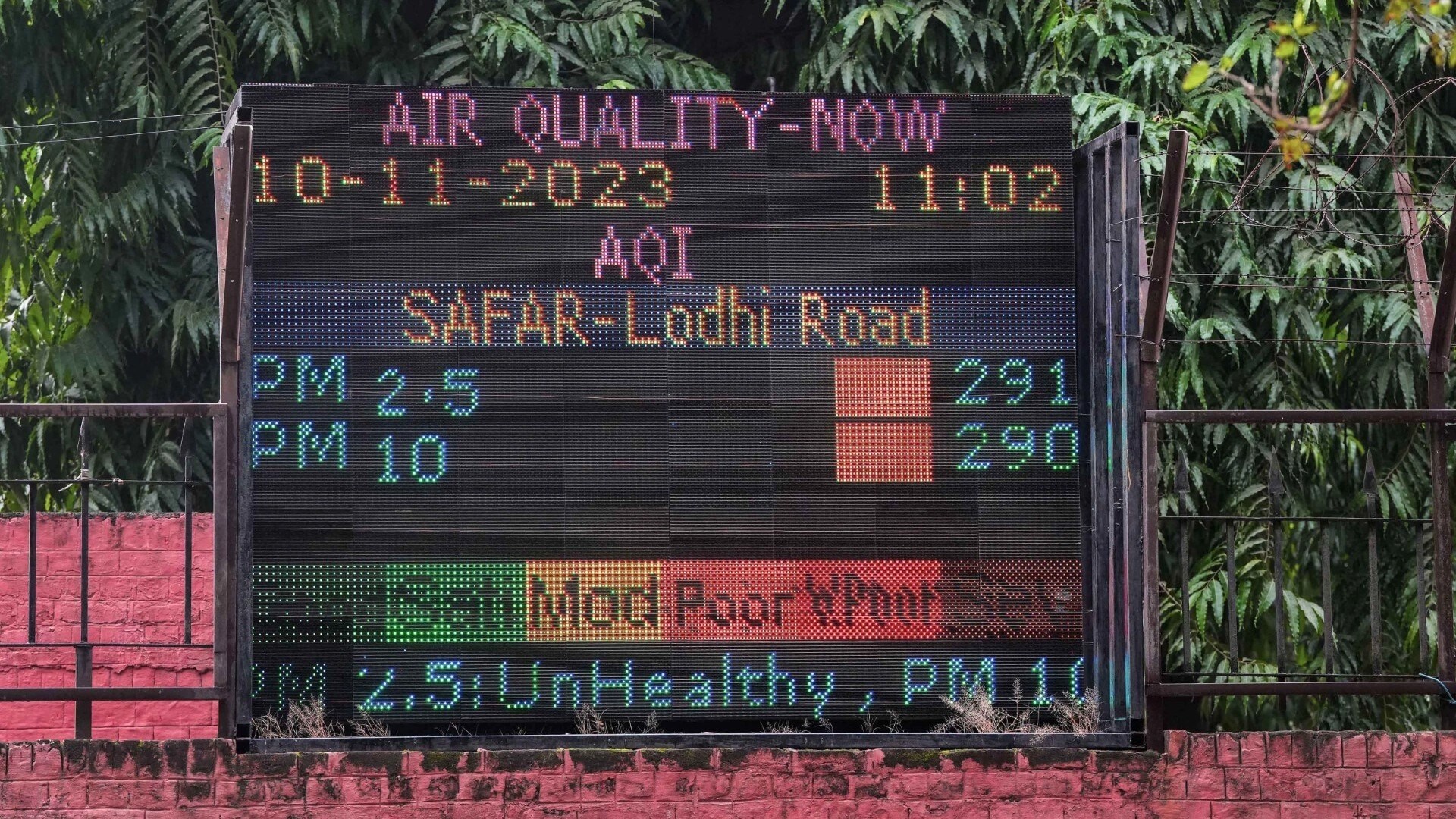
The air pollution levels in Delhi and surrounding areas continue to hover in the ‘very poor' range, with PM2.5 remaining the dominant pollutant. At 9:00 a.m. on Wednesday, Delhi's air quality index (AQI) stood at 337, as per the Indian System of Air Quality and Weather Forecasting and Research (SAFAR) data.
While pollution levels in Delhi-NCR have remained hazardous for over a month, fresh concerns arose on late Monday after ash from an Ethiopian volcanic eruption drifted into India. Delhi, Haryana, Jaipur and parts of Maharashtra were briefly covered by the high-altitude toxic plume from Hayli Gubbi volcano, leading to panic.
However, the smoke's much higher elevation (around 15,000 to 25,000 feet) was not expected to mix with the lower atmosphere, which could have further worsened pollution in Delhi and elsewhere, according to private forecaster SkyMet Weather.
“High-level satellite imagery shows the ash cloud sitting between 15,000 and 25,000 feet, with some pockets rising up to 45,000 feet—well above the air we breathe at ground level,” SkyMet said on Tuesday on X, noting that the smoke will likely completely exit India by around 7:30 p.m. and drift towards China.
Why Did Hayli Gubbi Volcano Erupt After 12,000 Years? What to Expect Next
November 25, 2025
Read at: https://t.co/6mTwBxBE9i#Skymet #AirPollution pic.twitter.com/hymk31F3qaAQI In Delhi
Even as concerns from the Hayli Gubbi volcanic ash may have dispersed, Delhi's AQI remains at alarming levels, posing serious health risks. Reading from several AQI monitoring stations on Wednesday morning showed that the national capital is reeling under 'very poor' to 'severe' air quality levels.
At 9:00 a.m., Mundka was among the places with the highest AQI at 371, while DTU was at 367 and Dwarka Sector-8 at 359. The Karni Shooting Range and ITO also showed severe pollution levels at 354 and 358, respectively. JNU Stadium recorded 337, while the Dhyan Chand Stadium stood at 301. Conditions were relatively better at IHBAS with 249 and Lodhi Road at 238. Other areas also recorded similar AQI levels.
PM Levels
According to the Central Pollution Control Board (CPCB), the 24-hour average data compiled from various cities by 4:00 p.m. on Tuesday showed that PM2.5 remained the dominant pollutant in Delhi, Jind, Gurugram, Faridabad and other areas. These cities recorded poor to very poor AQI levels, while cities like Haryana's Palwal and Rajasthan's Alwar and Bharatpur recorded PM10 as the dominant pollutant. Noida and Greater Noida also recorded PM2.5 and PM10 as major pollutants, as per the CPCB data.
Prolonged exposure to such AQI levels can result in respiratory illness and trigger headaches, fatigue and throat irritation.
AQI Forecast
According to the SAFAR monitoring system, the air quality in Delhi is likely to be in the “very poor" category from Nov. 26 to 28. In the subsequent six days, the AQI may hover in the severe to very poor category.”
On Nov. 26, the maximum and minimum temperatures over Delhi are likely to be in the range of 23 to 25°C and 08 to 10°C, respectively, it said.
“Mainly clear sky, shallow fog at most places and moderate fog at isolated places during morning hours is likely on Nov. 27. The maximum and minimum temperatures over Delhi are likely to be in the range of 23 to 25°C and 09 to 11°C respectively,” it added.

-
Indians Are Travelling, But Not Every Journey Is A Holiday | The Week In Whys

Pilgrims, patients and working women are the real travellers, and the system hasn't quite caught up with them.
-
Getting To Work Costs Women More | The Reason Why
It is not just about women paying more than men. It is about women paying much more in cities than in villages.
-
AI Bias In Investing Cannot Be Eliminated, But It Can Be Governed
Framing is a particularly important example as identical financial information presented in terms of gains rather than losses can lead an LLM to reach a different assessment.
-
Joining The Dots | Dark Skies, Steady Diya: Why Hope Holds This Diwali
With war, a weak rupee and foreign outflows weighing on sentiment, policymakers at the NDTV World Summit and market veterans at NDTV Profit Ignite: Diwali Edition offered the same advice: stay invested and filter out the noise.
-
The Curious Case of Equitas Small Finance Bank And A CEO Who Quit For Stock
PN Vasudevan believes persistent investor concerns over a perceived conflict of interest had become a governance overhang on Equitas Small Finance Bank's stock, even as the lender improved profitability and asset quality.
-
Talking Points This Week: AI Cash Burn, A Tiger Comeback And An India That Still Finds Its Own Path
India is not immune to higher oil or tighter global liquidity, yet its earnings base is broader, its domestic policy levers are still available.
-
Foreign Investors Own Half Of HDFC Bank and ICICI Bank. An LTCG Cut Could Matter Most Here
Foreign portfolio investors have US$115 billion parked in HDFC Bank, ICICI Bank. If the government cuts long-term capital gains tax, Jefferies says returning foreign money could land here first.
-
'Never Seen This Level Of Negativity': Sandeep Tandon Says The Next Rally May Be Closer Than You Think
Veteran investor Sandeep Tandon says foreign selling is easing, large-caps are due a comeback and mid-caps are crowded, while he turns positive on gold, power and pharma this Diwali.
-
Indians Stay With Family, Not In Hotels | The Reason Why
India still lacks enough clean, reliable and affordable hotels for budget-conscious travellers.
-
The Economic Imperative: Analysing The Material Driving Force Behind India-Canada Strategic Reset
This economic complementarity is further reinforced by deep institutional investment ties and talent mobility, which form the bedrock of the bilateral framework.










