Trio Takes Chemistry Nobel For ‘Cool’ Method To Study Molecules
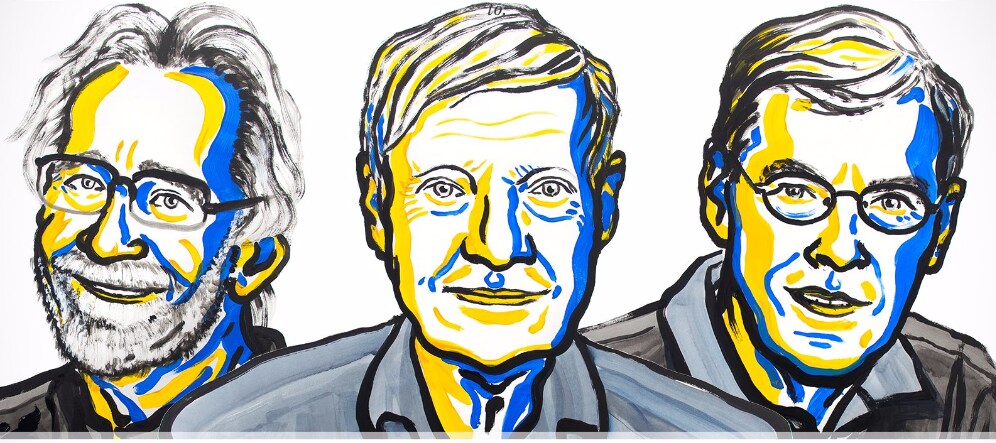
A revolutionary technique dubbed cryo-electron microscopy, which has shed light on the Zika virus and an Alzheimer's enzyme, earned scientists Jacques Dubochet, Joachim Frank and Richard Henderson the Nobel Chemistry Prize today.
Thanks to the international team's “cool method”, which uses electron beams to examine the tiniest structures of cells, "researchers can now freeze biomolecules mid-movement and visualise processes they have never previously seen,” the Nobel Chemistry Committee said.
This has been “decisive for both the basic understanding of life's chemistry and for the development of pharmaceuticals,” it added.
BREAKING NEWS The 2017 #NobelPrize in Chemistry is awarded to Jacques Dubochet, Joachim Frank & Richard Henderson. pic.twitter.com/RUZSnArJHO
October 4, 2017The ultra-sensitive imaging method allows molecules to be flash-frozen and studied in their natural form, without the need for dyes. It has laid bare never-before-seen details of the tiny protein machines that run all cells.
“When researchers began to suspect that the Zika virus was causing the epidemic of brain-damaged newborns in Brazil, they turned to cryo-EM (electron microscopy) to visualise the virus,” the Committee said.
Frank, a 77-year-old, German-born biochemistry professor at Columbia University in New York, was woken from his sleep when the committee announced the prize in Stockholm, six hours ahead.
2017 Chemistry Laureate Joachim Frank made the technology to portray biomolecules in 3D at atomic level generally applicable. pic.twitter.com/tNxmBJHvxa
October 4, 2017“There are so many other discoveries every day, I was in a way speechless,” he said. “It's wonderful news.”
In the first half of the 20th century, biomolecules – proteins, DNA and RNA – were terra incognita on the map of biochemistry. Because the powerful electron beam destroys biological material, electron microscopes were long thought to be useful only to study dead matter.
But 72-year-old Henderson, from the MRC Laboratory of Molecular Biology in Cambridge, used an electron microscope in 1990 to generate a three-dimensional image of a protein at atomic resolution, a groundbreaking discovery which proved the technology's potential.
Frank made it widely usable between 1975 and 1986, developing a method to transform the electron microscope's fuzzy two-dimensional images into sharp, 3-D composites.
Dubochet, today an honorary professor of biophysics at the University of Lausanne, added water. Now 75, he discovered in the 1980s how to cool water so quickly that it solidifies in liquid form around a biological sample, allowing the molecules to retain their natural shape even in a vacuum.
The electron microscope's every nut and bolt have been optimised since these discoveries.
The required atomic resolution was reached in 2013, and researchers "can now routinely produce three-dimensional structures of biomolecules," according to the Nobel Committee.
The trio will share the prize money of nine million Swedish kronor (around $ 1.1 million).
“Normally what I'd do if I was in Cambridge, we will have a party around tea-time in the lab but I expect we'll have it tomorrow instead,” said Henderson.
Photo of 2017 Chemistry Laureate Richard Henderson, kindly provided by MRC Laboratory of Molecular Biology #NobelPrize pic.twitter.com/Gf4ZxrhiQC
October 4, 2017The prize announcement was praised by the scientific community and observers around the world.
“By solving more and more structures at the atomic level we can answer biological questions, such as how drugs get into cells, that were simply unanswerable a few years ago,” Jim Smith, science director at the London-based biomedical research charity Wellcome, said in a statement.
Daniel Davis, immunology professor at the University of Manchester, said details of crucial molecules and proteins that make the human immune system function, can now be seen like never before.
“It has been used in visualising the way in which antibodies can work to stop viruses being dangerous, leading to new ideas for medicines – as just one example,” he said.
John Hardy, neuroscience professor at University College London, said Dubochet, Frank and Henderson's technique has transformed the field of structural biology. It has been used, for example, to compile a detailed identikit of an enzyme implicated in Alzheimer's. “Knowing this structure opens up the possibility of rational drug design in this area,” Hardy said.
“And as a biologist, I can say that the pictures are beautiful.”

-
The Economic Imperative: Analysing The Material Driving Force Behind India-Canada Strategic Reset

This economic complementarity is further reinforced by deep institutional investment ties and talent mobility, which form the bedrock of the bilateral framework.
-
Medicine Pricing: Where Must Profit Stop?
India must confront excessive margins, hidden incentives and regulatory gaps that threaten the integrity of medicine.
-
Why Amazon And Flipkart Are Struggling To Beat Meesho In India's Smaller Cities
With 274 million users and lowest-cost logistics, Meesho is defending its value commerce crown against giants like Amazon and Flipkart.
-
High US Salaries, No Green Card Certainty: The Financial Calculation Facing Indian H-1B Families
The suspension of PERM processing at eight technology employers does not cancel existing H-1B visas. What it does is force a question many Indian families have been avoiding: is the US salary worth tying your career and family plans to one employer?
-
Swiggy vs Eternal: Food Delivery's Two Rivals Are No Longer In The Same Race
Eternal is building a private AI assistant, dark.ai. Swiggy is still working out how to make Instamart pay, with an operating loss of Rs 895 crore in the July-September quarter while Blinkit stayed profitable.
-
Where You Live Shapes How You Get To Work | The Reason Why
Two-wheelers are the most popular way to get to work in India, accounting for nearly 43% of workplace commutes.
-
Unhedged Position: Can India See An Indonesia-Style Time Correction?
The Nifty is trading below levels it first clocked in 2024. Is there, then, as I have suggested in the headline, potential that the current time correction drags on painfully for the next three-five, even ten years?
-
Navigating Friction And Energy Realities: An Analysis Of Marco Rubio's October Visit To India
Occurring at a critical juncture marked by stalled trade negotiations and escalating geopolitical pressures over global energy supplies, the visit offers a profound window into modern US-India relations.
-
India Exports Capital. Why Not Export Trusteeship?
The big question, then, is whether India can build an institution that global borrowers, investors, banks, and lawyers can trust, even without an Indian connection.
-
France's Economy & Politics Are In Crisis | The Reason Why
Let's look at how the French economy and politics evolved under Nicolas Sarkozy, Franois Hollande and Emmanuel Macron.










