Billionaire Space Battle Heats Up As Jeff Bezos Eyes SpaceX Rival
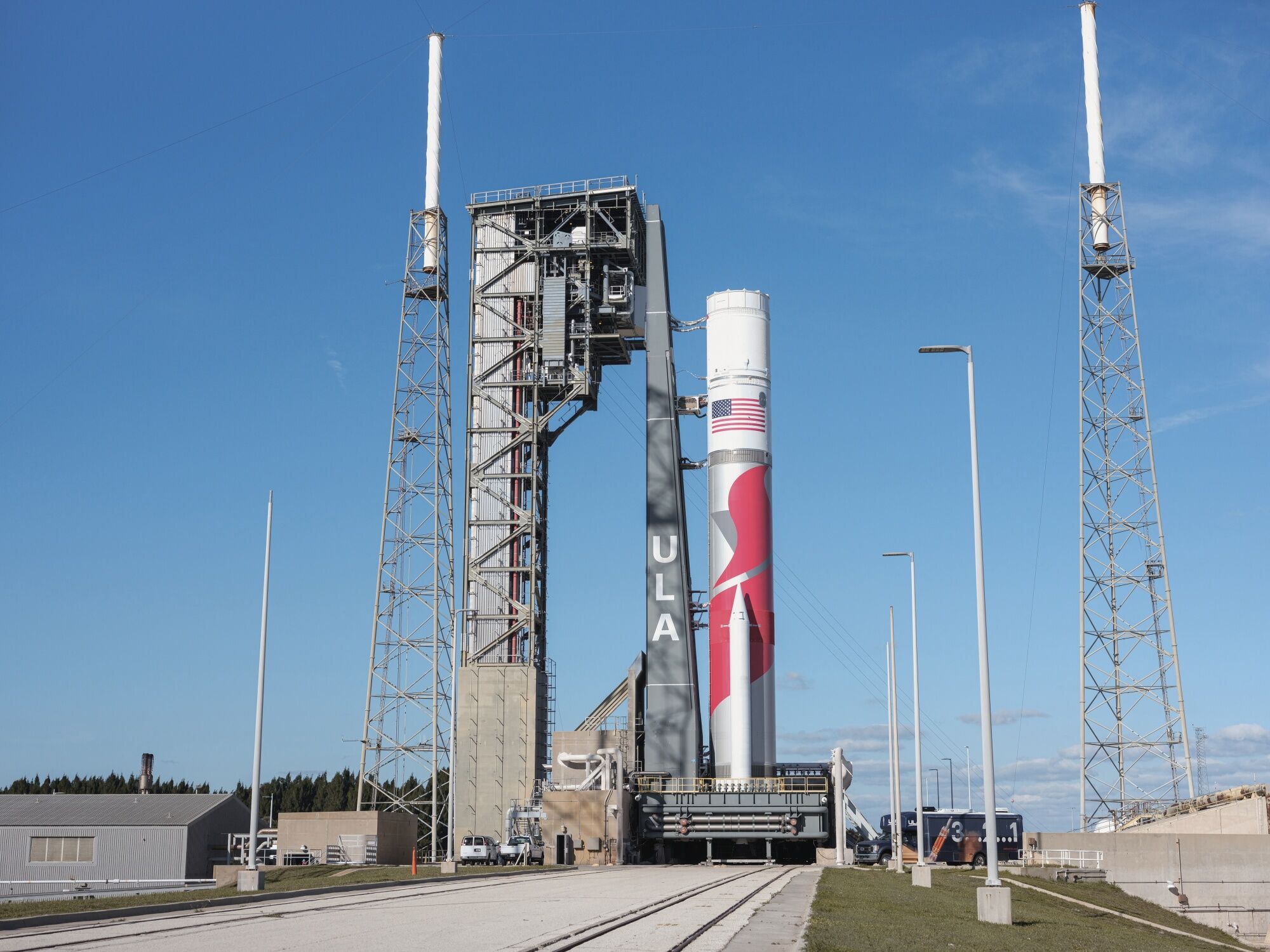
(Bloomberg) -- When the Vulcan rocket lifts off for the first time as soon as next week, multiple billionaires are sure to be watching.
Built through a joint venture of Boeing Co. and Lockheed Martin Corp., the new vehicle is poised to take on Elon Musk's SpaceX and ferry satellites and cargo for the likes of the Pentagon, NASA and even Amazon.com Inc.
Vulcan is also helping fuel takeover offers for the company building it, the United Launch Alliance. Among them is a multibillion-dollar bid from Blue Origin LLC, the ambitious space venture run by billionaire Jeff Bezos, according to people familiar with the matter.
It's a pivotal moment for ULA, a once-dominant launch provider for the US government whose star has faded in recent years. With SpaceX now leading the commercial market and making inroads with the government on the strength of its reusable Falcon 9 rocket, ULA finds itself needing to adapt to avoid being left behind.

“SpaceX likes to say they have a monopoly” in the launch market, Tory Bruno, ULA's chief executive officer, said in an October interview. “They don't.”
See Also: SpaceX Sets the Pace in Race to Build Larger Rockets
Vulcan, set to debut early Monday after almost a decade in development, enters a market starved for more capacity. The rocket is meant to be a cheaper, all-American alternative to ULA's legacy Atlas and Delta vehicles to carry the government's highest profile satellites.
If Vulcan proves it can fly — and then fly again and again — the vehicle is the company's best hope to gain ground on Musk's launch behemoth. ULA, which also aims to build out the commercial side of its business, has already signed contracts worth billions for roughly 70 Vulcan missions.
“It's important to demonstrate success as soon as they can,” said Cristina Chaplain, an independent space analyst and former director at the Government Accountability Office overseeing space and defense programs. “They really want to be able to stay in the game.”
‘Hatfields and McCoys'
ULA was formed by Boeing and Lockheed in 2006. The pioneering venture had “a virtual monopoly on US government launches” in those early years, said George Sowers, the company's former chief scientist. Those contracts were sweetened with extra money to ensure the Defense Dept. could maintain access to space at a time when there were few viable launch providers.
But the ownership structure — with two publicly traded companies that compete for defense contracts — also muddied its strategy. Sowers, who's now a professor at the Colorado School of Mines, likened it to “being owned by the Hatfields and McCoys.”
“Trying to get them to agree on anything at the level of the board of directors was nearly impossible,” he said.
Unlike newer launch rivals that have tapped the public and private markets for capital in pursuit of ambitious new technologies, ULA doesn't get cash infusions from investors, according to Bruno. That has forced the CEO to keep the company's operations and staff lean.
“We are profitable every year,” Bruno said. “Always have been.”
Now, ULA must execute an increasingly busy flight schedule in the coming years with even fewer launch operations personnel after recent layoffs, a person familiar with the matter said. ULA's headcount is hovering around 2,300 employees, the person said, compared with the more than 10,000 employees at both SpaceX and Blue Origin.
Last summer, ULA laid off some 75 people, roughly 40 percent of launch operations staff at its Vandenberg Space Force Base site in California and around 12 percent at Cape Canaveral in Florida, the person said, speaking on condition of anonymity because the matter is private.
“We work in an extremely competitive industry and as a company we continue to evolve to meet emerging mission requirements,” Ron Fortson, Director and General Manager of ULA Launch Operations, told employees in an Aug. 13 email announcing the layoffs seen by Bloomberg. “Due to strategic business alignments, we determined that a reduction in force was necessary.”
A ULA spokesperson did not respond to a request for comment in time for publication.
A spinoff or sale could give ULA access to more capital and free it from constraints that have limited growth. The company, which has been running a formal sale process, recently called for bids, according to the people familiar with the matter who asked not to be identified.
The timing, coinciding with the debut of Vulcan, offers bidders a glimpse of ULA's future. Aside from Blue Origin, potential buyers include private equity giant Cerberus and aviation manufacturer Textron Inc., the Wall Street Journal reported last month.
Vulcan Roots
The Vulcan program extends back to 2015, when ULA decided to move on from the decades-old Atlas V rocket, which used engines made in Russia. By that time, relying on Russia was becoming increasingly untenable for Western companies, especially for a US contractor like ULA tasked with launching spy satellites.
For Vulcan, the company opted for Blue Origin-made engines, which became a more palatable option to lawmakers. But switching providers and pursuing new designs came with challenges. ULA had originally hoped to launch Vulcan as early as 2019, but Blue Origin didn't deliver the hardware until late 2022. Then ULA suffered another setback last March after a Vulcan part exploded on a test stand.
When Vulcan finally does launch from Cape Canaveral, it'll be carrying a robotic lander bound for the moon.
The stakes are high for ULA, which plans seven Vulcan launches in 2024, and then expects to double that cadence by the first half of 2025. It's an ambitious schedule, especially since new rockets are notoriously slow to ramp up.
ULA is scheduled to handle about two dozen national security launches over the next two to three years, and Bruno said a working Vulcan will let it compete again for NASA contracts. The rocket also is in line for 38 launches on behalf of Amazon to send its Project Kuiper internet satellites into orbit.
Read More: Amazon Is Spending $10 Billion in Challenge to Musk's Starlink
Cost Competitive
In building a commercial business to complement its government work, ULA is trying to position itself as a price-competitive alternative to other providers. Though critics have lambasted the lack of reusability in ULA's rockets and the relatively higher price tag for launches — with Musk once calling the company “a complete waste of taxpayer money.”
Bruno wouldn't reveal how much ULA plans to charge, but he said Vulcan launches would “be very competitive with SpaceX.”
A Space Force contract awarded to both ULA and SpaceX in October provides a hint of what the government expects. The award gave 11 launches to ULA, worth a total of $1.3 billion, or roughly $118 million per launch. SpaceX's 10-launch deal was worth $1.23 billion, coming to $123 million per launch.
Aside from pricing, ULA says Vulcan's biggest advantage is that it's optimized for so-called high-energy missions — flights that need to take larger payloads directly to very high orbits.
“No one has chosen to design for that; we have,” Bruno said, arguing that the Falcon 9 is better-suited for low-Earth-orbit flights. High-energy missions are “pretty much exclusively for the government,” he said.
It's a critical stretch for ULA, which has a new vehicle and little room for error before jumping into a busy flight schedule.
“That's a change to your whole launch operations,” said Chaplain, the space analyst. “Can they do that?”
--With assistance from Kiel Porter.
More stories like this are available on bloomberg.com
©2024 Bloomberg L.P.

-
Getting To Work Costs Women More | The Reason Why

It is not just about women paying more than men. It is about women paying much more in cities than in villages.
-
AI Bias In Investing Cannot Be Eliminated, But It Can Be Governed
Framing is a particularly important example as identical financial information presented in terms of gains rather than losses can lead an LLM to reach a different assessment.
-
Joining The Dots | Dark Skies, Steady Diya: Why Hope Holds This Diwali
With war, a weak rupee and foreign outflows weighing on sentiment, policymakers at the NDTV World Summit and market veterans at NDTV Profit Ignite: Diwali Edition offered the same advice: stay invested and filter out the noise.
-
The Curious Case of Equitas Small Finance Bank And A CEO Who Quit For Stock
PN Vasudevan believes persistent investor concerns over a perceived conflict of interest had become a governance overhang on Equitas Small Finance Bank's stock, even as the lender improved profitability and asset quality.
-
Talking Points This Week: AI Cash Burn, A Tiger Comeback And An India That Still Finds Its Own Path
India is not immune to higher oil or tighter global liquidity, yet its earnings base is broader, its domestic policy levers are still available.
-
Foreign Investors Own Half Of HDFC Bank and ICICI Bank. An LTCG Cut Could Matter Most Here
Foreign portfolio investors have US$115 billion parked in HDFC Bank, ICICI Bank. If the government cuts long-term capital gains tax, Jefferies says returning foreign money could land here first.
-
'Never Seen This Level Of Negativity': Sandeep Tandon Says The Next Rally May Be Closer Than You Think
Veteran investor Sandeep Tandon says foreign selling is easing, large-caps are due a comeback and mid-caps are crowded, while he turns positive on gold, power and pharma this Diwali.
-
Indians Stay With Family, Not In Hotels | The Reason Why
India still lacks enough clean, reliable and affordable hotels for budget-conscious travellers.
-
The Economic Imperative: Analysing The Material Driving Force Behind India-Canada Strategic Reset
This economic complementarity is further reinforced by deep institutional investment ties and talent mobility, which form the bedrock of the bilateral framework.
-
Medicine Pricing: Where Must Profit Stop?
India must confront excessive margins, hidden incentives and regulatory gaps that threaten the integrity of medicine.










