Nvidia Chart Watchers Brace for More Pain With Dip Buyers at Bay
(Bloomberg) --The selloff that's hammered Nvidia Corp. shares over the past month has market technicians tracking a key momentum indicator for signs of more trouble ahead.
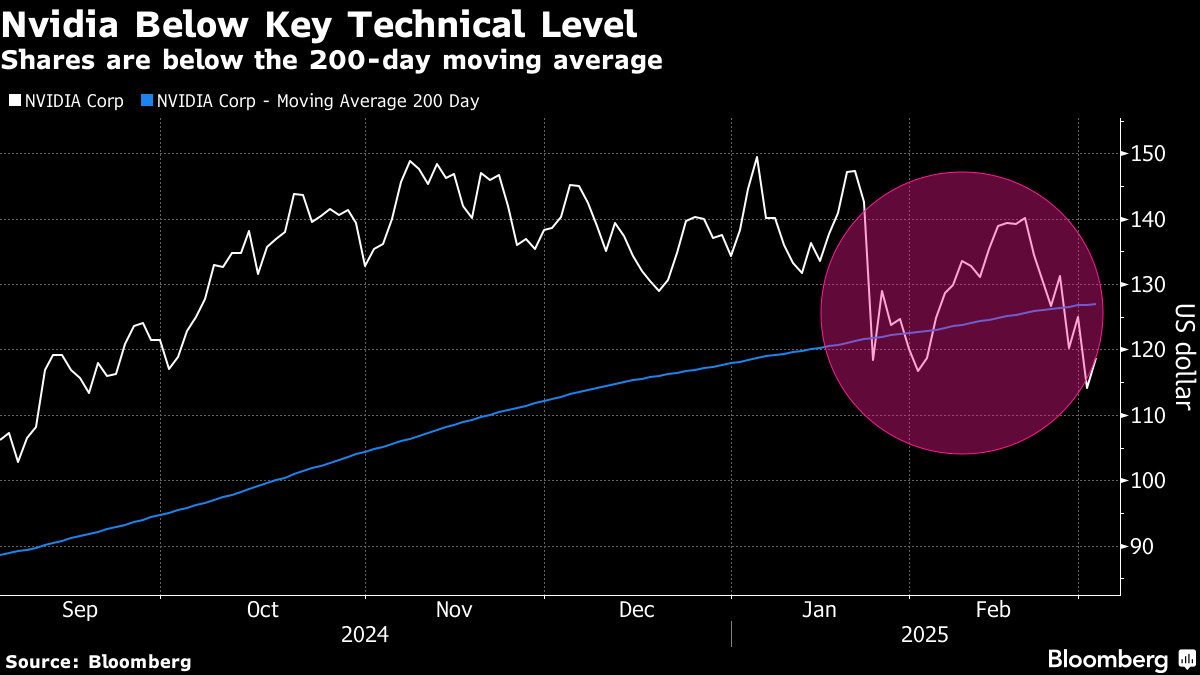
Chart watchers are fixated on the 200-day moving average, a measure of long term-momentum that was breached in January for the first time in more than two years. While Nvidia rose modestly on Tuesday, with the stock now trading well below the gauge, market professionals are fixated on the trajectory of the moving average.
“It's definitely a change of character compared to the last two years,” said Todd Sohn, senior ETF and technical strategist at Strategas Securities LLC. “On a tactical basis, it's hard to remain super bullish on a name once the 200-day starts to crest and slope downward.”
Sohn says the next level he's watching is $113 per share for Nvidia, the intraday low it hit in an early February trough. Rick Bensignor, chief executive officer of Bensignor Investment Strategies and a former Morgan Stanley strategist, has a similar area in focus.
“I'm inclined to think there's more to go on the downside,” Bensignor said. “We could see support anywhere from here to $110, but below that my minimum downside target is in the $107-$103 range.” The next support is at about $90, he added.
The Nvidia downturn has come amid broader market uncertainty that's shaken most of the biggest technology stocks. The so-called Magnificent Seven group of tech megacaps recently fell into correction territory — down more than 10% from its peak. The Nasdaq 100 Index is flirting with the same level.
Beyond the specific fears that have weighed on Nvidia since the emergence of DeepSeek, there are also broader questions around President Donald Trump's tariffs and exactly how much technology companies — especially those with exposure to China — would be impacted.
Nvidia is responsible for more than 30% of the Nasdaq's decline this year. Tesla Inc. and Broadcom Inc. are the second and third biggest contributors to the slide, and both are also near their 200-day moving average.
“It is possible we've seen a long-term peak in the stock. Nvidia remains the way to play AI, and people continue to debate AI,” said Buff Dormeier, chief technical analyst at Kingsview Partners. “The stock looks tired on a longer-term basis. The flattening of the 200-day trendline is a sign that momentum has been weakening and things are turning.”
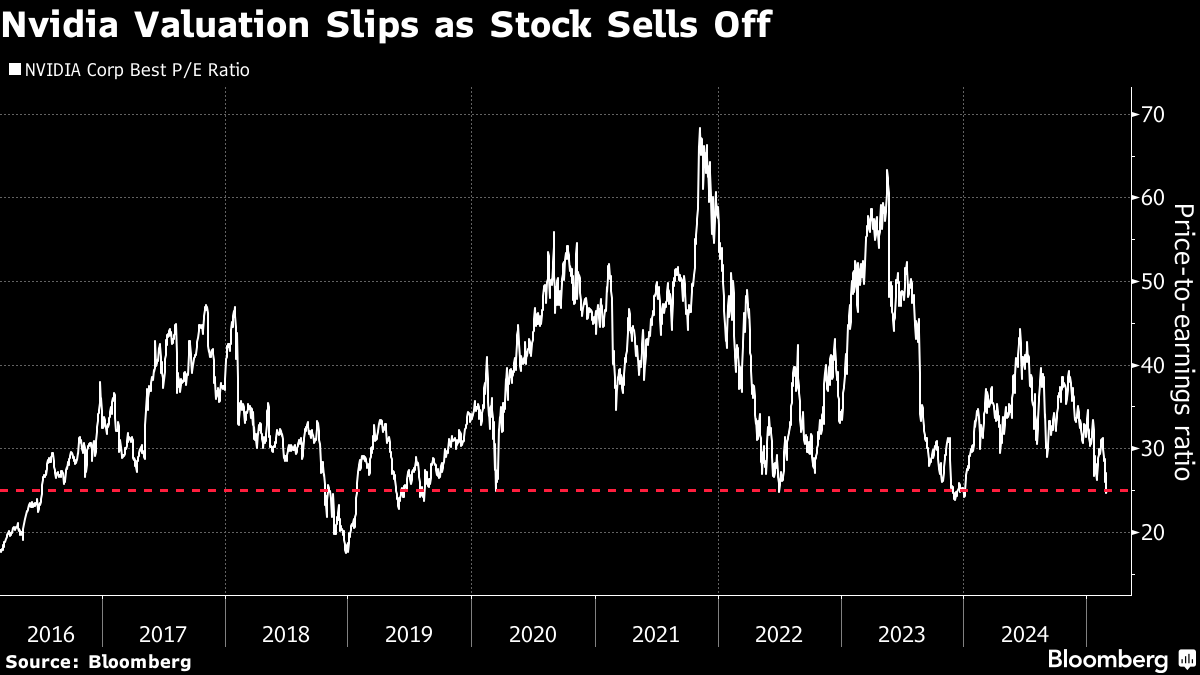
The rout has brought Nvidia's valuation based on forward earnings down to about 25, the lowest multiple the technology giant has seen in more than a year. The Nasdaq trades at about 22 times forward earnings, and the S&P 500 Index has a multiple around 20.
Nvidia's falling valuation and the recent pessimism on the shares have puzzled bulls, especially given that the biggest technology companies have made it clear that they're going to continue to spend billions of dollars on artificial intelligence in the coming years.
“The de-rating feels a little stunning especially right at the start of a product cycle,” Bernstein analysts led by Stacy Rasgon wrote in a March 4 note, referring to Nvidia's new Blackwell line of chips. “Worries that the AI trade is 'over' feel a little premature to us, and valuation is getting increasingly attractive.”
Still, caution might be warranted until some of the broader market pressures are alleviated.
“While risk-reward looks attractive on the stock with stock trading below historical troughs, we believe investors are looking for the clearance event on the overhang from the AI restrictions and tariff impact to gross margins,” Citigroup analysts led by Atif Malik wrote in a note.
Tech Chart of the Day

-
Foreign Investors Own Half Of HDFC Bank and ICICI Bank. An LTCG Cut Could Matter Most Here

Foreign portfolio investors have US$115 billion parked in HDFC Bank, ICICI Bank. If the government cuts long-term capital gains tax, Jefferies says returning foreign money could land here first.
-
'Never Seen This Level Of Negativity': Sandeep Tandon Says The Next Rally May Be Closer Than You Think
Veteran investor Sandeep Tandon says foreign selling is easing, large-caps are due a comeback and mid-caps are crowded, while he turns positive on gold, power and pharma this Diwali.
-
Indians Stay With Family, Not In Hotels | The Reason Why
India still lacks enough clean, reliable and affordable hotels for budget-conscious travellers.
-
The Economic Imperative: Analysing The Material Driving Force Behind India-Canada Strategic Reset
This economic complementarity is further reinforced by deep institutional investment ties and talent mobility, which form the bedrock of the bilateral framework.
-
Medicine Pricing: Where Must Profit Stop?
India must confront excessive margins, hidden incentives and regulatory gaps that threaten the integrity of medicine.
-
Why Amazon And Flipkart Are Struggling To Beat Meesho In India's Smaller Cities
With 274 million users and lowest-cost logistics, Meesho is defending its value commerce crown against giants like Amazon and Flipkart.
-
High US Salaries, No Green Card Certainty: The Financial Calculation Facing Indian H-1B Families
The suspension of PERM processing at eight technology employers does not cancel existing H-1B visas. What it does is force a question many Indian families have been avoiding: is the US salary worth tying your career and family plans to one employer?
-
Swiggy vs Eternal: Food Delivery's Two Rivals Are No Longer In The Same Race
Eternal is building a private AI assistant, dark.ai. Swiggy is still working out how to make Instamart pay, with an operating loss of Rs 895 crore in the July-September quarter while Blinkit stayed profitable.
-
Where You Live Shapes How You Get To Work | The Reason Why
Two-wheelers are the most popular way to get to work in India, accounting for nearly 43% of workplace commutes.
-
Unhedged Position: Can India See An Indonesia-Style Time Correction?
The Nifty is trading below levels it first clocked in 2024. Is there, then, as I have suggested in the headline, potential that the current time correction drags on painfully for the next three-five, even ten years?










