Trio Of Scientists Win Nobel Physics Prize
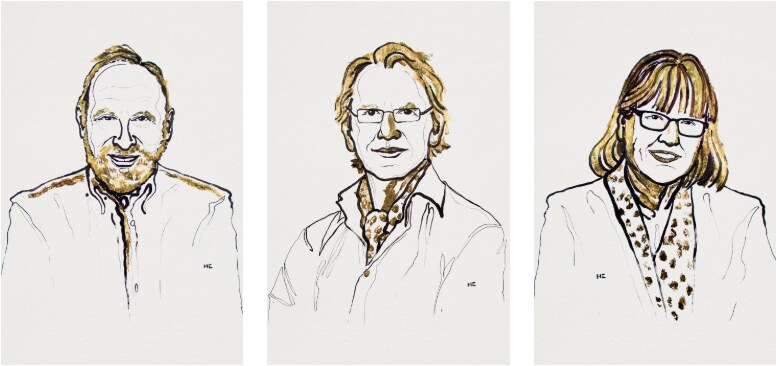
Three scientists on Tuesday won the Nobel Physics Prize for inventing optical lasers that have paved the way for advanced precision instruments used in corrective eye surgery and in industry.
Arthur Ashkin of the U.S. won one half of the nine million Swedish kronor (about $1.01 million) prize, while Gerard Mourou of France and Donna Strickland of Canada shared the other half.
Ashkin, 96, was honoured for his invention of “optical tweezers” that grab particles, atoms, viruses and other living cells with their laser beam fingers. With this he was able to use the radiation pressure of light to move physical objects, “an old dream of science fiction,” the Royal Swedish Academy of Sciences said.
A major breakthrough came in 1987 when Ashkin used the tweezers to capture living bacteria without harming them, the Academy noted.
Ashkin, who made his discovery while working at AT&T Bell Laboratories from 1952 to 1991, is the oldest winner of a Nobel prize, beating out American Leonid Hurwicz who was 90 when he won the 2007 Economics Prize.
Meanwhile Mourou, 74, and Strickland -- only the third woman to win the Physics Prize -- won for helping develop a method to generate ultra-short optical pulses, “the shortest and most intense laser pulses ever created by mankind,” the jury said.
Their technique is now used in corrective eye surgery.
Mourou was affiliated with the Ecole Polytechnique of France and the University of Michigan in the U.S., while Strickland, his student, is a professor at the University of Waterloo in Canada.
Speaking by phone to the academy, a moved Strickland said she was thrilled to receive the Nobel prize that has been the least accessible for women. “We need to celebrate women physicists because they're out there... I'm honoured to be one of those women.” Before her, only Marie Curie and Maria Goeppert Mayer had won the physics prize, in 1903 and 1963 respectively.
The Royal Swedish Academy of Sciences has in the past lamented the small number of women laureates in the science fields in general.
It has insisted that it is not due to male chauvinism bias on the award committees, instead attributing it to the fact that laboratory doors were closed to women for so long. “It's a small percentage for sure, that's why we are taking measures to encourage more nominations because we don't want to miss anyone,” the head of the Academy, Goran Hansson, said on Tuesday.
Last year, U.S. astrophysicists Barry Barish, Kip Thorne and Rainer Weiss won the physics prize for the discovery of gravitational waves, predicted by Albert Einstein a century ago as part of his theory of general relativity.
On Monday, two immunologists, James Allison of the U.S. and Tasuku Honjo of Japan, won this year's Nobel Medicine Prize for research into how the body's natural defences can fight cancer.
The winners of the chemistry prize will be announced on Wednesday, followed by the peace prize on Friday. The economics prize will wrap up the Nobel season on Monday, October 8.
For the first time since 1949, the Swedish Academy has postponed the announcement of the 2018 Nobel Literature Prize until next year, amid a #MeToo scandal and bitter internal dispute that has prevented it from functioning properly.

-
The Curious Case of Equitas Small Finance Bank And A CEO Who Quit For Stock

PN Vasudevan believes persistent investor concerns over a perceived conflict of interest had become a governance overhang on Equitas Small Finance Bank's stock, even as the lender improved profitability and asset quality.
-
Talking Points This Week: AI Cash Burn, A Tiger Comeback And An India That Still Finds Its Own Path
India is not immune to higher oil or tighter global liquidity, yet its earnings base is broader, its domestic policy levers are still available.
-
Foreign Investors Own Half Of HDFC Bank and ICICI Bank. An LTCG Cut Could Matter Most Here
Foreign portfolio investors have US$115 billion parked in HDFC Bank, ICICI Bank. If the government cuts long-term capital gains tax, Jefferies says returning foreign money could land here first.
-
'Never Seen This Level Of Negativity': Sandeep Tandon Says The Next Rally May Be Closer Than You Think
Veteran investor Sandeep Tandon says foreign selling is easing, large-caps are due a comeback and mid-caps are crowded, while he turns positive on gold, power and pharma this Diwali.
-
Indians Stay With Family, Not In Hotels | The Reason Why
India still lacks enough clean, reliable and affordable hotels for budget-conscious travellers.
-
The Economic Imperative: Analysing The Material Driving Force Behind India-Canada Strategic Reset
This economic complementarity is further reinforced by deep institutional investment ties and talent mobility, which form the bedrock of the bilateral framework.
-
Medicine Pricing: Where Must Profit Stop?
India must confront excessive margins, hidden incentives and regulatory gaps that threaten the integrity of medicine.
-
Why Amazon And Flipkart Are Struggling To Beat Meesho In India's Smaller Cities
With 274 million users and lowest-cost logistics, Meesho is defending its value commerce crown against giants like Amazon and Flipkart.
-
High US Salaries, No Green Card Certainty: The Financial Calculation Facing Indian H-1B Families
The suspension of PERM processing at eight technology employers does not cancel existing H-1B visas. What it does is force a question many Indian families have been avoiding: is the US salary worth tying your career and family plans to one employer?
-
Swiggy vs Eternal: Food Delivery's Two Rivals Are No Longer In The Same Race
Eternal is building a private AI assistant, dark.ai. Swiggy is still working out how to make Instamart pay, with an operating loss of Rs 895 crore in the July-September quarter while Blinkit stayed profitable.










