India’s Most Potent Missile Agni 5 Successfully Tested
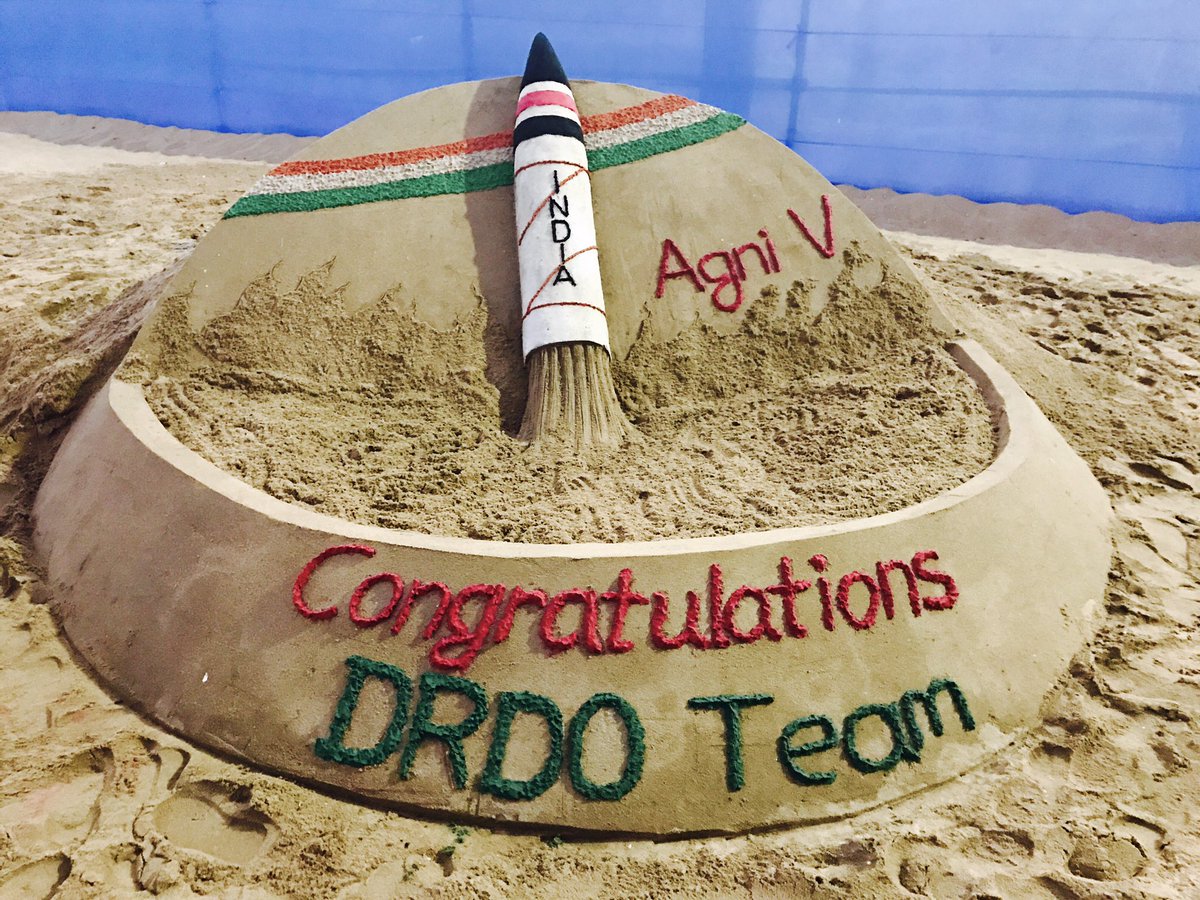
India on Monday successfully test-fired its nuclear-capable, inter-continental ballistic missile Agni 5, that has a range of over 5,000 kilometer covering whole of China, from Abdul Kalam island off the Odisha coast.
Defence sources said that the successful test-firing will pave the way for user trial of the most potent Indian missile and its eventual induction into the special forces command.
The three-stage, solid propellant surface-to-surface missile was test-fired from a mobile launcher from launch complex-4 of the Integrated Test Range at about 11:05 am, DRDO sources said.
About 17-metres long and weighing over 50 tonnes, the surface-to-surface missile majestically rose from the confines of its canister flawlessly and achieved all targets, sources in Defence Research and Development Organization said.
It is the fourth developmental and second canisterised trial of the missile.
While the first test was conducted on April 19, 2012, the second was on September 15, 2013 and the third on January 31, 2015 from the same base.
Among the missiles of Agni series, the latest Agni-5 is the most advanced having some new technologies incorporated with it in terms of navigation and guidance, warhead and engine, the sources said.
Lot of new technologies developed indigenously were successfully tested in the trial. The very high accuracy Ring Laser Gyro based Inertial Navigation System and the most modern and accurate Micro Navigation System had ensured the missile reached the target point within few metres of accuracy.
The high speed on board computer and fault tolerant software along with robust and reliable bus guided the missile flawlessly, said a DRDO official.
The missile is so programmed that after reaching peak of its trajectory, it turns towards earth to continue its journey towards the intended target with an increased speed due to the attraction of earth's gravitational pull and its path precisely directed by the advanced on-board computer and inertial navigation system.
The atmospheric air rubbing the skin of the missile during the re-entry phase raises the temperature to beyond 4,000 degree Celsius.
However, the indigenously designed and developed carbon-carbon composite heat shield continues to burn sacrificially protecting the payload, maintaining the inside temperature below 50 degree Celsius.
Finally, commanded by the on-board computer with a support of highly accurate ring laser gyro based inertial navigation system, the most modern micro inertial navigation system, fully digital control system and advanced compact avionics, the missile hit the designated target accurately, meeting all mission objectives, they said.
The ships located in midrange and at the target point tracked the vehicle and witnessed the final event. All the radars and electro-optical systems along the path monitored all the parameters of the missile and displayed in real time, the sources said.
The first two flights of Agni-5 in 2012 and 2013 were in open configuration and had already proved the missile.
The third test in 2015 and Monday's launch from a canister integrated with a sophisticated mobile launcher were in its deliverable configuration that enables launch of the missile with a very short preparation time as compared to an open launch, they said.
It also has advantages of higher reliability, longer shelf life, less maintenance and enhanced mobility.
At present, India possesses Agni-1 with 700 kilometer range, Agni-II with 2000 kilometer range, Agni-3 and Agni-4 with with 2,500 kilometer to more than 3,500 range in its armoury of Agni missile series, they said.

-
Signature Play: The Classic Cocktail Is Dead. Or Is It?

Classic cocktails are disappearing from India's cocktail menus. But they're still being ordered, taught to bartenders and borrowed from. So, who's really having the last drink?
-
A New Samvat Wishlist: Inclusive Prosperity And Human Development
India has strengthened its economic foundations through infrastructure, digital access and enterprise. Its next growth chapter must deepen productivity, create better livelihoods and widen participation in prosperity.
-
Love, Sex Aur Dhokha: The Audacious Plot To Spy On Jensen Huang
A Taipei dinner, a Singapore chip buyer and a suspected Chinese asset: inside the alleged spy operation that got close to NVIDIA's Jensen Huang.
-
Ten Things I Learnt This Samvat
Patience can be a trap. Cheap stocks can stay cheap. Leverage can wipe you out. What did Samvat 2082 teach us? Niraj Shah writes on 10 lessons from the year gone by.
-
Talking Points This Week: Tech Nerves, FII Buying, And A Faraway Banking Shock
The global markets are not shining this Diwali. The exception in the large markets is, India.
-
Midterm Rally Lasted A Day. The Hard Reality Of A Divided US May Last Two Years | Opinion
Between a contested AI boom, a debt ceiling that arrives in 2027 and a president with every incentive to act alone, the next two years may prove more volatile than the first day's rally suggests.
-
Blue Wave Will Derail the AI Trade but Won't Dismantle the AI Era | Unhedged Position
The Democrats' sweep of the US Congress will see politics collide with economic forces both over the long and short term.
-
It's Time To Take The GST Council's Bet On Trust Global
Payment records can prove India's services exports, and clear, proportionate rules can bring foreign digital sellers into the tax net.
-
Opinion | India at 38: From Innovation Overperformer to Innovation Powerhouse
India now has 453 VC-backed deep science startups, 18 of them late-stage, after 117 percent growth since 2020. Laurus Labs, at USD 9.3 billion, is the most valuable deep science company in any middle-income economy outside China.









