German Students Shatter Hyperloop Speed Record For Third Straight Time
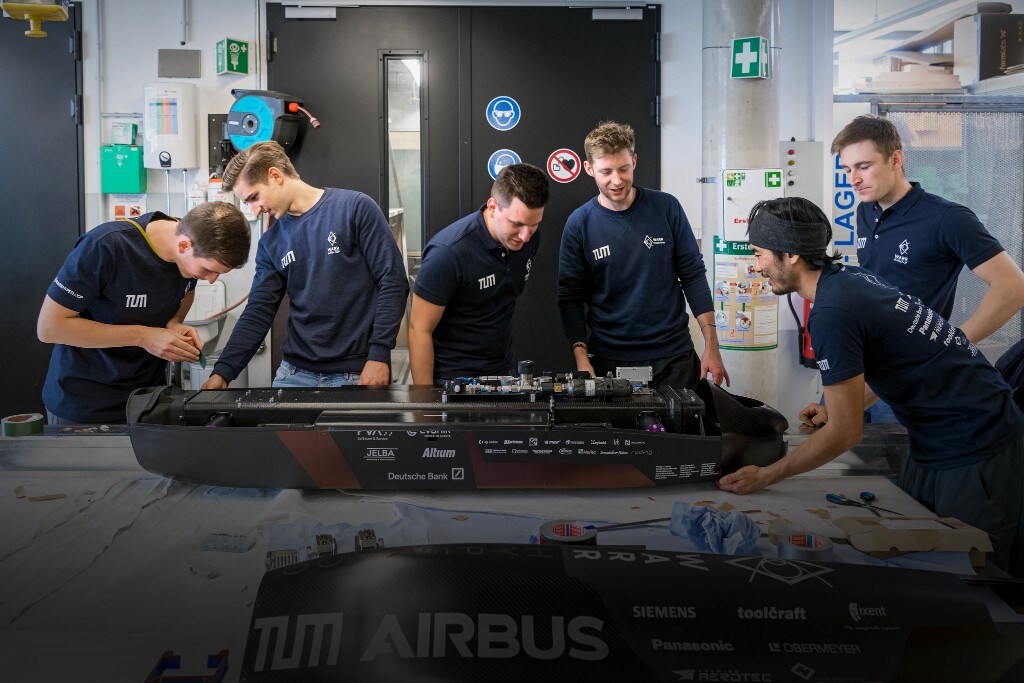
A bunch of German engineering students again smashed the speed record for hyperloop—Elon Musk's vision of a futuristic travel system that could slingshot a pod at super-high speeds through a system of sealed tubes.
WARR Hyperloop, built by students from the Technical University of Munich, won the SpaceX Hyperloop Pod Competition for the third time in a row. And it hit the top speed of record 290 miles an hour.
“We managed to go almost 50 percent faster than last year, reaching a final speed of 467km/h (290 mph)!,” the student initiative said in a media statement. “We'd like to sincerely thank all our sponsors! This journey wouldn't have been possible without you!”

Since Musk first envisaged and open sourced the Hyperloop in 2013, a number of companies including Richard Branson-backed Virgin Hyperloop One have joined the race to develop what has been touted as the future of city transportation. The Hyperloop pod competition has been conducted by Musk's SpaceX since 2015 at its headquarters in Hawthorne, California. It has just one criteria: maximum speed.
The first time track runs were done in January 2017, only three pods managed to reach the finish line of 1.2-kilometre-long-vaccum tube. WARR Hyperloop was the fastest and was also awarded for the best in-flight performance. The second competition in August the same year saw WARR's pod nick the top spot clocking 201 miles per hour. And this year, it has done it again, beating teams from the Massachusetts Institute of Technology and the Netherlands' Delft University of Technology.
But this is not a full-sized pod. Musk's Hyperloop is meant to be a people carrier. The pods in the competition aren't even big enough to fit one grown up person. Branson's Hyperloop One, however, claims to have achieved a top speed of 387 kilometres per hour using its full-sized pod.

The WARR team knows that their technology in its current state is not suitable for building bigger passenger compartments. But it still wants to keep working. “The technology is still in the development phase and our prototypes are built with the initial objective of testing various technologies,” the team said in a media statement in June. “However, this way we can contribute to making the Hyperloop vision a reality one day”
We want to explore other systems, in particular levitation systems and frictionless drive systems, which in our opinion will be very significant for the competition and for the further development of Hyperloop technology in the future.WARR Hyperloop
While scalability is one problem for WARR, the other is speed. Musk's ideal objective is to transport passengers at 1,200 kilometers per hour. That's thrice of what has been achieved till now, and with a much smaller pod. “This goal can't be achieved on the test track,” WARR said. “The tube in front of the SpaceX building in Los Angeles is only 1.2 kilometres long, and the pod has to accelerate to full speed and then brake again within this distance. This is a gigantic challenge: Our pod accelerates five times faster than an airplane during take-off.”
Musk, who was present at the competition, seemed to have slightly higher expectations though. “It should be capable of 330-ish, maybe 345 miles per hour,” he said in a video posted by WARR Hyperloop on their Facebook page. “But 290, I mean, that's very impressive too.”
He announced a fourth pod competition probably by next year.
Watch WARR Hyperloop's record-breaking test run here:

-
AI Bias In Investing Cannot Be Eliminated, But It Can Be Governed

Framing is a particularly important example as identical financial information presented in terms of gains rather than losses can lead an LLM to reach a different assessment.
-
Joining The Dots | Dark Skies, Steady Diya: Why Hope Holds This Diwali
With war, a weak rupee and foreign outflows weighing on sentiment, policymakers at the NDTV World Summit and market veterans at NDTV Profit Ignite: Diwali Edition offered the same advice: stay invested and filter out the noise.
-
The Curious Case of Equitas Small Finance Bank And A CEO Who Quit For Stock
PN Vasudevan believes persistent investor concerns over a perceived conflict of interest had become a governance overhang on Equitas Small Finance Bank's stock, even as the lender improved profitability and asset quality.
-
Talking Points This Week: AI Cash Burn, A Tiger Comeback And An India That Still Finds Its Own Path
India is not immune to higher oil or tighter global liquidity, yet its earnings base is broader, its domestic policy levers are still available.
-
Foreign Investors Own Half Of HDFC Bank and ICICI Bank. An LTCG Cut Could Matter Most Here
Foreign portfolio investors have US$115 billion parked in HDFC Bank, ICICI Bank. If the government cuts long-term capital gains tax, Jefferies says returning foreign money could land here first.
-
'Never Seen This Level Of Negativity': Sandeep Tandon Says The Next Rally May Be Closer Than You Think
Veteran investor Sandeep Tandon says foreign selling is easing, large-caps are due a comeback and mid-caps are crowded, while he turns positive on gold, power and pharma this Diwali.
-
Indians Stay With Family, Not In Hotels | The Reason Why
India still lacks enough clean, reliable and affordable hotels for budget-conscious travellers.
-
The Economic Imperative: Analysing The Material Driving Force Behind India-Canada Strategic Reset
This economic complementarity is further reinforced by deep institutional investment ties and talent mobility, which form the bedrock of the bilateral framework.
-
Medicine Pricing: Where Must Profit Stop?
India must confront excessive margins, hidden incentives and regulatory gaps that threaten the integrity of medicine.
-
Why Amazon And Flipkart Are Struggling To Beat Meesho In India's Smaller Cities
With 274 million users and lowest-cost logistics, Meesho is defending its value commerce crown against giants like Amazon and Flipkart.










