Can Fujifilm’s Nura Transform Healthcare With AI-Enabled Preventive Screening?
How do you create a use case for your products while taking elements from your culture to build a new line of business? Japanese conglomerate Fujifilm still makes photographic films but also has a huge business in healthcare, life sciences and electronics. Fujifilm provides solutions for diagnostic imaging—CT and MRI systems that today come with AI layers to deliver better outcomes. In 2021, the company established Nura with Indian firm Dr Kutty's Healthcare to offer high-quality medical checkups, supported by Fujifilm's medical devices. With the increasing focus on AI across industry sectors, Fujifilm and Nura are now pitching their AI-enabled checkups, reports and process as a key differentiator in the healthcare space with their USP being an in-depth health screening delivered in less than 120 minutes.
According to Masaharu Morita, founder and program director, Nura – AI Health Screening Centre, India was their first global expansion outside Japan. India was chosen because of the size of the market here and growing awareness of preventive healthcare through regular health screenings, which according to him is at the core of healthcare philosophy in Japan and a key reason behind the country's higher life expectancy.
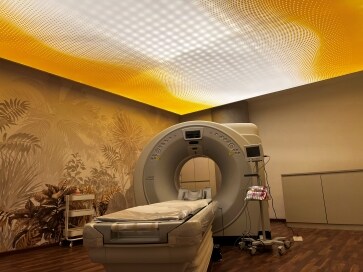
But private hospitals and diagnostic centres already do a roaring business in such health check-ups. According to Morita, what sets Nura apart is its 120-minute, AI-enabled offering. This, in a setting that is more tranquil Japanese Zen garden combined with sterile medical, as compared to a standard medical facility. With soft-spoken medical professionals, soothing piped music in the rooms where various tests are done, and even a comfortable kimono that ‘guests' wear during the process—Nura uses hospitality lingo and refers to customers as guests. Every part of the experience is thoughtfully and deliberately designed to finish everything within 120 minutes as customers move from one medical check-up or test to another in a calm yet clearly Japanese influenced, precision-driven environment. Even the final report is delivered by a doctor using a large touch screen as the customer sits across the table—digital interfaces simplify medical data into engaging visuals. Rather than pages of medical reports, Nura customers can explore images of their organs, body composition and health projections.
But where does AI come in and how does it make a difference? According to Morita, at the heart of Nura's process is Fujifilm's ultra-low-dose CT technology combined with AI-assisted imaging and a streamlined workflow. "Our legacy in high-quality scanning and image processing allows us to train AI systems with decades of imaging data. AI doesn't replace doctors, it empowers them. The AI system acts as a powerful assistant that helps specialists detect minute irregularities that might otherwise be missed during routine checks," he explains.
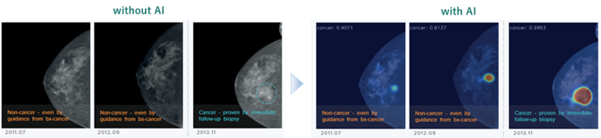
How AI enhances accuracy and detects irregularities that might be missed by the human eye. (Image: Nura)
An example illustrates how AI can significantly enhance accuracy in breast cancer screening. Mammogram images in the 'Without AI' picture show how subtle signs of early-stage cancer were initially interpreted as non-cancerous, even with professional review and biopsy guidance. Over time, the lesion developed and was later confirmed as cancer through a follow-up biopsy. When the same mammogram sequence was analysed using an AI-powered detection system, intelligent algorithms identified a small area of concern as a suspicious region that required further examination. The system assigned a high probability score for cancer, prompting doctors to review it more closely. It can be then verified through biopsy. Essentially, AI processes the scan and compares them to similar scans in Fujifilm's vast library of imaging data. This enables Nura to sharpen the low-dose image and identify anything abnormal that that might be missed by the naked eye. The Fujifilm systems keep getting better at such predictions as they continue to gather, classify, and examine large amounts of medical images.
Recognising that India is a value-conscious market Nura has tried to keep pricing around health check-up packages offered by other leading players. Morita pegs the screening cost at roughly ₹50 a day, which according to him makes it comparable to what many Indians spend on small daily conveniences
Since launch Fujifilm and Dr Kutty's Healthcare have expanded Nura centres to Bengaluru, Delhi, Mumbai, Hyderabad, and Calicut. Fujifilm has now expanded Nura beyond India and currently operates 11 centres globally: besides the five Indian centres there are six international centres across Mongolia, Vietnam, South Africa, Dubai and Thailand. By Q1 next year the company aims to scale its footprint in three major India metros. Morita says the aim is build a healthcare network with 100 centres worldwide by 2030. Morita adds that the Nura program is designed to be flexible and can be adopted by larger national healthcare players as well. “Fujifilm and Dr. Kutty are aligned in supporting such collaborations to broaden access to preventive screening. The long-term vision is to establish a network of dedicated preventive care centres that blend Japanese precision with trusted local healthcare partnerships.”

-
Signature Play: The Classic Cocktail Is Dead. Or Is It?

Classic cocktails are disappearing from India's cocktail menus. But they're still being ordered, taught to bartenders and borrowed from. So, who's really having the last drink?
-
A New Samvat Wishlist: Inclusive Prosperity And Human Development
India has strengthened its economic foundations through infrastructure, digital access and enterprise. Its next growth chapter must deepen productivity, create better livelihoods and widen participation in prosperity.
-
Love, Sex Aur Dhokha: The Audacious Plot To Spy On Jensen Huang
A Taipei dinner, a Singapore chip buyer and a suspected Chinese asset: inside the alleged spy operation that got close to NVIDIA's Jensen Huang.
-
Ten Things I Learnt This Samvat
Patience can be a trap. Cheap stocks can stay cheap. Leverage can wipe you out. What did Samvat 2082 teach us? Niraj Shah writes on 10 lessons from the year gone by.
-
Talking Points This Week: Tech Nerves, FII Buying, And A Faraway Banking Shock
The global markets are not shining this Diwali. The exception in the large markets is, India.
-
Midterm Rally Lasted A Day. The Hard Reality Of A Divided US May Last Two Years | Opinion
Between a contested AI boom, a debt ceiling that arrives in 2027 and a president with every incentive to act alone, the next two years may prove more volatile than the first day's rally suggests.
-
Blue Wave Will Derail the AI Trade but Won't Dismantle the AI Era | Unhedged Position
The Democrats' sweep of the US Congress will see politics collide with economic forces both over the long and short term.
-
It's Time To Take The GST Council's Bet On Trust Global
Payment records can prove India's services exports, and clear, proportionate rules can bring foreign digital sellers into the tax net.
-
Opinion | India at 38: From Innovation Overperformer to Innovation Powerhouse
India now has 453 VC-backed deep science startups, 18 of them late-stage, after 117 percent growth since 2020. Laurus Labs, at USD 9.3 billion, is the most valuable deep science company in any middle-income economy outside China.









