Top Chinese Scientist Claims India Moon Landing Nowhere Near South Pole
(Bloomberg) --
The rivalry between Asia's two biggest countries has extended into outer space.
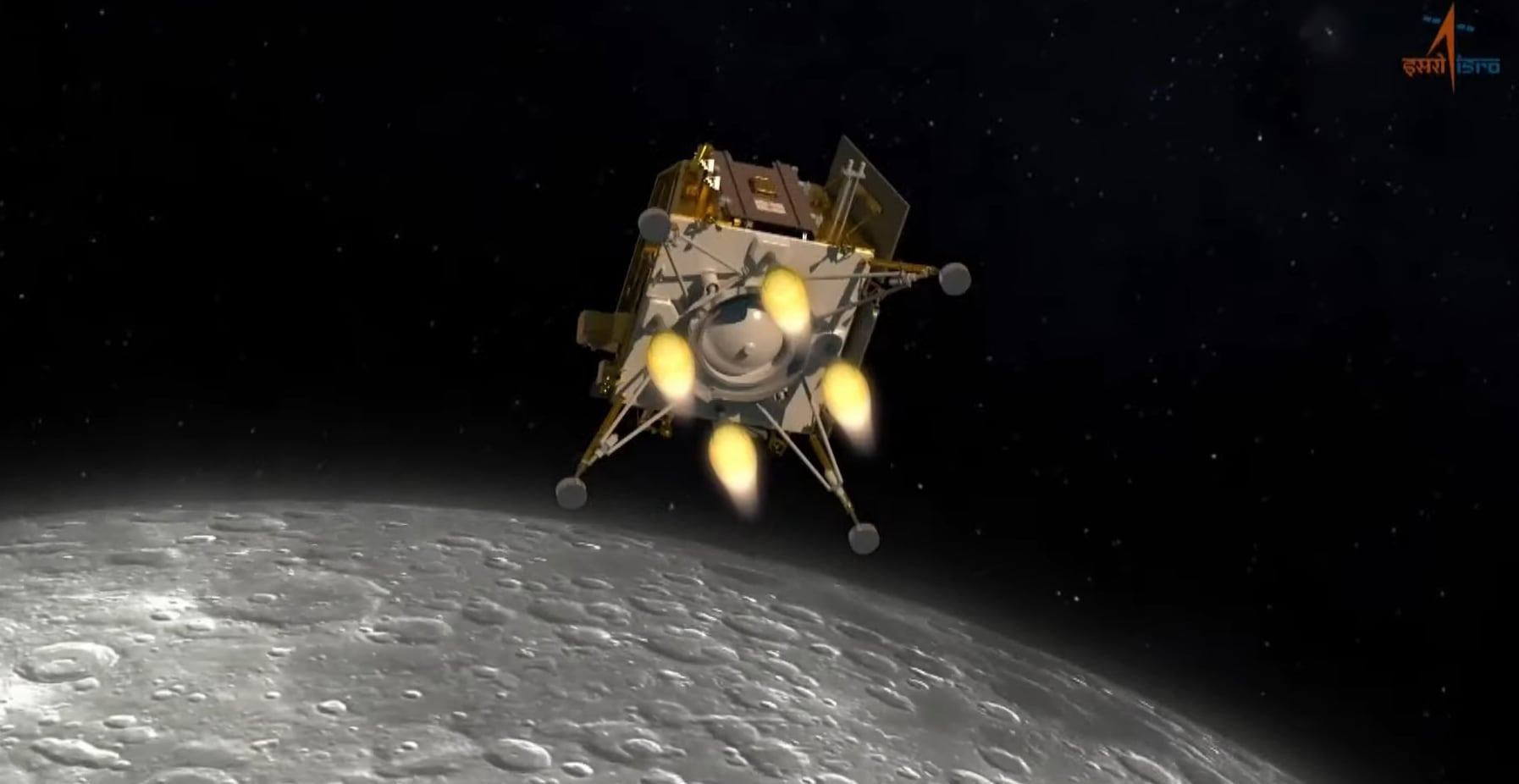
After India's landing of its Chandrayaan-3 rover on the moon last month — becoming the first country to put a spacecraft near the lunar south pole and breaking China's record for the southernmost lunar landing – a top Chinese scientist has said claims about the accomplishment are overstated.
Ouyang Ziyuan, lauded as the father of China's lunar exploration program, told the Chinese-language Science Times newspaper that the Chandrayaan-3 landing site, at 69 degrees south latitude, was nowhere close to the pole, defined as between 88.5 and 90 degrees.
On Earth, 69 degrees south would be within the Antarctic Circle, but the lunar version of the circle is much closer to the pole.
“It's wrong!” he said of claims for an Indian polar landing. “The landing site of Chandrayaan-3 is not at the lunar south pole, not in the lunar south pole region, nor is it near the lunar south pole region.”
The Chandrayaan-3 was 619 kilometers (385 miles) distant from the polar region, Ouyang said.
India's space agency didn't immediately respond to a request for comment on Thursday.
After the Chandrayaan-3 landing, the Communist Party's Global Times quoted Pang Zhihao, a Beijing-based senior space expert, as saying that China had much better technology.
China's space program “has been capable of sending orbiters and landers directly into Earth-Moon transfer orbit since the launch of Chang'e-2 in 2010, a maneuver that India has yet to deliver given the limited capacity of its launch vehicles,” the newspaper said. “The engine that China used is also far more advanced.”
Still, the Chandrayaan-3 went much farther south than any other spacecraft. Russia's attempt to land a spacecraft near the lunar south pole ended in failure last month when it crashed into the moon.
China's Chang'e 4, the first to land on the far side of the moon in 2019, touched down 45 degrees south. An uncrewed NASA probe, Surveyor 7, reached the moon at about 41 degrees south in 1968.
Getting close to the lunar south pole is important not just for bragging rights. Scientists think the region may have ice reserves that could potentially be valuable for long-term stays.
The US and China are both looking to the area for their upcoming plans to sent astronauts to the moon for the first time since NASA's Apollo program ended a half century ago.
--With assistance from Daniela Wei, Linda Lew and Ragini Saxena.
More stories like this are available on bloomberg.com
©2023 Bloomberg L.P.

-
We May Need Another Tukaram Mundhe To Fight Air Pollution | The Reason Why

Developers may install basic measures such as sprinklers and green nets, resume work, and continue violating rules when this equipment stops working.
-
Extracting Value From Battery Scrap Could Be Challenging For India | The Reason Why
A discarded lithium-ion battery still contains valuable materials such as lithium, nickel and cobalt. These can be recovered and reused. When such batteries are crushed and shredded, they produce a dark powder called black mass.
-
One El Nino, India Can Handle. Two Could Break The Granary
India's grain stocks can absorb one bad year, but a second El Nino could drain the buffer in two to three years, economists say.
-
India's Troika Of Good Luck | Joining The Dots
As Jensen Huang's exit drags Nvidia down, a cooling AI trade and resilient earnings have revived investor interest in India. A likely RBI rate hike looms.
-
Talking Points This Week: Leadership Shock At Nvidia, Earnings Strength, And The Fog Over Hormuz
The Anthropic IPO pricing and first trading day, Nvidia's upcoming earnings, and any fresh signals from Iran will set the tone for the following week.
-
Signature Play: The Classic Cocktail Is Dead. Or Is It?
Classic cocktails are disappearing from India's cocktail menus. But they're still being ordered, taught to bartenders and borrowed from. So, who's really having the last drink?
-
A New Samvat Wishlist: Inclusive Prosperity And Human Development
India has strengthened its economic foundations through infrastructure, digital access and enterprise. Its next growth chapter must deepen productivity, create better livelihoods and widen participation in prosperity.
-
Love, Sex Aur Dhokha: The Audacious Plot To Spy On Jensen Huang
A Taipei dinner, a Singapore chip buyer and a suspected Chinese asset: inside the alleged spy operation that got close to NVIDIA's Jensen Huang.
-
Ten Things I Learnt This Samvat
Patience can be a trap. Cheap stocks can stay cheap. Leverage can wipe you out. What did Samvat 2082 teach us? Niraj Shah writes on 10 lessons from the year gone by.
-
Talking Points This Week: Tech Nerves, FII Buying, And A Faraway Banking Shock
The global markets are not shining this Diwali. The exception in the large markets is, India.









