Systemic Risks In Banking: ‘Normally’ Safe, Compliant, And Very Risky
Reserve Bank of India Governor Shaktikanta Das, at a recent event, made several astute and insightful observations about the Covid-19 crisis and its impact on Indian banking. Governor Das highlighted the fact that ‘once in a lifetime' economic events are becoming ‘once in a decade' events. He acknowledged that such events have a fat-tail distribution.
The implication being that extreme events are more likely to happen than one would think.
In the light of the Covid-19 crisis and the Governor's comments, it is time to rethink certain critical aspects of the systemic stress-testing that RBI conducts. The stress-testing exercise that banks themselves conduct on their own books is significantly impacted by RBI's approach and that also requires a higher level of rigour and sophistication.
As such, inadequacy in the stress-testing framework provides a false sense of complacency in good times while aggravating the problem when the risk events occur.
False Comfort Of Normal Distributions
The problem with ‘fat-tail' is an issue not with the event itself but with the human modeler who made over-simplistic assumptions, such as believing economic events follow a bell-shaped or normal distribution.
For systemic stress testing, Indian GDP growth is assumed to have a normal distribution with a long term average of growth of around 6% and a standard deviation (SD or sigma) of 2%.
As per this ‘normal' fairy tale, 0% growth in any year is a three-sigma event. It is an event as rare as 1-in-1000. The current consensus estimate of real GDP change for FY21 is a contraction of around 5.0-6.0%, which is a six-sigma event. As per the normal distribution, such a negative growth rate is even rarer than one-in-a-million. Under assumptions of ‘normality,' these are stark outlier events and no one can be blamed for lapses in oversight or risk governance.
But how do decision-makers know that GDP growth follows a normal distribution?
There are enough arguments to the contrary – i.e. that GDP growth does not follow a normal distribution. That GDP growth rates have distributions, whose extreme values (the tail of the distribution) are fatter than a normal distribution, is a well-established fact (Canning et al., 1998; Lee et al., 1998; Castaldi and Dosi, 2004). Additionally, it is well-known that credit portfolio losses follow non-normal distributions. Understandably stress tests should assume scenarios that are ‘severe but plausible'.
However, assuming an event to be rarer than it actually is, by using normal distribution, fails the core purpose of stress-testing.
Not Very ‘Stressful' Tests
The last RBI Financial Stability Report, published in December 2019, continued with a similar stress testing framework as the previous years.
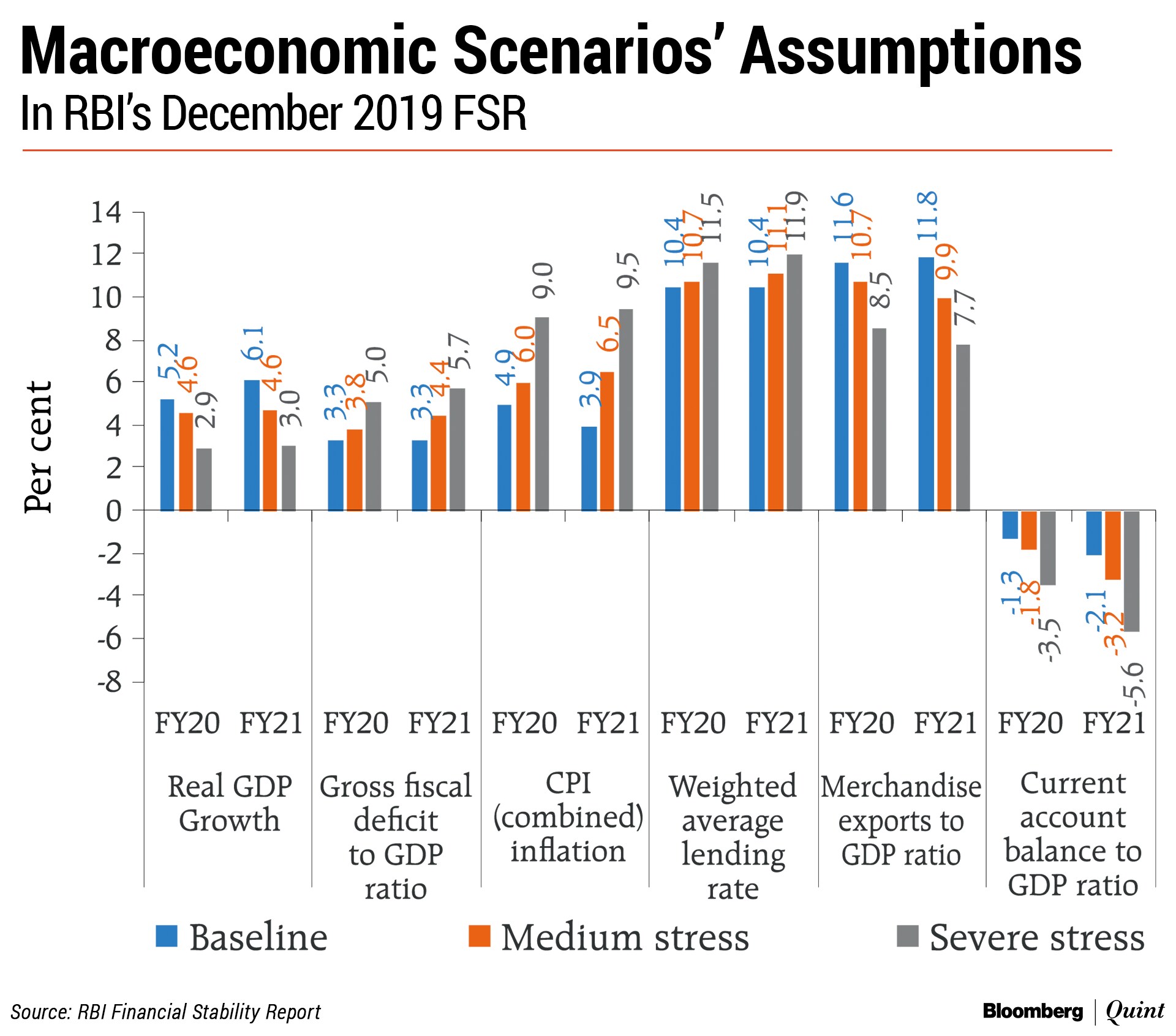
For the purpose of stress-testing, six macro-economic variables are used. The expected future value of these variables forms the base case. For adverse risk scenarios, the variables are stressed by up to 1 standard deviation of their values for medium risk and 1.25 to 2 standard deviation for severe risk. The standard deviation is calculated based on data of the previous ten years.
An assumption of two-sigma stress in normal distribution creates a comforting view of a stress level that, in very simplified terms, is as rare as a one-in-fifty year shock. To the extent that stress tests are supposed to assume ‘severe but plausible' scenarios, the two-sigma stress looks good on paper. But knowing that normal distribution under-predicts the likelihood of extreme events, it is surprising that a 2 standard deviation stress is considered a sufficiently adverse scenario.
So while the economic activity has been sliding for last several quarters from 2018, even in December 2019 , a scenario where GDP growth can be less than zero is considered implausible. The stress-scenario considers a GDP growth of 2.9%. Needless to say the impact of the likely -5% to -6% GDP growth, if it happens, will impact Indian banks significantly.
It may be argued that if a stress level of 98% was considered under the stress test framework but instead of normal distributions, non-normal distributions had been considered, this would have been practically and theoretically more accurate. For those interested in the technicals, non-normal distribution methodologies such as Cauchy, Laplace and Extreme Value Distribution could have been considered.
It may be noted that a 98% stress level under such non-normal distributions would have simulated a stress scenario closer to what is being played out during the Covid crisis.
Can Indian Banking Bear the Covid-Shock?
Before the pandemic hit, the health of the Indian banking system was gradually improving.
The capital to risk-weighted assets ratio or CRAR for scheduled commercial banks improved to 14.8% in March 2020, from 14.3% a year earlier. Within that, public sector banks' capital position showed improvement with a CRAR of 13% in March 2020 from 12.2%. A significant portion of the bad debt had been provided for, as reflected by the steady improvement in the provision coverage ratio, which as of March 2020 stood at 65.4%. Thus, while gross NPAs were at 8.3%, net NPAs were at a more manageable 2.9%.
The system, as of March 2020, was better positioned to handle an economic shock than was the case in the previous few years.
As per the last available FSR, under a severe shock of 2 standard deviation, the GNPA at a system-level will move up to 15.6% from 9.4%. Correspondingly, the CRAR will decline from 14.9% to 11.2%. The same FSR pointed out that a shock of 3.5 standard deviation will bring the system-level CRAR to 9%.
However, in the same framework, a 5% GDP contraction is likely to translate into a stress level significantly above 5.5 standard deviation. Governor Das was prompt to point out that the minimum capital requirement of banks, based on historical loss events, may not be sufficient to absorb the losses.
Stress-Testing In A Post-Covid World
While Covid-19 is an unforeseen event, the stress test framework requires some rethinking. It is debatable whether the current systemic stress-testing framework is apt, even without the coronavirus impact. Now, with the pandemic still playing out, the stress testing framework needs to leapfrog to the next level.
Continuing with normal distribution assumptions will cause the regulator as well as the banks to under-estimate the impact of the shock.
Governor Das, in his speech, said “it is imperative that the approach to risk management in banks should be in tune with the realisation of more frequent, varied and bigger risk events than in the past”.
It is expected that RBI will take the lead in improving the adequacy and pertinence of system-wide stress testing. Of course, banks, who care for their stakeholders, may not wait for RBI but can decide to go to the next level of stress-testing now.
Deep Narayan Mukherjee is a financial services professional and a visiting faculty on risk management at Indian Institute of Management, Calcutta.
The views expressed here are those of the author and do not necessarily represent the views of BloombergQuint or its editorial team.

-
Gold Is Rs 22,000 Cheaper Than A Month Ago. Should You Buy Amid The Wedding Season?

Gold's potential slide to $3,500 could save around Rs 4,700 per 10 grams, but a soft inflation print could just as easily push prices back up. One way to split the risk is to buy in parts, some now and the rest after the Fed's Dec. 9 decision.
-
AI Agents Are Gaining Power. Who Governs Them?
Artificial intelligence agents promise to transform productivity by moving machines from assisting decisions to executing them. But as organisations delegate greater authority to these AI-agents, they must first establish who controls that authority and who remains accountable when things go wrong.
-
Why Swapping Your Old Gold Can Trigger A Rs 5 Lakh Tax Bill, And How You Can Avoid It Legally
Swapping old gold for new is taxed as a sale and a fresh purchase. Getting your own gold remade can cut most of that bill, though it has its own costs.
-
The AI Trade is Done. The Real Opportunity for Investors Starts in 2027 | Unhedged Position
As pureplay AI stocks plunge and circular, capex-led financing unwinds, 2027 is set to be a year of reckoning for AI companies. Yet the bust clears the way for a better opportunity for investors in 2027 -- shifting the spotlight from AI builders to the companies using AI.
-
Leadership As Mission: Why The Age Of AI Demands More Human Leadership
Debjani Ghosh examines how AI is changing leadership, arguing that its success must be measured by its impact on people and the accountability of those guiding its use.
-
We May Need Another Tukaram Mundhe To Fight Air Pollution | The Reason Why
Developers may install basic measures such as sprinklers and green nets, resume work, and continue violating rules when this equipment stops working.
-
Extracting Value From Battery Scrap Could Be Challenging For India | The Reason Why
A discarded lithium-ion battery still contains valuable materials such as lithium, nickel and cobalt. These can be recovered and reused. When such batteries are crushed and shredded, they produce a dark powder called black mass.
-
One El Nino, India Can Handle. Two Could Break The Granary
India's grain stocks can absorb one bad year, but a second El Nino could drain the buffer in two to three years, economists say.
-
India's Troika Of Good Luck | Joining The Dots
As Jensen Huang's exit drags Nvidia down, a cooling AI trade and resilient earnings have revived investor interest in India. A likely RBI rate hike looms.
-
Talking Points This Week: Leadership Shock At Nvidia, Earnings Strength, And The Fog Over Hormuz
The Anthropic IPO pricing and first trading day, Nvidia's upcoming earnings, and any fresh signals from Iran will set the tone for the following week.









