Coronavirus: Production Of Essential Goods Runs Low As Manufacturers Face Lockdown Hurdles
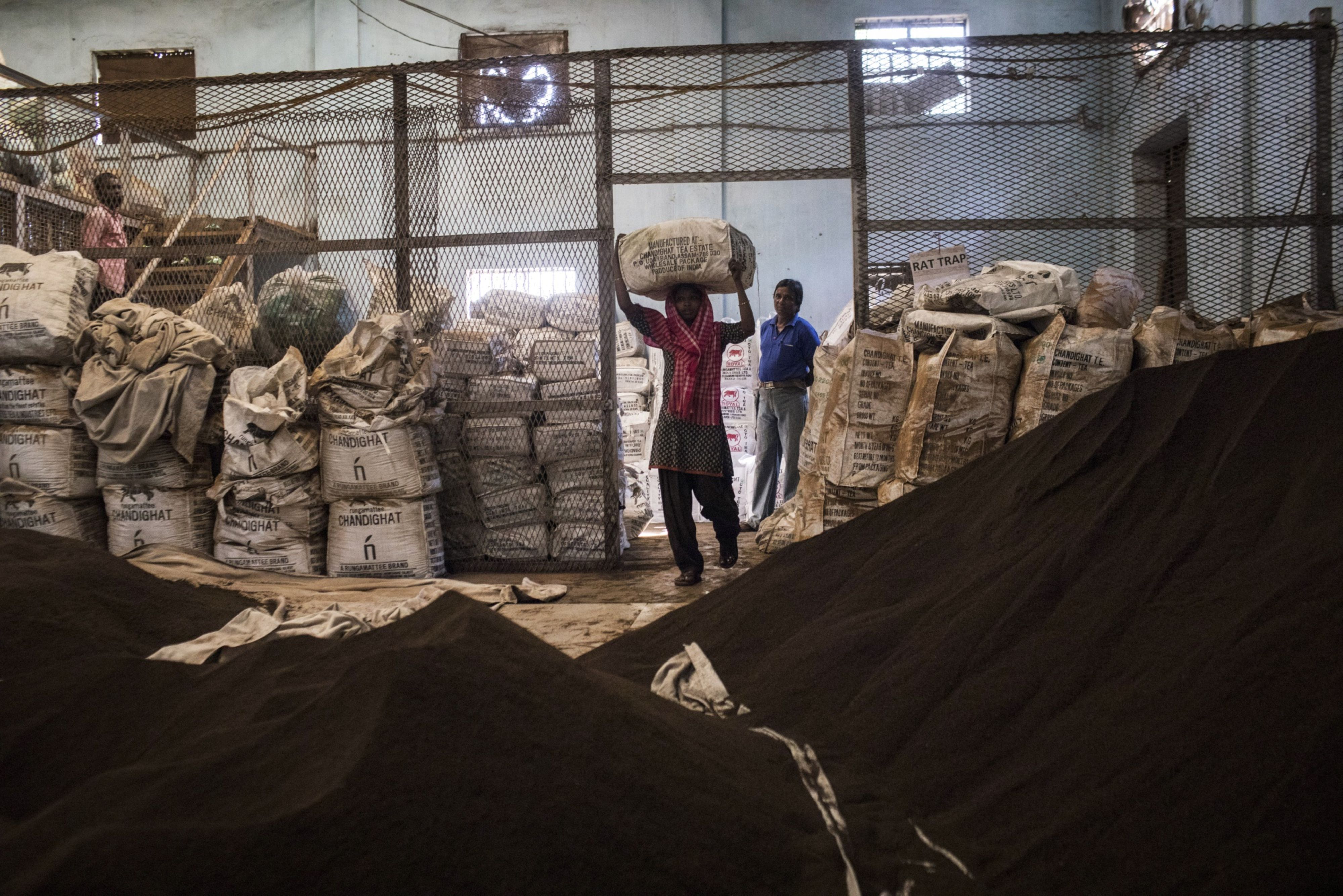
Production of several essential goods is running low, ever since India put 1.3 billion people under lockdown. First the state-wide shutdowns and then the national one that came into effect on March 24 midnight has meant consumer goods companies are facing myriad issues, from state permissions for manufacture, absent labour, to stranded trucks.
A senior executive at a large fast-moving consumer goods company said the production of essential goods, such as packaged food items, soaps and detergents is running at less than 10 percent of ordinary levels. An official at a prominent packaged atta (wheat flour) maker said that factories are currently running at 40 percent capacity, while another at an edible oil refiner said refineries are working at below 50 percent capacity. An executive at a leading biscuit manufacturer said that current capacity utilisation stands at 20 percent. These executives all spoke to BloombergQuint on Saturday, on condition of anonymity.
The situation seems to be better at Amul, India's largest dairy co-operative. Managing Director RS Sodhi told BloombergQuint that all it has all permissions from the state government to continue production and is running at full capacity.
At Godrej Consumer Products Ltd., Managing Director and CEO Vivek Gambhir confirmed that essential goods facilities are running but not at capacity. “Some of our factories have received permissions to manufacture essential hygiene products, at reduced capacity. Some of the CFAs (carrying and forwarding agents) too have received permissions to distribute essential items,” he told BloombergQuint in an emailed statement.
Feminine hygiene products face imminent risk of going out of stock. Most sanitary napkin manufacturers have shut their plants as they haven't been included in the essential items list issued by the central government or state governments. “The central government is yet to clarify if sanitary napkins is an essential item because of which almost all factories have shut. State governments also need to add sanitary napkins to the essential items list so that companies can start manufacturing,” Rajesh Shah, president of Feminine and Infant Hygiene Association of India told BloombergQuint. Since, India's borders have also been closed, imports of sanitary pads are also impacted. Chinese sanitary pads take care of 10-15 percent of India's demand for sanitary pads, Shah said. Johnson & Johnson India, which sells sanitary napkins under the brand name Stayfree, and Procter & Gamble Hygiene and Health Care which sell sanitary napkins under the brand name Whisper, are yet to respond to BloombergQuint's query.
What Is ‘Essential'?
The first of the problems facing many of these companies is that a week ago when states announced shutdowns there was no common list of essential goods and hence many had to shut facilities in several states. For instance, Nestle India Ltd. said in a statement on March 24 that “In view of the lockdown in many of the states / union territories across the country, the operations in some of the locations (manufacturing, distribution centres / warehouses, offices, suppliers) are scaled down or suspended”. The company is in discussion with the authorities to continue operations in the factories / distribution centres where the operations have been suspended, the statement said.
Even where plants are running, workers are absent – some having left for their home towns and villages, others not able to get to work due to strict enforcement of local stay-at-home orders. To travel to factories workers need passes from local authorities (police) but that's been tough to get with no clear definition of what is “essential” and no clear system in place. There is still confusion in issuing permission letters by the local authorities (at the district level) as they are interpreting the guidelines in their own way, an FMCG company official told BloombergQuint on the condition of anonymity.
The definition problem has also manifested in stranded trucks. As states shut down borders, trucks carrying supplies or finished goods have found it tough to crossover. Some truckers have abandoned their vehicles in fear to rush home.
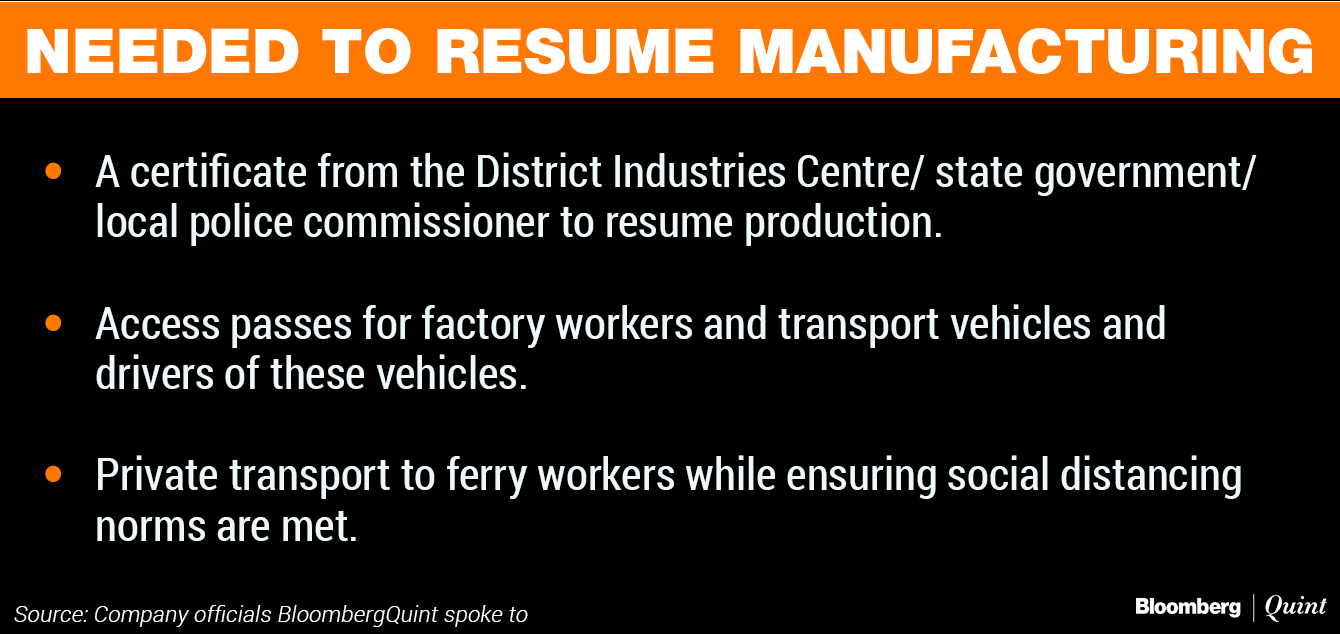
When the national lockdown was announced, Prime Minister Narendra Modi assured that manufacturing units of essential commodities would remain unaffected. The accompanying notification said the same but with no common definition of “essentials” the confusion persisted.
A recent notification by the Union Home Ministry, has attempted to clarify that by providing an indicative list of essential food items and asking states to ensure the supply chain around these is allowed to function smoothly.
- Fruits & Vegetables
- Rice, wheat flour, other cereals and pulses
- Sugar and salt, spices and masalas
- Bakery and dairy (milk, milk products)
- Tea and coffee
- Eggs, meat and fish
- Food grains, oil, masala and food ingredients
- Packaged food and beverages
- Health supplements, nutraceuticals, food for special dietary use and food for special medical purpose
- Infant/baby food
- Animal feed/pet food
- Food delivery services and e-commerce for above mentioned products
- Cold storage and warehousing of food products
- Fuel such as coal, rice husk, diesel/furnace oil and others necessary to run manufacturing plants and factories.
- All raw materials, intermediaries, packaging materials needed to support the above list of products.
Using the list many companies are now scrambling to restart operations where stalled. For others, the list will help in ensuring factory workers can access facilities where otherwise they were being blocked by police and other authorities. It will hopefully also ease passage of supply trucks seeking to cross state borders to bring raw materials to facilities or despatched goods to consumers.
But many goods, like sanitary napkins, are still not covered. Meanwhile, state governments are also trying to get their act together.
The Maharashtra state government has asked district collectors and divisional commissioners to issue certificates to manufacturing facilities of essential items. The state government expects to launch a website by Sunday to streamline the entire process, B Venugopal Reddy, principal secretary. Industries, Energy and Labour Department, Government of Maharashtra told BloombergQuint.
A secretary in the Department of Industries of the Telangana Government told BloombergQuint that it is issuing certifications to factories of essential goods and is working with companies to ensure workers can reach the factory to restart production. There is a portal for companies to apply for certification, he said, without wanting to be named.
“We are hoping that with the herculean efforts being made by the central and state governments and the full commitment of the industry, we will see the supply chain for essential items functioning soon,” Godrej's Gambhir said.
The Manpower Issue
Despite the best efforts of authorities and companies, one problem will be difficult to overcome. The shortage of manpower. Many migrant workers have left for their home towns. Other don't want to go to work due to fear and stigma. Some workers have been asked to vacate hostels and rentals as owners fear contagion, an executive at a consumer goods company told BloombergQuint. In some instances, village authorities have warned factory workers that they won't be accepted back if they leave for work at factories, he said.
The number of workers reporting to factory/distributor locations is still very low due to social pressure and safety concerns, Gambhir said. “Many difficulties are being faced in transportation, especially for inter-state transportation,” he added.
ITC Ltd. has obtained necessary permissions in some states for manufacturing, transporting and distributing essentials, it said in a statement to BloombergQuint. While the movement of trucks across states has been impacted, ITC said it will take a few days for the entire ecosystem and processes to fall into place for movement of essential goods.

-
Gold Is Rs 22,000 Cheaper Than A Month Ago. Should You Buy Amid The Wedding Season?

Gold's potential slide to $3,500 could save around Rs 4,700 per 10 grams, but a soft inflation print could just as easily push prices back up. One way to split the risk is to buy in parts, some now and the rest after the Fed's Dec. 9 decision.
-
AI Agents Are Gaining Power. Who Governs Them?
Artificial intelligence agents promise to transform productivity by moving machines from assisting decisions to executing them. But as organisations delegate greater authority to these AI-agents, they must first establish who controls that authority and who remains accountable when things go wrong.
-
Why Swapping Your Old Gold Can Trigger A Rs 5 Lakh Tax Bill, And How You Can Avoid It Legally
Swapping old gold for new is taxed as a sale and a fresh purchase. Getting your own gold remade can cut most of that bill, though it has its own costs.
-
The AI Trade is Done. The Real Opportunity for Investors Starts in 2027 | Unhedged Position
As pureplay AI stocks plunge and circular, capex-led financing unwinds, 2027 is set to be a year of reckoning for AI companies. Yet the bust clears the way for a better opportunity for investors in 2027 -- shifting the spotlight from AI builders to the companies using AI.
-
Leadership As Mission: Why The Age Of AI Demands More Human Leadership
Debjani Ghosh examines how AI is changing leadership, arguing that its success must be measured by its impact on people and the accountability of those guiding its use.
-
We May Need Another Tukaram Mundhe To Fight Air Pollution | The Reason Why
Developers may install basic measures such as sprinklers and green nets, resume work, and continue violating rules when this equipment stops working.
-
Extracting Value From Battery Scrap Could Be Challenging For India | The Reason Why
A discarded lithium-ion battery still contains valuable materials such as lithium, nickel and cobalt. These can be recovered and reused. When such batteries are crushed and shredded, they produce a dark powder called black mass.
-
One El Nino, India Can Handle. Two Could Break The Granary
India's grain stocks can absorb one bad year, but a second El Nino could drain the buffer in two to three years, economists say.
-
India's Troika Of Good Luck | Joining The Dots
As Jensen Huang's exit drags Nvidia down, a cooling AI trade and resilient earnings have revived investor interest in India. A likely RBI rate hike looms.
-
Talking Points This Week: Leadership Shock At Nvidia, Earnings Strength, And The Fog Over Hormuz
The Anthropic IPO pricing and first trading day, Nvidia's upcoming earnings, and any fresh signals from Iran will set the tone for the following week.









