When Family Are Friends: The Secret Of Parsi Dairy’s Successful 107-Year Run
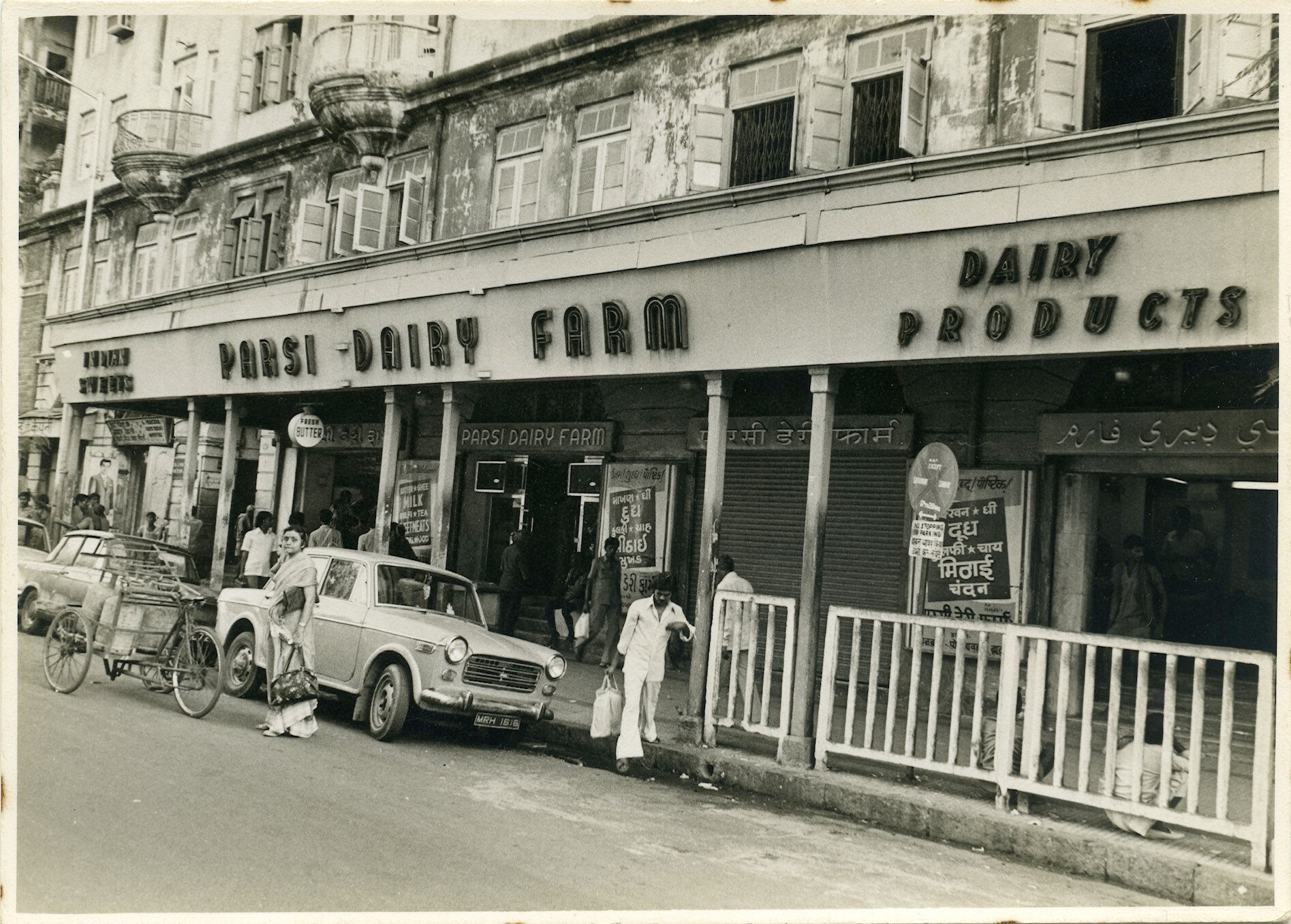
As you enter through the new fire engine red door, you see the ‘unchanging wall' that tells stories of a time when ghee was sold in tin cans; milk came to your doorstep in glass bottles delivered by men in bright blue uniforms; phone numbers had five digits and advertisements featured family. The secret recipes of one of India's oldest operational dairies, now managed by the fourth generation of founder Nariman Ardeshir's family, may remain the same but many other things have changed.
As its only outlet located in south Mumbai undergoes a dramatic makeover and the family run business draws up plans to expand—starting with two new outlets in suburban Borivali and Ghatkopar—and makes a blueprint to export its iconic products, I met the generation that now runs Parsi Dairy Farm to find out how this family brand has stayed relevant for 107 years.

The new fire engine red door at Parsi Dairy Farm in Mumbai's Marine Lines.
Cousins—sisters Parvana Mistry and Zeenia Patel and brothers Sarfaraz Irani and Bakhtyar Irani—grew up learning the dairy trade at the store as they helped their parents pack goodies during the festive season, working amid piles of freshly made jalebis and handmade sutarfeni. Now, they have clearly defined responsibilities.
Parvana, a Cordon Bleu graduate, handles production and quality. Graphic designer Zeenia manages branding and packaging, Sarfaraz focuses on sales and marketing and Bakhtyar, at 41 the oldest of the quartet, is the managing director who captains the ship. Both their mothers sit in on board meetings too and all decisions are taken collectively, with the person whose expertise it is leading the way.
“We respect each other's positions. We don't interfere in each other's work but we are all four very happy to be together. We've all grown up here,” says Parvana. “I've sat at the counter as a teenager and then handed over my responsibility to Sarfaraz at six so that I could run for a party.” The cousins understood very early in life that they could depend on each other to pass the baton safely.
At the store, the glass cabinets are loaded with sweetness. One of the storefront windows is constructed from ghee bottles, some of them full of the golden goodness that is PDFs most popular product. The full bottles spell the word ghee. There are bright pink ice cream barfi and double decker barfis, both favourites with children, fluffy sutarfeni, an auspicious mava boi, a mava fish coated in silver leaf and considered auspicious, barela (caramelised or ‘burnt' in Gujarati) pedas, raspberry kopra pak with a glob of dark pink in the midst of a perfect circle of coconut barfi, a plate-sized, beautifully layered malai khaja—puff pastry with malai inside. “Do I have to buy the whole thing?” a gent asks. There is a constant hum of customers both times I visit the store.

The Bengali sweets corner is a hit especially with Swiggy and Zomato customers. There are sugar-free products such as date squares; two types of ghee, lassi, masala milk, flavoured shrikhand and dahi, whose flavours come from fruit preserves manufactured in house; toffee dispensers that hold milk drops, now repackaged as The Great Indian Toffee; the iconic kulfis including the latest coffee variant; and four types of milk…among other products.
Apart from the fact that their products don't contain any emulsifiers or additives, and are made with the most basic ingredients, customers can depend on their taste being exactly as remembered. “We have consistency. Customers marvel at how the malai kulfi has tasted the same for the 50 years they've been coming here,” says Sarfaraz. His brother Bakhtyar attributes their success to the team, many of whom have been working with the company for decades. “Treat your staff as family. They are the main cause of your success,” he says.
The packaging skips extravagance and favours practicality. The lassi is sold in glass shaped containers that don't require a straw. The curd is set in earthen pots, served just as it was 100 years ago. The plastic butter container doubles up as a dish to hold the butter once it has been opened. “We are very conscious about wasting things. It's very easy to go extravagant but we are conscious that our children have to live in this world,” says Parvana.

Three generations of the Parsi Dairy family.
Seated: Jeroo Nariman; standing from left: Bakhtyar K Irani, Parvana S Mistry, Meheru K Patel, Shernaz K Irani, Zeenia K Patel and Sarfaraz K Irani
As they rebranded and made plans for a new future, the cousins also settled a long-running dispute with one of their partners, and opted to drop charges they had filed against him. “These kinds of problems happen in every family,” says Bakhtyar. “Settle, don't press charges. Move forward.”
But it's Zeenia who triggers the aha moment when she shares what she thinks is a big reason for their success. “Agree to disagree,” she says. “We complement each other in a way that we are very strong together. We even go out together. We party together, we work together.” This is the catalyst for a conversation.
“We are together all the time,” agrees Parvana.
“We hang together out of work hours too,” says Sarfaraz.
“Sarfaraz is the only one who has friends. I don't have any friends,” says Parvana.
“Sarfaraz's friends are my friends,” says Bakhtyar.
“All our friends know all of us,” says Zeenia.
“Growing up we were four of us and we pretty much spent 24/7 with each other, I don't think I ever missed the fact that I didn't have friends,” says Parvana.
A family whose members share a long running friendship. That is the underlying goodness of Parsi Dairy Farm.
Priya Ramani is a Bengaluru-based journalist and is on the editorial board of Article-14.com.
The views expressed here are those of the author and do not necessarily represent the views of BQ Prime or its editorial team.

-
The Curious Case of Equitas Small Finance Bank And A CEO Who Quit For Stock

PN Vasudevan believes persistent investor concerns over a perceived conflict of interest had become a governance overhang on Equitas Small Finance Bank's stock, even as the lender improved profitability and asset quality.
-
Talking Points This Week: AI Cash Burn, A Tiger Comeback And An India That Still Finds Its Own Path
India is not immune to higher oil or tighter global liquidity, yet its earnings base is broader, its domestic policy levers are still available.
-
Foreign Investors Own Half Of HDFC Bank and ICICI Bank. An LTCG Cut Could Matter Most Here
Foreign portfolio investors have US$115 billion parked in HDFC Bank, ICICI Bank. If the government cuts long-term capital gains tax, Jefferies says returning foreign money could land here first.
-
'Never Seen This Level Of Negativity': Sandeep Tandon Says The Next Rally May Be Closer Than You Think
Veteran investor Sandeep Tandon says foreign selling is easing, large-caps are due a comeback and mid-caps are crowded, while he turns positive on gold, power and pharma this Diwali.
-
Indians Stay With Family, Not In Hotels | The Reason Why
India still lacks enough clean, reliable and affordable hotels for budget-conscious travellers.
-
The Economic Imperative: Analysing The Material Driving Force Behind India-Canada Strategic Reset
This economic complementarity is further reinforced by deep institutional investment ties and talent mobility, which form the bedrock of the bilateral framework.
-
Medicine Pricing: Where Must Profit Stop?
India must confront excessive margins, hidden incentives and regulatory gaps that threaten the integrity of medicine.
-
Why Amazon And Flipkart Are Struggling To Beat Meesho In India's Smaller Cities
With 274 million users and lowest-cost logistics, Meesho is defending its value commerce crown against giants like Amazon and Flipkart.
-
High US Salaries, No Green Card Certainty: The Financial Calculation Facing Indian H-1B Families
The suspension of PERM processing at eight technology employers does not cancel existing H-1B visas. What it does is force a question many Indian families have been avoiding: is the US salary worth tying your career and family plans to one employer?
-
Swiggy vs Eternal: Food Delivery's Two Rivals Are No Longer In The Same Race
Eternal is building a private AI assistant, dark.ai. Swiggy is still working out how to make Instamart pay, with an operating loss of Rs 895 crore in the July-September quarter while Blinkit stayed profitable.










