The Ban On Agri Commodities Futures Is Weak In Law And Economics
Last week, the Securities and Exchange Board of India issued a direction to commodity exchanges prohibiting the issuance of new derivative contracts in seven agricultural commodities for one year. The commodities covered in the ban constitute more than 70% of the traded volumes in the Indian agri-commodities futures market. In this article, we argue that this direction is weak in economics and law.
Weak Connection Between Ban And Price Rise
At the outset, the ban seems to be motivated by the desire to rapidly check the rising spot prices of the commodities in question. There also appears to be a belief that rising prices in futures markets lead to hoarding and profiteering in the spot market. As the world economy recovers from the pandemic, there is a sharp rise in the demand for all commodities. At the same time, there is evidence suggesting that supply constraints remain. It is possible that the rising demand and constrained supply have led to a significant and rapid rise in the prices of all commodities, and the futures markets have made little or no contribution to the spot prices.
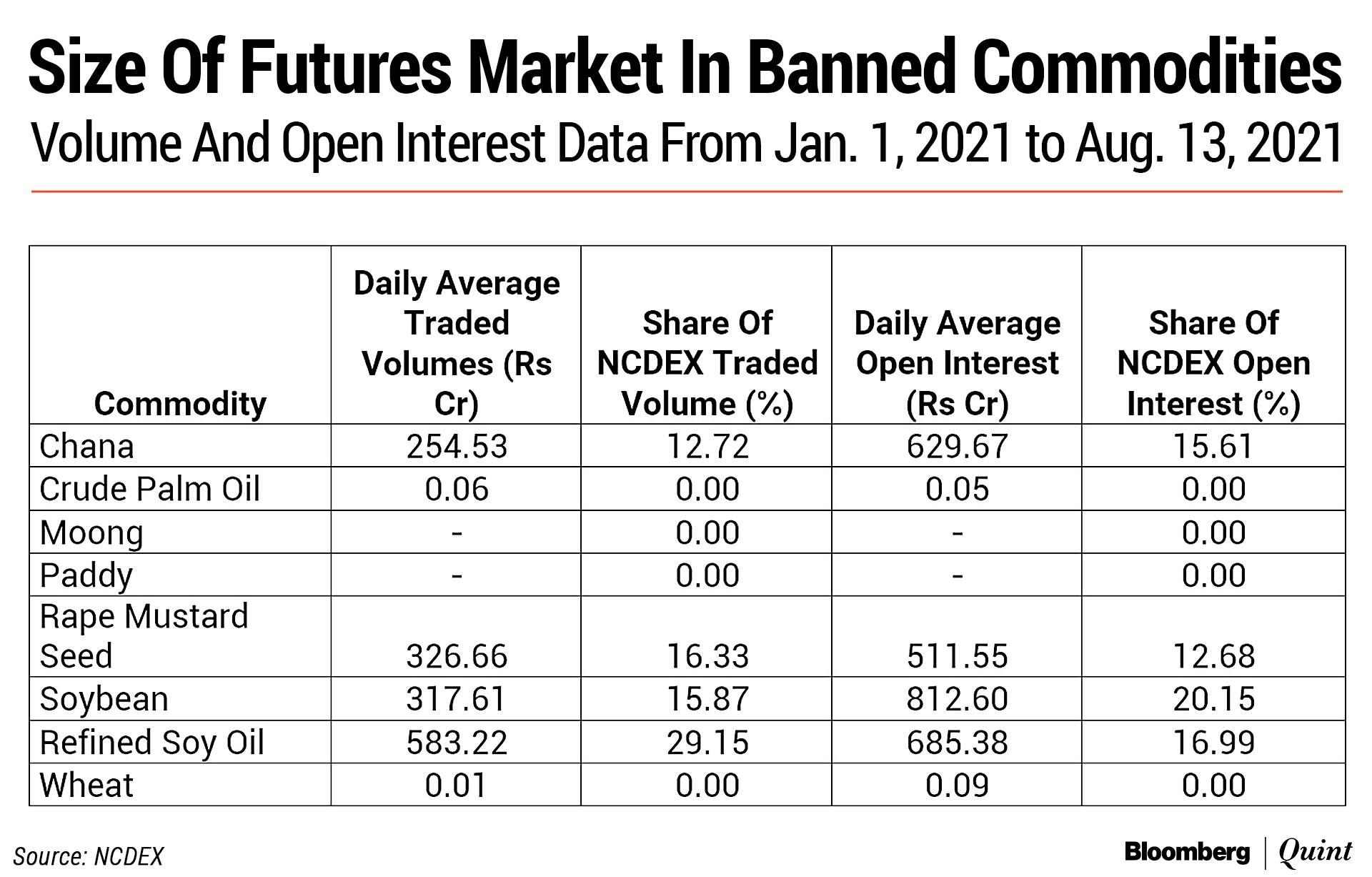
The following table shows the average daily traded volumes and open interest of the seven commodities covered in the ban. Of these, paddy, moong, crude palm oil, and wheat have a negligible share in the agri-commodity futures market.
Therefore, the argument that futures trading in these commodities is driving up the spot prices of wheat, paddy, and moong is tenuous at best.
The key question in principle is, of course, whether and to what extent do futures trading drive up prices in the spot markets, that is, the agricultural mandis? Earlier this year, futures contracts in two of these agricultural commodities—chana and raw mustard seeds—were banned. We looked at the spot prices pattern in these commodities over a one-year period from Dec. 1, 2020, to Dec. 22, 2021.
We also looked at the spot market prices for wheat and moong. The chart below presents the indexed prices for these four commodities over this one year period (i.e. price on Dec. 1, 2020 = Rs 100 per quintal)
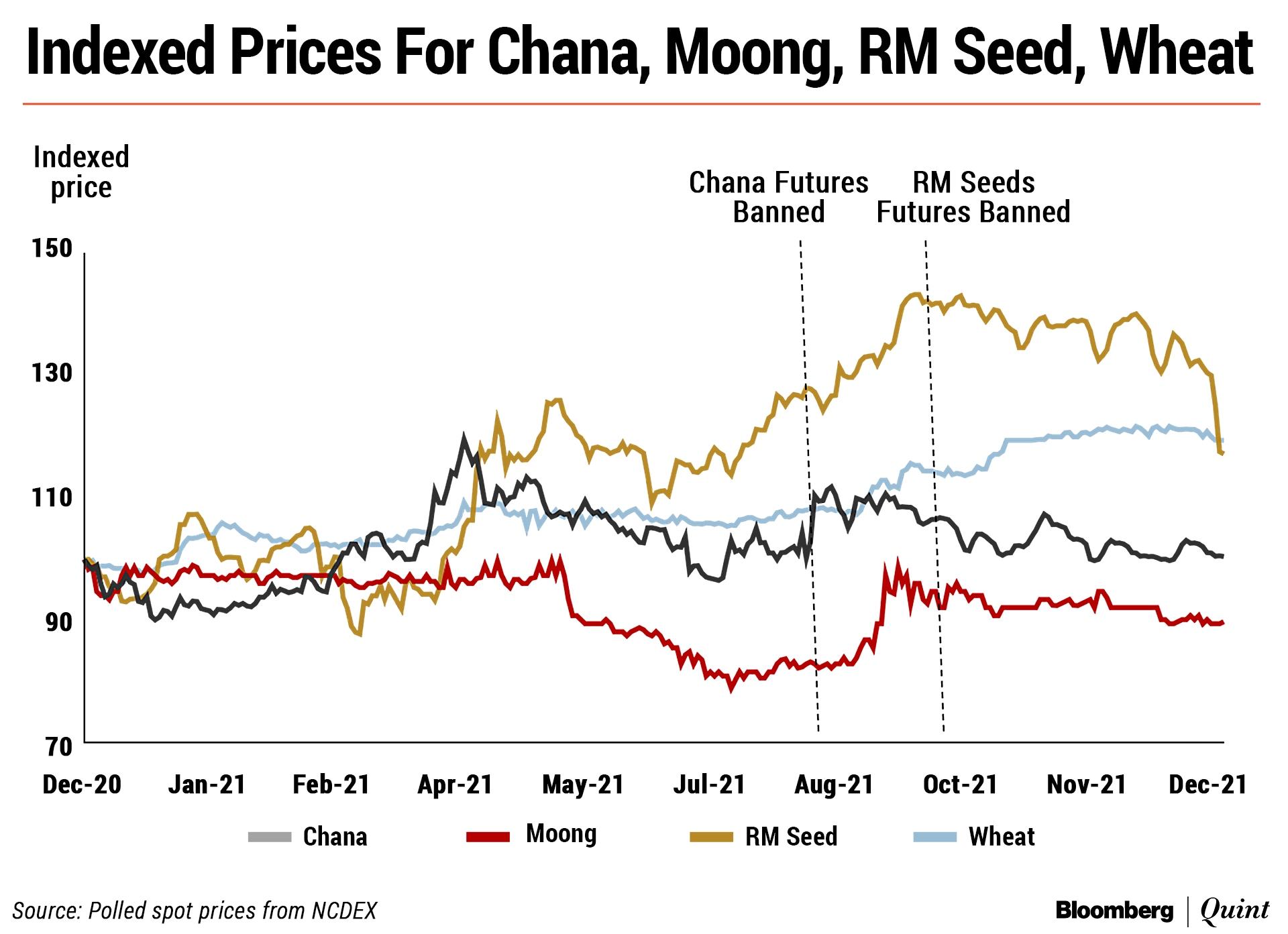
The chart shows that after new futures contracts were banned in chana on Aug. 16, the prices of chana remained by and large at the same level. For raw mustard seeds, after the imposition of the ban on new contracts on Oct. 8, the prices dropped marginally for about two months. The prices then sharply declined in December largely due to reliable information about harvest levels that arrives in the markets typically in November and December, and harvesting actually takes place in January-February.
Banning futures deprives market participants, most importantly the farmers in the spot market, of a crucial source of price information.
Spot markets (i.e. the mandis) for agricultural commodities are fragmented across geographical locations. Futures prices provide a critical reference point for pricing in these spot markets. Especially for small farmers, these prices can help set a reference for price negotiations with the traders. Futures prices play an informational role that is critical in integrating these fragmented spot markets. Banning the futures markets, thus, amounts to the proverbial shooting the messenger.
Weak Law
Second, the ban does not meet the proportionality standard laid down by Indian courts for restricting the fundamental right to carry on trade, business, or profession guaranteed under the Indian Constitution. This standard is best summarised as a four-pronged test in a 2016 judgment of the Supreme Court.
It requires the state to demonstrate that:
The measure is designated for a proper purpose;
The measure is rationally connected to the fulfilment of the purpose;
There are no alternative less invasive measures; and
There is a proper relation between the importance of achieving the aim and the importance of limiting the right.
As demonstrated above, a prohibition on the issuance of new futures contracts virtually debilitates the business of commodity exchanges on which such contracts are offered and traded. While SEBI has full powers to regulate the futures markets, its press release neither mentions the reason for the prohibition on the issuance of new contracts nor demonstrates whether alternate less invasive measures were available, considered, and discarded.
Incidentally, the four-pronged test was most recently affirmed by the Supreme Court in the constitutional challenge mounted by crypto-exchanges against the RBI's prohibition on banks on offering their services to persons dealing in cryptocurrencies. The exchanges succeeded in the challenge as the RBI's prohibition failed the proportionality standard.
SEBI's Mandate
Finally, let's assume that the sovereign is concerned about price rise in the spot market for these seven commodities and this is indeed a proper purpose and a fit measure. Even then, the prohibition raises several questions on whether checking price rise is within SEBI's legal mandate. To be sure, SEBI's mandate, as articulated in the preamble of the SEBI Act, involves investor protection, regulation, and development of the securities market. Price stability, on the other hand, is the core mandate of the RBI.
It is unclear how the prohibition will serve the goal of either investor protection, market regulation, or development.
If anything, there are good arguments, made by several other authors, on how such prohibitions may in fact impede the development of an agri-futures market.
The origin of this prohibition could perhaps be traced to the Securities Contracts (Regulation) Act, 1956 which allows the central government to notify the commodities on which commodity derivative contracts may be written. It is unclear whether the prohibition on the issuance of new contracts originated from the central government or not. In any event, the issuance of this direction from SEBI to the exchanges raises critical questions on the independence of securities markets' regulatory policy.
This is a key objective for the creation of an independent statutory regulator for the Indian securities market. Whichever way you see it, the ban is weak in form, substance, and optics.
Bhargavi Zaveri-Shah is a doctoral student at the National University of Singapore. Harsh Vardhan is a management consultant and also serves as a Public Interest Director on the board of National Commodity Clearing Ltd. These are their personal views.
The views expressed here are those of the authors and do not necessarily represent the views of BloombergQuint or its editorial team.

-
Gold Is Rs 22,000 Cheaper Than A Month Ago. Should You Buy Amid The Wedding Season?

Gold's potential slide to $3,500 could save around Rs 4,700 per 10 grams, but a soft inflation print could just as easily push prices back up. One way to split the risk is to buy in parts, some now and the rest after the Fed's Dec. 9 decision.
-
AI Agents Are Gaining Power. Who Governs Them?
Artificial intelligence agents promise to transform productivity by moving machines from assisting decisions to executing them. But as organisations delegate greater authority to these AI-agents, they must first establish who controls that authority and who remains accountable when things go wrong.
-
Why Swapping Your Old Gold Can Trigger A Rs 5 Lakh Tax Bill, And How You Can Avoid It Legally
Swapping old gold for new is taxed as a sale and a fresh purchase. Getting your own gold remade can cut most of that bill, though it has its own costs.
-
The AI Trade is Done. The Real Opportunity for Investors Starts in 2027 | Unhedged Position
As pureplay AI stocks plunge and circular, capex-led financing unwinds, 2027 is set to be a year of reckoning for AI companies. Yet the bust clears the way for a better opportunity for investors in 2027 -- shifting the spotlight from AI builders to the companies using AI.
-
Leadership As Mission: Why The Age Of AI Demands More Human Leadership
Debjani Ghosh examines how AI is changing leadership, arguing that its success must be measured by its impact on people and the accountability of those guiding its use.
-
We May Need Another Tukaram Mundhe To Fight Air Pollution | The Reason Why
Developers may install basic measures such as sprinklers and green nets, resume work, and continue violating rules when this equipment stops working.
-
Extracting Value From Battery Scrap Could Be Challenging For India | The Reason Why
A discarded lithium-ion battery still contains valuable materials such as lithium, nickel and cobalt. These can be recovered and reused. When such batteries are crushed and shredded, they produce a dark powder called black mass.
-
One El Nino, India Can Handle. Two Could Break The Granary
India's grain stocks can absorb one bad year, but a second El Nino could drain the buffer in two to three years, economists say.
-
India's Troika Of Good Luck | Joining The Dots
As Jensen Huang's exit drags Nvidia down, a cooling AI trade and resilient earnings have revived investor interest in India. A likely RBI rate hike looms.
-
Talking Points This Week: Leadership Shock At Nvidia, Earnings Strength, And The Fog Over Hormuz
The Anthropic IPO pricing and first trading day, Nvidia's upcoming earnings, and any fresh signals from Iran will set the tone for the following week.









