Opinion: "Tulipmania Meets The Real Economy At WhatsApp Speed"

With the cryptocurrency world's luminaries having joined globetrotting elites at Davos — and punters swept up in the market crash suffering sleepless nights — it's time for regulators to reflect on the real-world impact of the next boom-and-bust crypto cycle.
Fintech and crypto apps have already expanded rapidly into digital cash, loans and complex products that can seem as simple as a credit card in e-mail form. That has created financial channels far beyond a one-way wager on Bitcoin or Bored Apes: Decentralized-finance (DeFi) platforms offer crypto yields of 8%-10% to investors; some then in turn fund startups around the world without touching banks. Tulipmania meets the real economy at WhatsApp speed.
In these times of market stress, rewards revealing themselves to be unsustainable have given way to a messy cascade of losses — highlighting the immense challenge facing policy makers, some of whom concede they've dropped the ball on crypto.
Crypto funds are currently being yanked from lending platforms, even those backed by real-world assets. One project offering 8% yields on tokenized debt issued by French payday lender Bling has been hit with “massive” redemptions in excess of its available cash and a credit line from venture-capital backers. For one investor I spoke to, that means potentially waiting months to get his money back. His main motivation for investing in the first place was free token rewards that have since evaporated.
Meanwhile, at the other end of the chain, lending for the end-consumer has also hit a brick wall. Bling suspended its cash-advance service in April, as regulators cracked down on the sector. One consumer-advocacy group estimated the cost of Bling's instant one-month advance as equivalent to a 128% annualized interest rate when including fees.
A small collateral-backed project like this rushing to sell assets is obviously nothing on the scale of the $60 billion Terra collapse, which has seen desperate Koreans beat a path to founder Do Kwon's door. But it does show why regulators are nervous about future risks to the financial system.
Those free rewards and high returns are reeling in people who might be least able to afford it. European Central Bank data shows crypto ownership is a U-shaped affair, with top and bottom-income households more likely to own crypto than those in the middle.
Links with the financial system are growing as venture funds and banks seek to capitalize on crypto's disruptive potential — Societe Generale SA has been tinkering with DeFi loans while others are launching stablecoins. “There is a very broad sense within the investor community that one has to dip one's toes,” says economist Eswar Prasad, author of “The Future of Money.”
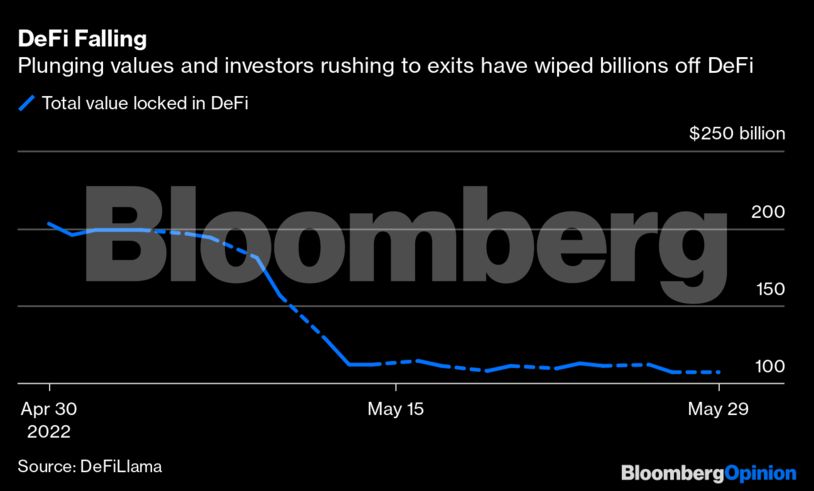
Crypto markets today are modest in size — the current total value locked in DeFi is around $100 billion, or about one-sixth of total venture-capital investing last year — but what might a dozen crypto lending blowups look like in the future if the sector keeps growing? A race to sell assets to meet crypto redemptions could have huge spillover effects, especially if managed algorithmically via smart contracts. Parallels with the subprime mortgage market that triggered a global financial meltdown in 2008 are being drawn more frequently.
“Although the risks are currently small, they could rise significantly if platforms started to offer services to the real economy, instead of remaining confined to the crypto universe,” the ECB said last week, noting that crypto credit on DeFi platforms grew by a factor of 14 in 2021.
The founders and financiers behind DeFi platforms such as Centrifuge or Goldfinch say that serving real-world businesses is still a good-news story for crypto. Algorithmically managing projects and cutting paper-shuffling means unlocking efficiency gains and access to capital, they argue, and builds useful infrastructure in the way past market bubbles built railroads and the internet.
Perhaps. But these are also bank-like activities that could do with more bank-like oversight. They often involve complex financial structures stringing together several Delaware-based LLCs with little legal recourse and high counterparty risk. And they're part of a broader explsoive proliferation of fintech lending that has yet to be properly tested in a downturn. Rather than a high-speed train, this can look more like “shadow banking squared,” says fintech investor Peter Lugli.
Expect some of this activity to be dragged more into the light as a result of institutional and regulatory focus: Maybe the next step is that the likes of Bling will behave more like regular banks and DeFi lending platforms will feature more centralized big-name funds doing due diligence. But given the way animal spirits have a tendency to return, regulators will know managing the risks will only get harder from here.
(Except for the headline, this story has not been edited by NDTV staff and is published from a syndicated feed.)

-
Why Swapping Your Old Gold Can Trigger A Rs 5 Lakh Tax Bill, And How You Can Avoid It Legally

Swapping old gold for new is taxed as a sale and a fresh purchase. Getting your own gold remade can cut most of that bill, though it has its own costs.
-
The AI Trade is Done. The Real Opportunity for Investors Starts in 2027 | Unhedged Position
As pureplay AI stocks plunge and circular, capex-led financing unwinds, 2027 is set to be a year of reckoning for AI companies. Yet the bust clears the way for a better opportunity for investors in 2027 -- shifting the spotlight from AI builders to the companies using AI.
-
Leadership As Mission: Why The Age Of AI Demands More Human Leadership
Debjani Ghosh examines how AI is changing leadership, arguing that its success must be measured by its impact on people and the accountability of those guiding its use.
-
We May Need Another Tukaram Mundhe To Fight Air Pollution | The Reason Why
Developers may install basic measures such as sprinklers and green nets, resume work, and continue violating rules when this equipment stops working.
-
Extracting Value From Battery Scrap Could Be Challenging For India | The Reason Why
A discarded lithium-ion battery still contains valuable materials such as lithium, nickel and cobalt. These can be recovered and reused. When such batteries are crushed and shredded, they produce a dark powder called black mass.
-
One El Nino, India Can Handle. Two Could Break The Granary
India's grain stocks can absorb one bad year, but a second El Nino could drain the buffer in two to three years, economists say.
-
India's Troika Of Good Luck | Joining The Dots
As Jensen Huang's exit drags Nvidia down, a cooling AI trade and resilient earnings have revived investor interest in India. A likely RBI rate hike looms.
-
Talking Points This Week: Leadership Shock At Nvidia, Earnings Strength, And The Fog Over Hormuz
The Anthropic IPO pricing and first trading day, Nvidia's upcoming earnings, and any fresh signals from Iran will set the tone for the following week.
-
Signature Play: The Classic Cocktail Is Dead. Or Is It?
Classic cocktails are disappearing from India's cocktail menus. But they're still being ordered, taught to bartenders and borrowed from. So, who's really having the last drink?
-
A New Samvat Wishlist: Inclusive Prosperity And Human Development
India has strengthened its economic foundations through infrastructure, digital access and enterprise. Its next growth chapter must deepen productivity, create better livelihoods and widen participation in prosperity.









