Opinion: Even the People's Bank of China Can't Kill Bitcoin FOMO
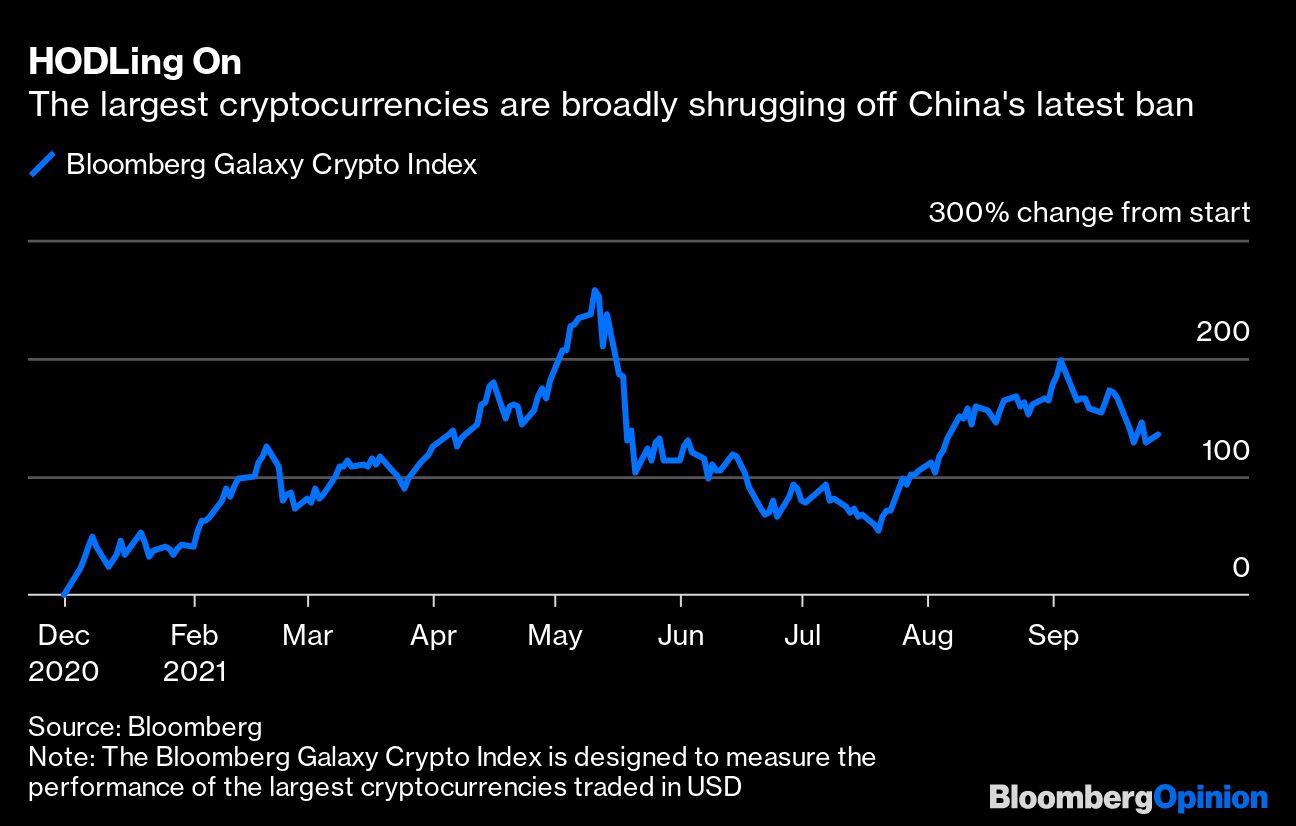
The cryptocurrency crowd has wasted no time in dancing on the grave of China's “FUD” (internet speak for fear, uncertainty and doubt). Last week's move by the People's Bank of China to ban crypto transactions and mining dented the prices of Bitcoin, Ethereum and other digital currencies, but they've largely rebounded.
The bulls reckon the latest attempt by Beijing to crack down on crypto — the seventh, by research firm Fundstrat's calculations — will fail to throttle an asset that bypasses borders and banking systems. They also hope that what seems “bad” for crypto will prove to be “good.” Advocates are using China's ban as ammunition to promote an opportunity for America: It can lead the way for a more permissive approach to crypto.
This looks like the kind of warped logic that paints Bitcoin mining as a “green” form of energy use, even as it breathes new life into aging fossil-fuel power plants. What's bad for crypto sometimes really is just bad.
The jury may be out on whether this ban will be more successful than previous ones, but painting it as a way for the U.S. to steal a march on China is a stretch. The Biden administration has made clear it sees cryptocurrencies as fuel for ransomware, a vehicle for fraud and a potential threat to financial stability and post-Covid reconstruction. The crypto industry has attempted to plead for more lenient treatment as a poke in China's eye in the past — see Facebook Inc.'s Mark Zuckerberg's defense of the Libra project — to no avail. More regulation of this sector is undoubtedly on the way, and those on the frontlines know it.
The question of whether the U.S. could follow suit with a ban of its own, as Ray Dalio has imagined, is a trickier one. The laser-eyed crowd may have a point in that it's getting rather late in the day for the U.S. to try the Chinese approach, not least with Wall Street eyeing a bigger share of the crypto pie. But that doesn't mean regulation is out of sight. In fact, it's quite the opposite.
The crypto market has metastasized into a $2 trillion monster, driven by a Fear of Missing Out (FOMO) that continues to draw in smart wealthy people, especially in North America. That's where one-third of specialist crypto hedge funds — worth $3.8 billion, according to PwC — are listed, and where endowment funds and hedge-fund billionaires are starting to dip their toes. The time for regulation is ticking as the ranks of wealthy backers grows.
Ironically, one of the closest things to a U.S. crypto “ban” — a raft of proposals by the Bank for International Settlements that might force banks to hold one dollar in capital for each dollar worth of Bitcoin — has triggered an outcry from Wall Street. A letter sent by several financial-industry associations to the BIS called the package too “restrictive,” and would stop them catering to customer demand. Even with evidence piling up that crypto is a nightmare when it comes to environmental, social and governance concerns, plenty of investors are happy to keep buying.
Those assuming that the rivalry between the U.S. and China will be favorable for a cryptocurrency like Bitcoin are kidding themselves. The ante is being upped for regulators in a post-Covid world, where lives are increasingly lived online and where technology makes weak governance an even bigger threat. China's crypto ban is designed to boost its own pandemic priorities — including favoring a digital-currency revamp of the yuan. Central banks elsewhere in the world have their own versions of programmable money in the works.
A truly effective global crackdown on crypto is only hard to imagine because of the political will and capital needed to achieve it; it's not a technological impossibility. There would need to be international cooperation like that seen in the crackdown on tax havens, combined with national measures like those 20th-century rules preventing the private ownership of gold. But China and Covid may end up making this mix more likely, not less.
Crypto-evangelists should bear this in mind. FOMO may have the upper hand now, but FUD won't be far behind.

-
Why Swapping Your Old Gold Can Trigger A Rs 5 Lakh Tax Bill, And How You Can Avoid It Legally

Swapping old gold for new is taxed as a sale and a fresh purchase. Getting your own gold remade can cut most of that bill, though it has its own costs.
-
The AI Trade is Done. The Real Opportunity for Investors Starts in 2027 | Unhedged Position
As pureplay AI stocks plunge and circular, capex-led financing unwinds, 2027 is set to be a year of reckoning for AI companies. Yet the bust clears the way for a better opportunity for investors in 2027 -- shifting the spotlight from AI builders to the companies using AI.
-
Leadership As Mission: Why The Age Of AI Demands More Human Leadership
Debjani Ghosh examines how AI is changing leadership, arguing that its success must be measured by its impact on people and the accountability of those guiding its use.
-
We May Need Another Tukaram Mundhe To Fight Air Pollution | The Reason Why
Developers may install basic measures such as sprinklers and green nets, resume work, and continue violating rules when this equipment stops working.
-
Extracting Value From Battery Scrap Could Be Challenging For India | The Reason Why
A discarded lithium-ion battery still contains valuable materials such as lithium, nickel and cobalt. These can be recovered and reused. When such batteries are crushed and shredded, they produce a dark powder called black mass.
-
One El Nino, India Can Handle. Two Could Break The Granary
India's grain stocks can absorb one bad year, but a second El Nino could drain the buffer in two to three years, economists say.
-
India's Troika Of Good Luck | Joining The Dots
As Jensen Huang's exit drags Nvidia down, a cooling AI trade and resilient earnings have revived investor interest in India. A likely RBI rate hike looms.
-
Talking Points This Week: Leadership Shock At Nvidia, Earnings Strength, And The Fog Over Hormuz
The Anthropic IPO pricing and first trading day, Nvidia's upcoming earnings, and any fresh signals from Iran will set the tone for the following week.
-
Signature Play: The Classic Cocktail Is Dead. Or Is It?
Classic cocktails are disappearing from India's cocktail menus. But they're still being ordered, taught to bartenders and borrowed from. So, who's really having the last drink?
-
A New Samvat Wishlist: Inclusive Prosperity And Human Development
India has strengthened its economic foundations through infrastructure, digital access and enterprise. Its next growth chapter must deepen productivity, create better livelihoods and widen participation in prosperity.









