Crisis-Hit IL&FS Needs To Go Under The Knife, Very Soon
When even a 24-year-old Indian entrepreneur has no difficulty raising $1 billion in a day from global investors, it's easy to forget that it wasn't always like this.
Only two decades ago, a storied Mumbai financier could get away with raising $25 million of debt for a client, giving it just about half of that money five years later, and making the company service the full amount thereafter.
But what goes around, comes around. The institution that made a business of exploiting India's desperation for funds, particularly for long-gestation infrastructure projects, is now seeking to protect its assets from unpaid creditors trying to push it into bankruptcy.
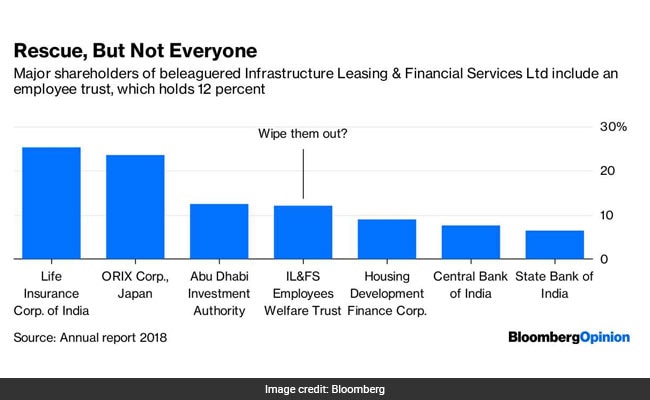
Infrastructure Leasing & Financial Services Ltd. had 30 years to spawn an Indian clone of Macquarie Group: a powerhouse of finance, investments, asset ownership and risk management. Instead, Ravi Parthasarathy, the founder who stepped down recently as chairman, went on to build an unwieldy, debt-fueled empire that has now crumbled. Shareholders will have to move in to rescue IL&FS in their meeting on Saturday.
What went wrong? The $25 million that IL&FS arranged in 1997 via floating-rate notes - guaranteed by USAID and sold to Bear Sterns & Co. - illustrates the chutzpah that sank the firm. New Tirupur Area Development Corp., the borrower, was floated as a lifeline for a textile center in Tamil Nadu where industrial waste had polluted the groundwater. Tirupur's knitwear business and its households were suffering, but the state didn't have the $250 million required to draw river water, treat it and supply it to the town.
IL&FS showed the way out. Let New Tirupur get a 30-year contract for private water supply and handling of sewage, and a reasonable 20 percent annual return to lure investors who would share the equity risk with the government and IL&FS. The financial institution, which was also one of the lenders to the project, paid its share in September 2002, just as work on the water-treatment facility was about to start. But instead of the committed 1.4 billion rupees in equity, senior and subordinate debt - $29 million at the time - Parthasarathy released less than 1 billion rupees.
The big hole was a 46 per cent shortfall in the 900 million-rupee ($25 million) senior debt, owing to an inexplicable 150 million-rupee deduction. IL&FS said it was "costs relating to the USAID loan." A third of it was a commitment fee, and the rest was precious Bear Sterns dollars that had lain in an escrow account and bled, with net losses compounding at 12 per cent a year.
Thus, before New Tirupur could put a single brick on the ground, its stakeholders lost money they never even got to touch. The economics of the project became shaky, and a tussle began between equity holders and creditors. The government of Tamil Nadu had to pump in more public money. As a Madras High Court judge would later note, "Water started flowing (or trickling down) to the common users, both industrial and domestic, in May 2005. What flowed thereafter appears to be only litigation."
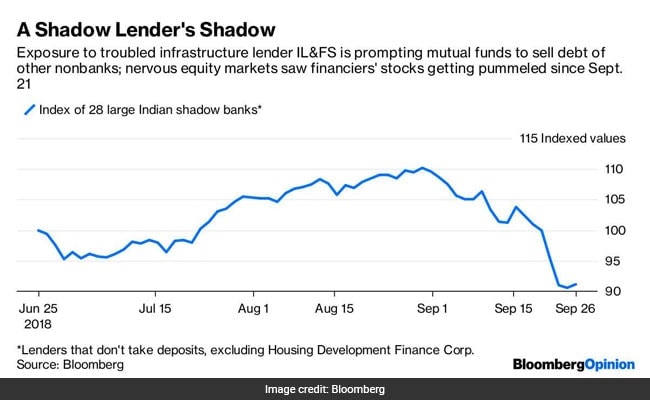
This became a pattern of behavior. For IL&FS to win, other stakeholders had to lose. Never mind if a 30-year concession on a toll road became a license to collect money from commuters in perpetuity. In New Tirupur, even state-run Life Insurance Corp. of India, the biggest shareholder in IL&FS itself, saw its equity interest diluted. As a result, it had to give up its board seat in the water company.
The irony is that the same Life Insurance Corp. may now have to lead the rescue of IL&FS before the money market's exposure to its toxic debt deepens a liquidity crisis for other shadow banks - a sort of a mini-Lehman moment for India. However, it would only be fitting to wipe out the 12 per cent stake held in IL&FS by the employees' welfare trust. The employees seem to have fared very well: Parthasarathy took home $3.65 million in his last year.
Next will come the inevitable question of dismemberment. Why should a systemically important financial institution have units running border check posts in an Indian state, or computerizing land records in the Philippines? The empire that Parthasarathy built has to go under the knife, and pretty soon.

-
Gold Is Rs 22,000 Cheaper Than A Month Ago. Should You Buy Amid The Wedding Season?

Gold's potential slide to $3,500 could save around Rs 4,700 per 10 grams, but a soft inflation print could just as easily push prices back up. One way to split the risk is to buy in parts, some now and the rest after the Fed's Dec. 9 decision.
-
AI Agents Are Gaining Power. Who Governs Them?
Artificial intelligence agents promise to transform productivity by moving machines from assisting decisions to executing them. But as organisations delegate greater authority to these AI-agents, they must first establish who controls that authority and who remains accountable when things go wrong.
-
Why Swapping Your Old Gold Can Trigger A Rs 5 Lakh Tax Bill, And How You Can Avoid It Legally
Swapping old gold for new is taxed as a sale and a fresh purchase. Getting your own gold remade can cut most of that bill, though it has its own costs.
-
The AI Trade is Done. The Real Opportunity for Investors Starts in 2027 | Unhedged Position
As pureplay AI stocks plunge and circular, capex-led financing unwinds, 2027 is set to be a year of reckoning for AI companies. Yet the bust clears the way for a better opportunity for investors in 2027 -- shifting the spotlight from AI builders to the companies using AI.
-
Leadership As Mission: Why The Age Of AI Demands More Human Leadership
Debjani Ghosh examines how AI is changing leadership, arguing that its success must be measured by its impact on people and the accountability of those guiding its use.
-
We May Need Another Tukaram Mundhe To Fight Air Pollution | The Reason Why
Developers may install basic measures such as sprinklers and green nets, resume work, and continue violating rules when this equipment stops working.
-
Extracting Value From Battery Scrap Could Be Challenging For India | The Reason Why
A discarded lithium-ion battery still contains valuable materials such as lithium, nickel and cobalt. These can be recovered and reused. When such batteries are crushed and shredded, they produce a dark powder called black mass.
-
One El Nino, India Can Handle. Two Could Break The Granary
India's grain stocks can absorb one bad year, but a second El Nino could drain the buffer in two to three years, economists say.
-
India's Troika Of Good Luck | Joining The Dots
As Jensen Huang's exit drags Nvidia down, a cooling AI trade and resilient earnings have revived investor interest in India. A likely RBI rate hike looms.
-
Talking Points This Week: Leadership Shock At Nvidia, Earnings Strength, And The Fog Over Hormuz
The Anthropic IPO pricing and first trading day, Nvidia's upcoming earnings, and any fresh signals from Iran will set the tone for the following week.









