Angel Tax: Revised Provisions Have No Real Substance

The angels descended gracefully to bless with capital but the tax demons were faster and the political motivation possibly even faster! As the battles get fierce, the only ones to suffer are the talented entrepreneurs who dared start a company.
As dramatic as it may sound, ‘angel tax' is one of the most bizarre tax provisions in recent times, causing extreme heartburn amongst startups. It treats capital raised by private unlisted companies—which includes startups—as “income from other sources” and levies an income tax of 30.9 percent on the amount considered above “fair value” i.e. it taxes the premium over fair value as if it were ordinary income when it is, in fact, an ‘equity infusion' or a ‘capital transaction'.
As a first, Indian regulators took way too long to catch up with the startup ecosystem, leave alone regulate it. With billions of dollars already pumped in by 2016, the Department of Industrial Policy & Promotion, and the government in general, were fashionably late in recognising startups. FDI inflows were at $55.6 billion for the year ending March 2016.
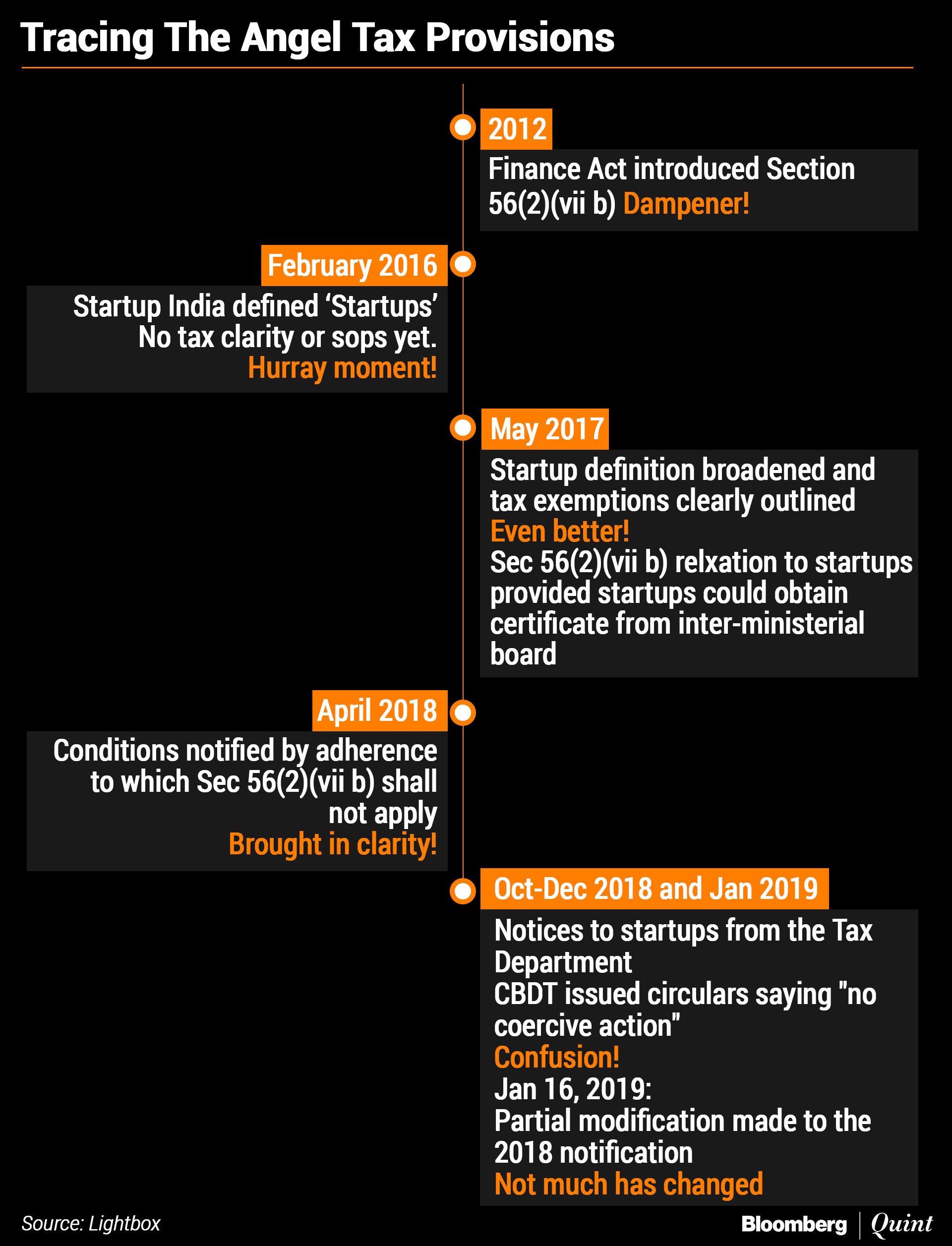
The definition of the term ‘startup' was first introduced in India at the beginning of 2016, under the Startup India Action Plan. Until then, there was neither any formal recognition nor any tax sops for startups. In May 2017, tax exemptions for startups were first notified, that too for startups incorporated only after April 2016 provided they met certain key conditions including an inter-ministerial board application.
This meant all startups incorporated prior to 2016 that had come off financial maturity by 2016 were simply excluded from any tax incentives!
If we were to trace the origin of the income tax provisions pertaining to the angel tax; the subsequent DIPP notifications between 2017 and 2018; compare the intent of the law to the vigour with which the tax department issued notices in 2018, contradicting a perfectly benign regulatory framework; it leaves the startup community utterly confused and apprehensive. They probably fell prey to being called a startup in the first place.
What The January 2019 Notification Means for Startups
- Enhances the returned income thresholds for a financial year for resident Indian investors investing in startups from Rs 25 to 50 lakh, which is worse!
- The net worth threshold for investors to be Rs 2 crore or amounts invested whichever is higher; again not a big change
- The requirement to get a valuation report remains unchanged—rather, not too clear—as the notification is only a partial modification. So, there is not much of a policy change or relaxation here again, if this has not gone away. This may be debatable, though.
- The capital raise threshold of Rs 10 crore, which translates into $1.4 million, is probably the equivalent of a seed round in the United States or Singapore but is expected to sustain an Indian startup till they make an IPO.
On the procedural front, what is commendable is that the DIPP has paid heed to the representations by startups on the tax demands and harassment they have faced. Effective the date of this notification, applications of recognised startups will receive a tax exemption under Section 56(2)(vii b). This shall be transmitted by DIPP to the Central Board of Direct Taxes with the necessary documents, rather than by the startup itself.
One could argue it is now essentially an inter-departmental game because the final decision of whether to grant the exemption or not rests with the CBDT.
However; it will certainly have greater persuasive power when transmitted through DIPP and supported by the appropriate documentation.
The process should certainly curb tax harassment by the CBDT in cases where recognition exists. It would also have been good if this new application procedure had been extended to all startups. For instance, startups for which assessment orders have already been passed by assessing officers for the relevant financial year are not eligible to apply for this tax exemption according to the notification.
The procedural change with the latest notification is welcome. However what needs to change are the rampant tax notices, and coercive action against genuine startups who already run very boot-strapped operations.
Why This Hurts So Much
Tax demand notices of 30 percent on the capital premium, added to the incomes of operationally loss-making startups, can be an extremely high amount, depending on the quantum of capital raised.
Startups run on a very thin profit margin, if at all. Such tax demands wipe away their business models.
Relative to the financing raised by the startups, the addition of capital premium to their income and the threat of tax outflow of such high magnitude throws all business assumptions off gear!
The premiums commanded by these businesses are based on future projections of possible outcomes of their business. Tax officials seem to be assessing the value of the startups based on their net asset value at a certain point in time. Several startups find it difficult to justify the higher valuation to tax officials, in which case they are acted against as “sham” or “bogus entities”. Tax officials do not seem to recognise that while not all startups succeed, some execute extremely well. In that case, the valuation attributable as of the date of tax notices would possibly be even higher than the valuation commanded at the point of investment.
As the cost of litigation in defending notices is very high, it adversely affects startups' cash flow. Show cause notices under Section 179 and/or prosecution of directors under the Income Tax Act also endangers entrepreneurs' personal wealth. This is extremely demotivating and distracting for genuine founders that have pledged their personal wealth to run bootstrap businesses.
Let us hope that after the January 2019 notification, this unfortunate practice of taxing sound young companies which have bright dreams for India's future is nipped in the bud. Hopefully, Budget 2019 clarifies some of these issues, if not resolving them altogether, so that startups can do what they do best. Run their businesses rather than worrying about tax notices!
Rashmi Guptey is the chief financial officer at Lightbox, a leading venture capital firm.
The views expressed here are those of the author and do not necessarily represent the views of BloombergQuint or its editorial team.

-
One El Nino, India Can Handle. Two Could Break The Granary

India's grain stocks can absorb one bad year, but a second El Nino could drain the buffer in two to three years, economists say.
-
India's Troika Of Good Luck | Joining The Dots
As Jensen Huang's exit drags Nvidia down, a cooling AI trade and resilient earnings have revived investor interest in India. A likely RBI rate hike looms.
-
Talking Points This Week: Leadership Shock At Nvidia, Earnings Strength, And The Fog Over Hormuz
The Anthropic IPO pricing and first trading day, Nvidia's upcoming earnings, and any fresh signals from Iran will set the tone for the following week.
-
Signature Play: The Classic Cocktail Is Dead. Or Is It?
Classic cocktails are disappearing from India's cocktail menus. But they're still being ordered, taught to bartenders and borrowed from. So, who's really having the last drink?
-
A New Samvat Wishlist: Inclusive Prosperity And Human Development
India has strengthened its economic foundations through infrastructure, digital access and enterprise. Its next growth chapter must deepen productivity, create better livelihoods and widen participation in prosperity.
-
Love, Sex Aur Dhokha: The Audacious Plot To Spy On Jensen Huang
A Taipei dinner, a Singapore chip buyer and a suspected Chinese asset: inside the alleged spy operation that got close to NVIDIA's Jensen Huang.
-
Ten Things I Learnt This Samvat
Patience can be a trap. Cheap stocks can stay cheap. Leverage can wipe you out. What did Samvat 2082 teach us? Niraj Shah writes on 10 lessons from the year gone by.
-
Talking Points This Week: Tech Nerves, FII Buying, And A Faraway Banking Shock
The global markets are not shining this Diwali. The exception in the large markets is, India.
-
Midterm Rally Lasted A Day. The Hard Reality Of A Divided US May Last Two Years | Opinion
Between a contested AI boom, a debt ceiling that arrives in 2027 and a president with every incentive to act alone, the next two years may prove more volatile than the first day's rally suggests.
-
Blue Wave Will Derail the AI Trade but Won't Dismantle the AI Era | Unhedged Position
The Democrats' sweep of the US Congress will see politics collide with economic forces both over the long and short term.