Dairy Disparity: India's Gender Gap In Milk Consumption May Be Eroding Women's Bones

From ghee in chapatis, curd as a side to a warm glass of milk before bed, Indian culture and its dairy centrality is a well known phenomenon. Yet, to think that something as fundamentally essential as milk is equally accessible and consumed by every individual would be a mistake.
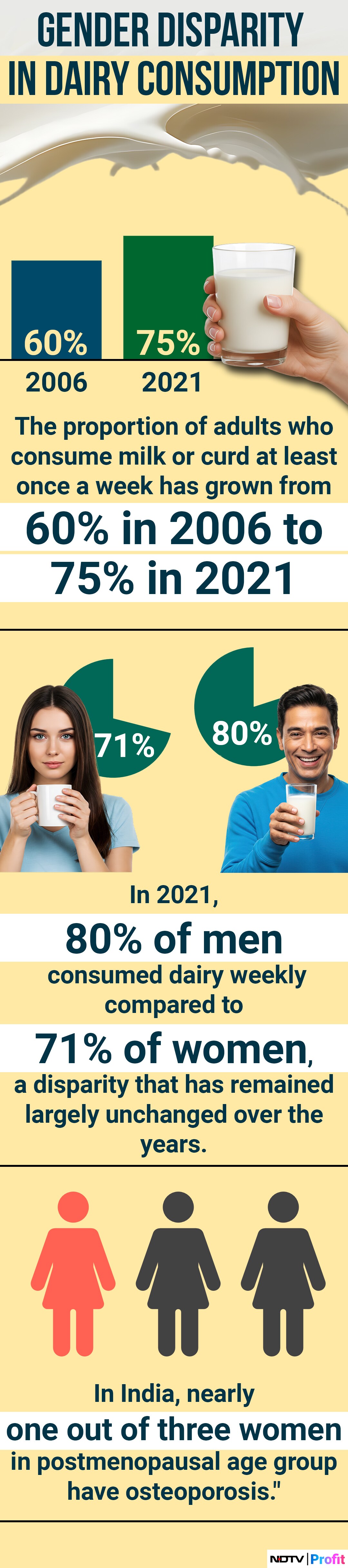
A study done by International Institute for Population Sciences -- National Family Health Survey -- reveals that even though the weekly consumption of dairy staples such as milk and curd in India increased 15% over 15 years (from 60% in 2006 to 75% in 2021), the proportion of females consuming dairy products remains lesser in comparison to their male counterparts, indicating a gender disparity.
"In 2021, 80% of men consumed dairy weekly compared to 71% of women, a disparity that has remained largely unchanged over the years", the study states.
While it may not seem as stark of a difference prima facie, women consuming less dairy might be leading to dire health related consequences.
"Yes there is definitely a disparity in consumption of dairy in India," said Vasudha Mathur, Chief Dietician at Yashoda Hospitals in Hyderabad.
She added that low milk intake in women may result in calcium deficiency and weaker bones and ultimately increases risk of osteoporosis and fractures especially post menopause.
What Is Osteoporosis, Who Is More At Risk, And Why?
World Health Organization or WHO defines osteoporosis as bone loss based on bone mineral density or BMD.
As per a study done by International Journal of Research in Orthopaedics on over 30 thousand participants across India, overall osteoporosis prevalence was 33.1% among post menopausal and elderly women; it states, "Nearly one out of three women in postmenopausal age group have osteoporosis."
Besides the lower intake of dairy products, the dip in estrogen levels during menopause "accelerates" bone loss in women making them more vulnerable to the condition, said Mathur.
She added that anatomically, women have less dense bones and lesser muscle mass compared to men which is another factor that aggravates the condition and makes them prone to injuries.
(Source: NDTV Profit)
Possible Reasons Behind This Divide
According to the Chief Dietician, "There are some medical professionals who advice against consuming milk to women suffering from Polycystic Ovarian Disease or PCOD because it might trigger hormonal imbalance..." She added that while the claim that milk contains hormone is not refutable entirely, "There is no sufficient data to recommend stopping milk because of PCOD or PCOS"
Other reasons include cultural and household food distribution often prioritises men, leaving women nutritionally disadvantaged.
Milk Up For Stronger Bones
"Milk is one of the best sources of calcium. In some form of the other, we should include that in our diet", stated Mathur.
She advised women to consume at least 500 ml-700ml of milk, and said that toned milk which is "fortified with Vitamin A and Vitamin D" will help in preventing bone loss since Vitamin D helps in calcium absorption.
"Near menopause we should be careful about our bone density, and take supplements if required to keep our levels under check."

-
Signature Play: The Classic Cocktail Is Dead. Or Is It?

Classic cocktails are disappearing from India's cocktail menus. But they're still being ordered, taught to bartenders and borrowed from. So, who's really having the last drink?
-
A New Samvat Wishlist: Inclusive Prosperity And Human Development
India has strengthened its economic foundations through infrastructure, digital access and enterprise. Its next growth chapter must deepen productivity, create better livelihoods and widen participation in prosperity.
-
Love, Sex Aur Dhokha: The Audacious Plot To Spy On Jensen Huang
A Taipei dinner, a Singapore chip buyer and a suspected Chinese asset: inside the alleged spy operation that got close to NVIDIA's Jensen Huang.
-
Ten Things I Learnt This Samvat
Patience can be a trap. Cheap stocks can stay cheap. Leverage can wipe you out. What did Samvat 2082 teach us? Niraj Shah writes on 10 lessons from the year gone by.
-
Talking Points This Week: Tech Nerves, FII Buying, And A Faraway Banking Shock
The global markets are not shining this Diwali. The exception in the large markets is, India.
-
Midterm Rally Lasted A Day. The Hard Reality Of A Divided US May Last Two Years | Opinion
Between a contested AI boom, a debt ceiling that arrives in 2027 and a president with every incentive to act alone, the next two years may prove more volatile than the first day's rally suggests.
-
Blue Wave Will Derail the AI Trade but Won't Dismantle the AI Era | Unhedged Position
The Democrats' sweep of the US Congress will see politics collide with economic forces both over the long and short term.
-
It's Time To Take The GST Council's Bet On Trust Global
Payment records can prove India's services exports, and clear, proportionate rules can bring foreign digital sellers into the tax net.
-
Opinion | India at 38: From Innovation Overperformer to Innovation Powerhouse
India now has 453 VC-backed deep science startups, 18 of them late-stage, after 117 percent growth since 2020. Laurus Labs, at USD 9.3 billion, is the most valuable deep science company in any middle-income economy outside China.









